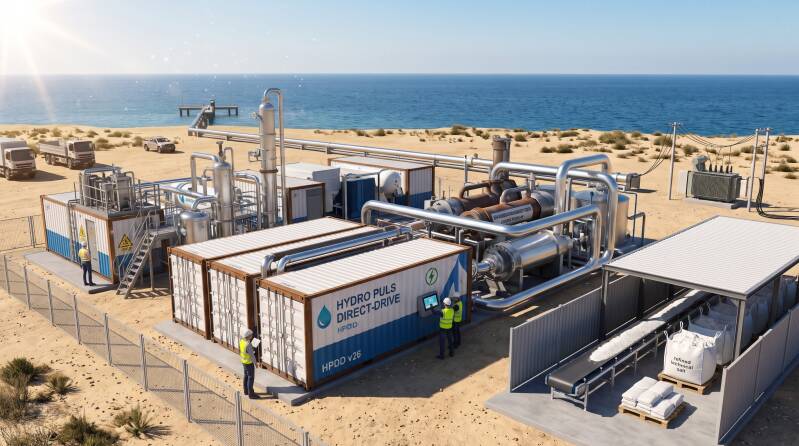
Natural Gas In, Zero Emissions Out: 63% Thermal Efficiency for Industrial Desalination ⚡💧🌱
There is a widespread misconception that industrial decarbonization requires waiting a decade for multi-billion-dollar green hydrogen pipelines and major grid upgrades.
In gas-rich regions like Algeria, the energy source is already readily available. The decisive technological leap is not abandoning natural gas, it is redefining how we convert it.
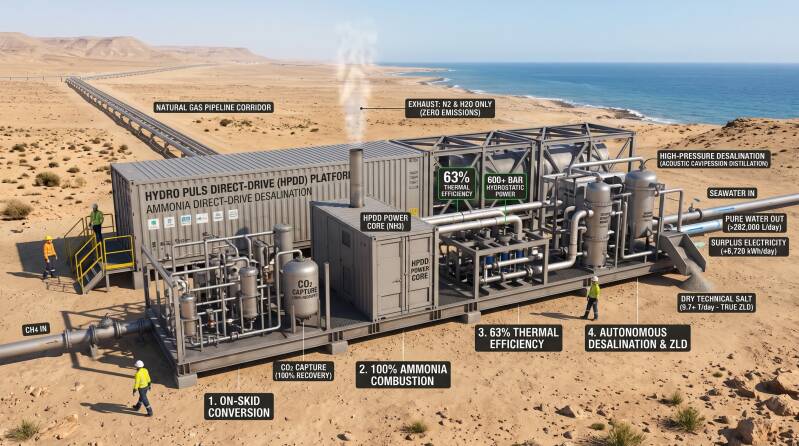
With the Hydro Puls Direct-Drive (HPDD) platform, standard pipeline natural gas (CH4) directly drives industrial-scale seawater desalination at 63% net thermal efficiency, completely CO2-neutral:
How does conventional gas run a zero-emission process?
1. On-Skid Conversion to Ammonia: Natural gas is reformed locally into hydrogen and synthesized with atmospheric nitrogen into anhydrous ammonia (NH3). The concentrated CO2 stream from reforming is captured directly at the source, preventing atmospheric venting.
2. 100% Ammonia Pulse Combustion: The HPDD core operates directly on synthesized ammonia without diesel pilot fuel or engine lube oil. The exhaust contains exclusively nitrogen (N2) and pure water vapor.
3. 63% Net Efficiency via Direct-Drive: By eliminating crankshafts, heavy marine gearboxes, and multi-stage electrical conversions, chemical energy converts directly into +600 bar hydrostatic power and a 230°C closed-loop thermal baseline.
4. Autonomous Desalination & ZLD: This hydrostatic force and process heat directly actuate our Acoustic Cavitation Reactor (ACR) and Vapor Compression Distillation (VCD) units. A single containerized module outputs >282,000 liters/day of pure water, exports +6,720 kWh/day of net surplus electricity, and recovers 9.7+ metric tons/day of dry technical salt under True Zero Liquid Discharge.
Industry does not need to stall while waiting for centralized hydrogen grids. We can leverage existing natural gas assets today with tomorrow’s thermodynamic efficiency, cleanly, autonomously, and profitably.
#NaturalGas #EnergyTransition #Desalination #Ammonia #HPDD #CleanTech #Decarbonization #EngineeringInnovation #Algeria #WaterSecurity