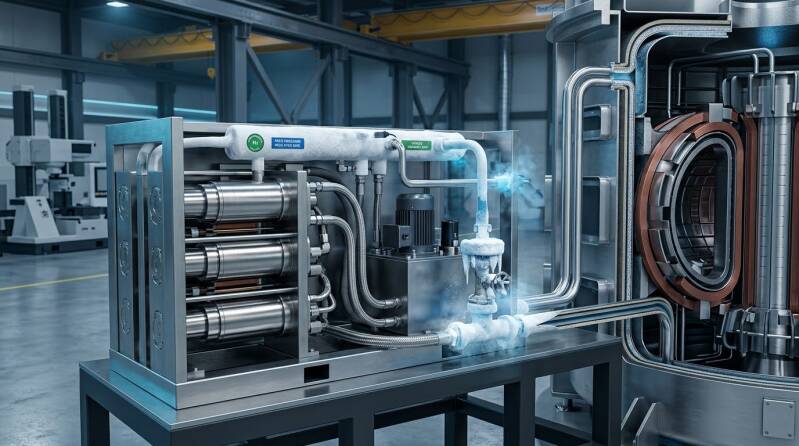
Fusion cooling
HPDD Cryogenic Integration: Zero-OPEX Pre-Cooling for Nuclear Fusion
Eliminating Parasitic Refrigeration Loads via Process-Integrated Nitrogen Expansion (-93°C)
OVERVIEW: THE CRYOGENIC PARASITIC BOTTLENECK
In magnetic confinement fusion (Tokamaks, Stellarators, and HTS architectures), achieving a scientific net energy surplus in the plasma (Q_plasma > 1) is only half the battle. The defining challenge for commercial viability is achieving net positive electricity delivered to the grid (Q_electric > 1).
Currently, plant-scale commercial viability is heavily burdened by parasitic electrical loads. A massive fraction of this power is consumed by the cryogenic infrastructure required to cool superconducting magnets near absolute zero (4.5 K to 77 K).
According to Carnot principles, cryogenic refrigeration carries an extreme thermodynamic penalty: removing heat at cryogenic baselines requires hundreds of watts of electrical compression power per watt of heat removed. Over 40% of a fusion facility's total cryogenic electrical power (often 30 to 40 MW at scale) is expended simply cooling gas from ambient temperature (+20°C / 293 K) down to 80 K.
THE HPDD SOLUTION: ZERO-ENERGY EXPANSION COOLING
The Hydro Puls Direct-Drive (HPDD) platform fundamentally alters balance-of-plant thermodynamics by providing direct, continuous, zero-OPEX pre-cooling as an integrated process byproduct.
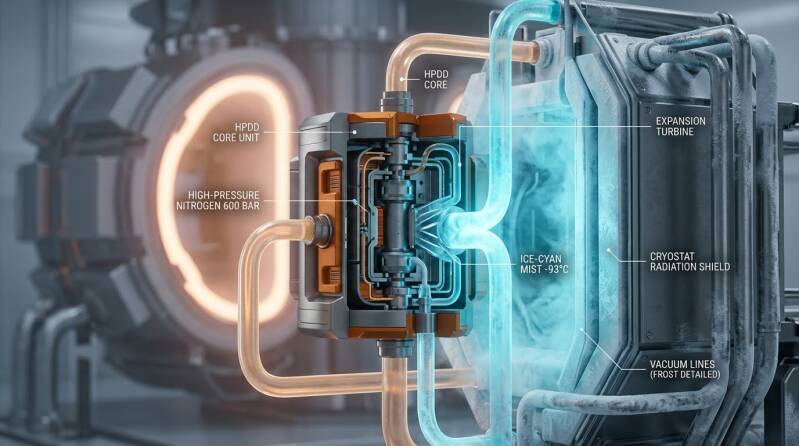
While the primary function of the HPDD core is to deliver stiff hydraulic work within a strictly closed mass balance (Delta Mass = 0.000 kg), its operational cycle continuously manages a process stream of 500 kg/h of nitrogen at 600 bar.
When expanding this stream from 600 bar down to 1 bar through controlled linear expansion, the gas temperature drops instantly to -93°C (180 K).
Key Technical Highlights:
- Continuous Cold Stream: 500 kg/h mass flow delivered directly at -93°C (180 K).
- Upfront Enthalpy Drop: Covers 53% of the total temperature drop from ambient (+20°C) to the 80 K thermal shield baseline.
- Zero Added Electricity: The pressure was already established within the primary hydraulic drive cycle; the expansion cold represents pure byproduct cooling with zero additional grid draw.
SYSTEM INTEGRATION & PLANT-LEVEL IMPACT
1. Direct Radiation Shield Protection (80 K Loop)
The continuous -93°C nitrogen stream feeds directly into the primary thermal radiation shields encasing the cryostat and vacuum vessel. Intercepting thermal radiation at -93°C prevents ambient heat leakage from penetrating deeper into the cryogenic core, cutting the power demand of the 80 K refrigeration stage by over 50%.
2. Cold Box Intercooling
By supplying sub-zero gas to intermediate heat exchangers in the helium and HTS refrigeration loops, the primary compressors avoid the heavy work of bulk ambient-to-subzero thermal lifting.
3. Slashing Recirculating Plant Power
By halving the power demand of the shield cooling loop, HPDD reduces the total electrical power consumption of the plant's cryogenic infrastructure by an estimated 20% to 25%. On a 35 MW cryoplant, this preserves 7 to 9 MW of continuous electrical power that would otherwise be wasted on auxiliary parasitic loads.
COMMERCIAL & ENGINEERING SIGNIFICANCE
Every megawatt eliminated from the balance-of-plant auxiliary load directly improves the plant's net recirculating power fraction. By replacing conventional, energy-intensive warm chiller stages with deterministic HPDD fluid expansion, fusion operators can accelerate the timeline to a bankable, net-positive electricity balance (Q_electric > 1).
TECHNICAL COLLABORATION & INQUIRIES
We partner with fusion reactor developers, magnet engineers, and Tier-1 cryogenic system integrators to evaluate skid-level integration and thermal balance models.
Contact our cryogenic integration engineering team to review full process flow diagrams and mass-enthalpy specifications.