

Beyond Biological Basins
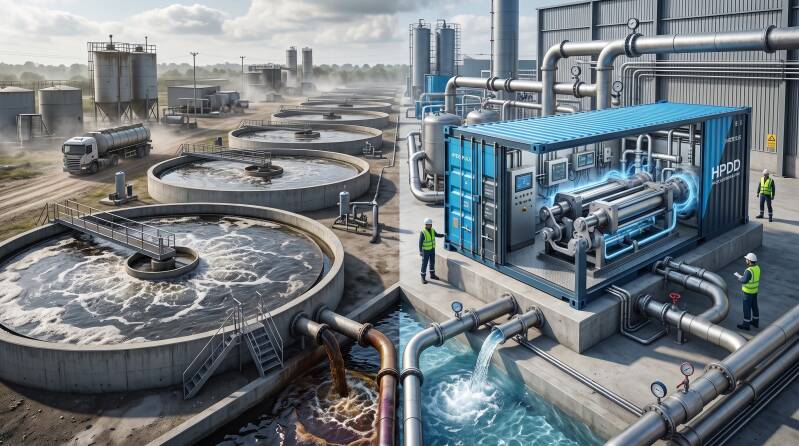
Beyond Biological Basins: Shattering Recalcitrant Industrial Effluents via Mechanochemistry
This process was developed in collaboration with Chemical Engineer Srivathsan R.
In complex industrial wastewater treatment (textile azo dyes, synthetic pigments, extreme COD/BOD loads), conventional plants face a chronic economic burden: sprawling biological aeration basins, high chemical coagulant costs, and severe sludge hauling tariffs.
Synthetic chromophores with stable aromatic rings and azo (-N=N-) bonds resist standard biological digestion. Instead of treating these streams with brute-force chemicals, the Hydro Puls Direct-Drive (HPDD) platform applies high-frequency hydrodynamic shock pulses and acoustic cavitation reactors (ACR) to tackle the molecular problem directly:
• Mechanochemical Bond Cleavage: Localized micro-jets, transient high-energy micro-zones, and extreme shear forces physically and chemically cleave persistent dye bonds—rapidly breaking refractory chains down into biodegradable intermediates without massive chemical dosing.
• Controlled Thermal Boundaries: Unlike Supercritical Water Gasification (SCWG), which demands severe supercritical conditions (>374°C, >22.1 MPa) to gasify biomass into syngas, HPDD operates at targeted kinetic shear envelopes (e.g., ~230°C jacket/reaction boundaries), minimizing parasitic heating loads and material stress.
• Modular Process Intensification: Dual opposed-piston linear architecture eliminates the rotating crankshaft entirely, packaging continuous destruction, nutrient crystallization, and fluid power inside a containerized footprint.
Replacing an open yard of clarifiers and dosing systems with closed-loop fluid-kinetic shear fundamentally turns chronic Opex into an efficient, modular capital asset.
#CleanTech #ProcessIntensification #WastewaterTreatment #Mechanochemistry #IndustrialEngineering #AzoDyes #CircularEconomy #ZeroLiquidDischarge #HydroPuls