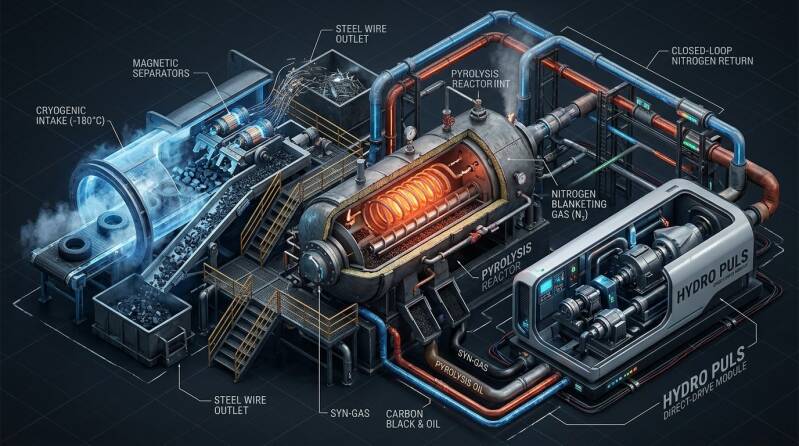
Cryogenic Tyre Gasification
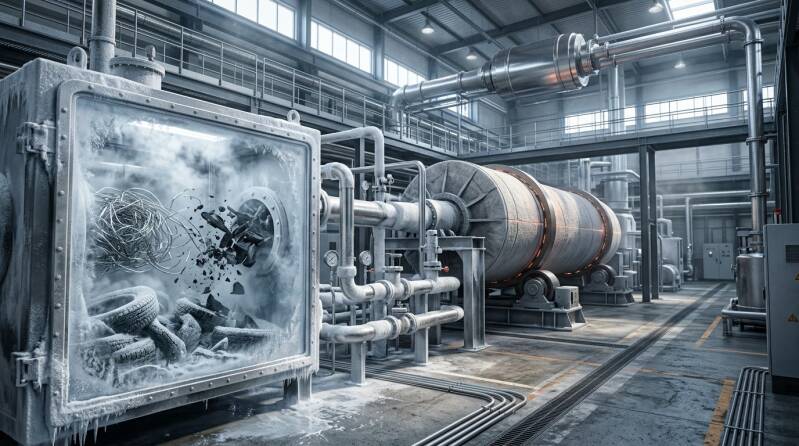
Cryogenic tire glassification at -180°C and oxygen-free kiln blanketing, powered by the very same process stream.
For tire pyrolysis operators, external liquid nitrogen (LN2) deliveries for cryogenic grinding and dedicated inerting gases for the kiln represent continuous, heavy operating costs.
The HPDD platform removes this liability entirely by giving nitrogen a dual functional role:
🔹 Step 1: Cryogenic Separation (-180°C)
The deep cold flux from the HPDD nitrogen expansion brings end-of-life tires below their glass transition temperature. The rubber shatters cleanly into fine, uniform granules:
• Clean separation of high-tensile steel cord and textiles without rubber cling.
• Drastic reduction in shredder wear, maintenance downtime, and cutting energy.
• Highly uniform feedstock that maximizes thermal cracking kinetics in the kiln.
🔹 Step 2: Inert Reactor Blanketing
The warmed nitrogen gas feeds directly into the pyrolysis kiln as an inert carrier atmosphere. This shields the reaction against oxidation, preserves carbon atom yields, and stabilizes vapor evacuation.
From cryogenic shattering to supercritical in-flight de-ashing: zero external nitrogen logistics, complete mass utilization.
#TireRecycling #Pyrolysis #CryogenicEngineering #HPDD #SustainableIndustry #CircularEconomy #CleanTechnology