

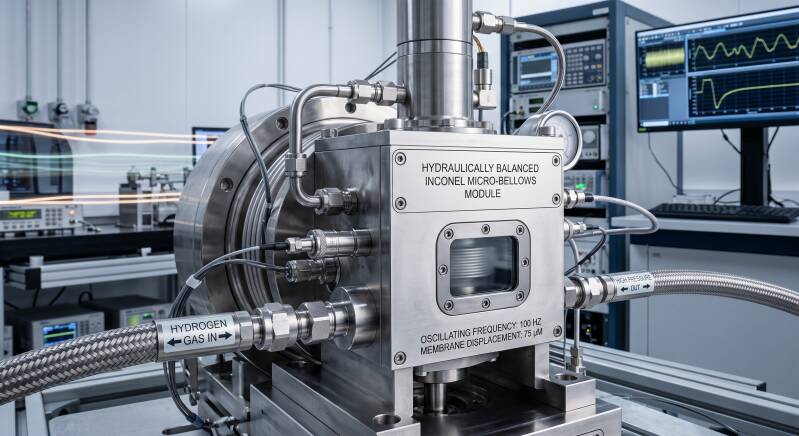
The fundamental flaw in modern gas compression isn’t the thermodynamics, it’s the sliding friction.
When you compress hydrogen or synthesis gases to 200+ bar using mechanical pistons, you are forced into an engineering compromise:
1. Use dynamic seals and crankcase lubricants, risking catalyst poisoning (lubricant carryover).
2. Fight high side-thrust forces that ovalize cylinder bores and accelerate wear.
What if you eliminate sliding dynamic seals entirely?
Consider this architectural shift: a hydraulically balanced Inconel micro-bellows oscillating at 100 Hz with a displacement of just 75 microns.
Why 75 µm at 100 Hz works where macro-strokes fail:
* Infinite Fatigue Life: A 75-micron deflection keeps stress amplitudes far below the endurance limit of high-nickel superalloys. The material stays strictly in its elastic zone, cycling millions of times without fatigue failure.
* Hydrodynamic Pressure Balancing (ΔP ≈ 0): The static 200+ bar pressure isn't carried by the thin metal wall; it is backed by an incompressible fluid column behind it. The bellows only experiences a working differential of 1 to 3 bar.
* High Frequency Replaces Stroke Length: You don't need a 100 mm mechanical stroke to move industrial volume. Pairing a 200 mm diameter membrane with 100 Hz acoustic-speed kinetics delivers continuous, near-isothermal mass displacement.
* Absolute 0.00 ppm Hermetic Integrity: No dynamic piston rings. No sliding wear surfaces. Zero lubricant interface. The process gas touches only pure metal.
Compressor engineering has spent a century trying to perfect dynamic mechanical seals. Perhaps the real breakthrough is designing a system that makes them obsolete.
Curious to hear from compressor specialists and materials engineers: where do you see the limits of high-frequency micro-deflection in extreme gas kinetics?
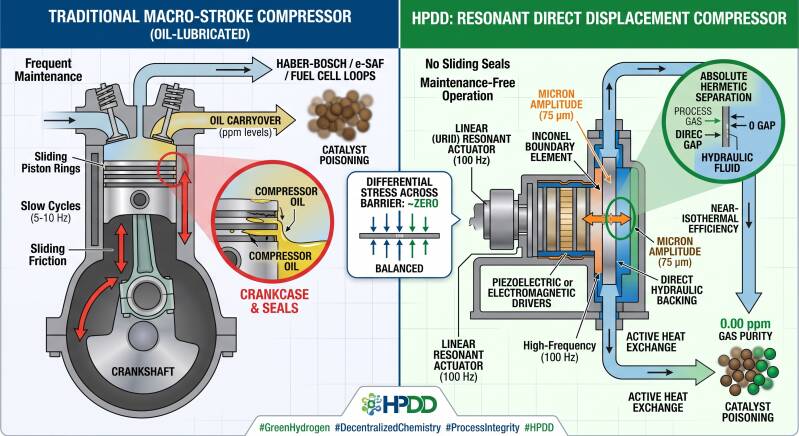
Every chemical engineer running Haber-Bosch, e-SAF, or fuel-cell loops knows the silent plant killer: compressor oil carryover.
Even fractions of a part per million of lubricant passing through multi-stage compressor seals will gradually blind expensive ruthenium, iron-wüstite, or precious metal catalyst beds.
To get true 0.00 ppm purity at high pressure, the industry often relies on slow, expensive metal diaphragm compressors with massive footprints and frequent maintenance intervals.
The alternative is transitioning from slow macro-strokes to high-frequency micro-fluidics.
By driving an Inconel boundary element with a mere 75-micron amplitude at 100 Hz:
- The displacement is entirely elastic—eliminating mechanical friction and seal degradation.
- Direct hydraulic backing absorbs the process pressure (200 to 600 bar), keeping differential stress across the barrier near zero.
- The high-frequency fluid column acts as an active heat exchanger, pulling heat directly out of the compression stroke for near-isothermal efficiency.
No crankshafts. No sliding rings. Absolute hermetic separation between hydraulic driver and reaction gas.
Decentralized chemical synthesis doesn't just need cheaper green molecules; it needs compressor architecture that doesn't poison the reactor.
Is the industry ready to move away from rotating crankshaft compressors toward resonant direct displacement?