

Thermal Inversion Cycle (Cryo Cooling)

The Coldest Revolution in Power Generation.
Eliminating the compressor entirely. The HPDD platform utilizes the Thermal Inversion Cycle to simultaneously deliver high-pressure hydraulic energy and direct cryogenic cooling down to -80°C from a single, emission-free combustion process.
THE DISRUPTION: THE TEMPERATURE MIRROR
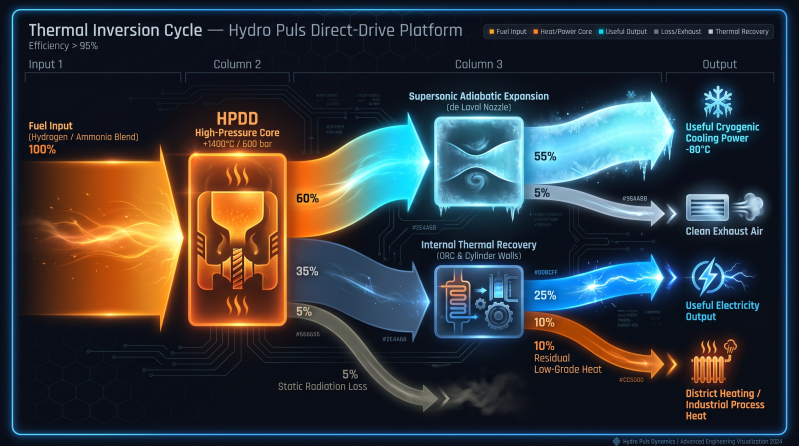
Why copy physics when you can route it?
Traditional industrial cooling is a parasitic loop: mechanical compressors consume massive amounts of electricity to fight heat, releasing destructive thermal waste into the atmosphere.
The HPDD platform turns this paradigm completely upside down. By executing combustion under a constant, high-pressure core base of 600 bar, we harness the energy others throw away. Through a supersonic conically shaped de Laval nozzle, the internal molecular kinetics, the extreme heat, are instantly absorbed and converted into physical velocity.
- In: Fuel energy compressed to +1400°C / 600 bar.
- Out: High-value hydraulic shaft power AND an ice-cold cryogenic air stream down to -80°C.
- The Result: A thermodynamic transformer with a virtual COP that leaves traditional refrigeration systems decades behind.
KEY ADVANTAGES:
- Zero Chemical Refrigerants (F-Gases)
- We have completely eradicated the need for harmful refrigerants. The HPDD platform uses natural mass flow and advanced thermodynamic expansion, making your cooling loop entirely eco-friendly and compliant with future global regulations.
- Indirect Cryo-Transfer Interface
- Safety and reliability are engineered into the core. By utilizing an advanced secondary heat-exchanger loop, the cryogenic energy is safely transferred to your environment (via glycol or specialized mediums) without any direct contact between exhaust gases and your sensitive hardware or products.
- Self-Cleansing Thermodynamic Architecture
- Due to the extreme velocity and rapid nanosecond-scale pressure drop during expansion, the combustion is chemically "frozen." This physically prevents the formation of nitrogen oxides (NO_x) and eliminates ammonia-slip, ensuring a pure, emission-free profile without the need for complex catalysts.

TARGET INDUSTRIES:
1. Hyperscale Data Centers
Simultaneously generate stable, grid-independent power for your high-performance AI clusters while routing the cryogenic output directly into a secondary cooling loop to eliminate thermal throttling.
2. Deep-Level Mining
Deploy HPDD modules directly into deep shafts. Deliver immediate hydraulic power to heavy machinery while instantly blasting -80°C air into the tunnels, bypassing the massive efficiency losses of traditional surface-to-deep water lines.
3. Cold Chain & Industrial Storage
Achieve extreme sub-zero freezing capacity as a direct, high-efficiency byproduct of power generation, introducing "Cooling-as-a-Service" to the logistics sector.
System Comparison: Traditional Refrigeration vs. HPDD
Architectural simplification: Replacing complex parasitic loops with a single-step thermodynamic transformation.
| Feature / Parameter | Traditional Electrical Cooling | HPDD Cryo-Power Platform |
|---|---|---|
| Primary Operational Principle | Mechanical vapor compression (consumes high grid power to "pump" heat). | Thermal Inversion Cycle (instant conversion of +1400°C combustion energy via supersonic expansion). |
| System Components | Generator + Electric Motor + Compressor + Condenser + Evaporator. | All-in-one module: Direct hydraulic/ORC power core integrated with a supersonic nozzle. |
| Energy Chain Complexity | Fuel → Electricity → Mechanical Work → Cooling (3 to 4 stages of cumulative thermal and friction losses). | Direct 1-step transformation: Thermal inversion delivers cryogenic flow as an immediate exergy byproduct. |
| Sub-Zero Capability | Inefficient at extreme depth; COP collapses toward < 0.5 at temperatures below -40°C. | Effortless down to -80°C driven by the supersonic adiabatic pressure drop to 1 bar. |
| Theoretical Efficiency (COP) | Typically ~3.0 for basic AC, drops dramatically for deep-freeze or industrial cooling applications. | Theoretical virtual COP of 10 to 15 (cooling is harvested as a direct byproduct of primary power generation). |
| Environmental Impact & Gases | Dependent on harmful chemical refrigerants (F-gases, synthetic fluids, or high-risk ammonia slip). | 100% Eco-Friendly. Zero chemical refrigerants; ultra-fast "Frozen State" expansion physically prevents NOx formation. |
| Thermal Waste vs. Asset | Discharges massive amounts of high-temperature parasitic waste heat into the atmosphere. | Ice-cold, cryogenic exhaust stream monetized directly via a safe, isolated secondary heat exchanger. |
| Infrastructure Footprint | Massive support infrastructure required (cooling towers, extensive external piping, heavy grid-ties). | Ultra-compact and modular; deployed directly at the point of consumption (e.g., server rooms or deep mine shafts). |
PHYSICAL SECURITY & SAFETY
Exterior Isolation Architecture
The HPDD Cryo-Power platform is housed in a fully enclosed, self-contained exterior utility container (skid). By keeping the mechanical core outside the building envelope, we eliminate any combustion risks within the storage environment. Only the clean, sub-zero secondary cooling loop enters your facility via heavily insulated, cryo-certified piping.
Economic Impact: From Cost Center to Profit Center
Traditional refrigeration is a pure cost center—consuming massive electricity to fight temperature grids. The HPDD platform introduces Cooling-as-a-Service (CaaS). Because the cryogenic cooling loop is a direct thermodynamic byproduct of your on-site hydraulic power generation, your operational cooling costs drop effectively to zero, significantly shortening the ROI of the installation.

The HPDD Scalability Roadmap
The Hydro Puls Direct-Drive architecture is engineered as a scalable platform designed to grow alongside global industrial demand. Our operational roadmap transitions seamlessly from high-efficiency baseline units to extreme-density power hubs:
Current Standard: Optimized for continuous high-pressure operations up to 600 bar.
Next-Gen Scaling: The platform is architected to scale up to a 200 Hz / 410 kW configuration. This ensures that as computational or industrial cooling loads multiply, the HPDD platform scales its density without increasing its physical footprint.
More information?

Micro-Precision Thermal Management
Operating a continuous 600 bar cycle requires material science pushed to the absolute limit. The HPDD platform achieves zero-leakage performance through proprietary material matching and precise geometric tolerances:
- Perfect Thermal Expansion Synchronization: At an operating temperature of 230°C, both critical Inconel components, the cylinder boring and the opposing pistons, expand by exactly 109 µm. This uniform expansion maintains an ultra-precise, constant 25-micron gap throughout the entire thermal cycle.
- Optimized Architecture: Leveraging an engineered 120/40 stroke-to-diameter ratio combined with a proprietary spiral angle, the system guarantees dynamic fluid sealing without mechanical wear.
- Non-Pressurized Siloxane: To ensure maximum lifetime and safety, the dual pairs of opposing pistons operate with a specialized siloxane volume that remains completely unpressurized.
TECHNICAL FAQ
- Q: How does the cold storage room maintain a stable temperature if power demands fluctuate?
- A: Thanks to the software-defined pressure balance, the HPDD platform can modulate its cryogenic output independently from the shaft load, while the secondary heat-exchanger loop acts as a thermal buffer.
- Q: Is there a risk of freezing damage at the building entry point?
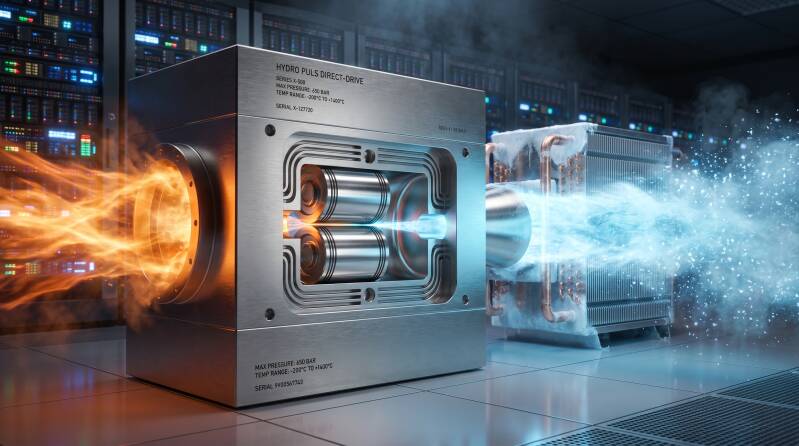
- A: All transport lines are wrapped in high-grade cryo-insulation. The managed frost accumulation outside at the coupling node (as shown in the architectural render) is a natural result of the extreme Delta T and does not impact internal flow efficiency.
- Q: Does this system comply with strict local emissions regulations near distribution centers?
- A: Yes. Due to the ultra-fast "Frozen State" expansion, the chemical reaction is physically stopped before nitrogen oxides (NO_x) can form, ensuring clean exhaust compliance without bulky catalyst blocks.