Palm Oil Rafinage
Mild, Closed-Loop Palm Oil Refining (CPO & CPKO)
Upgrade crude palm oil into export-grade RBD palm oil without heavy chemical degumming, high-temperature thermal degradation, cooling towers, or stack emissions.
Conventional chemical and physical palm oil refineries rely on high-pressure steam boilers, heavy phosphoric acid and caustic dosing, large volumes of spent bleaching earth, and high-temperature deodorization (250–270 °C). Beyond high energy and water demand, extreme deodorization temperatures cause neutral oil losses, strip natural tocotrienols (Vitamin E), and accelerate the formation of 3-MCPD and glycidyl esters (GE).
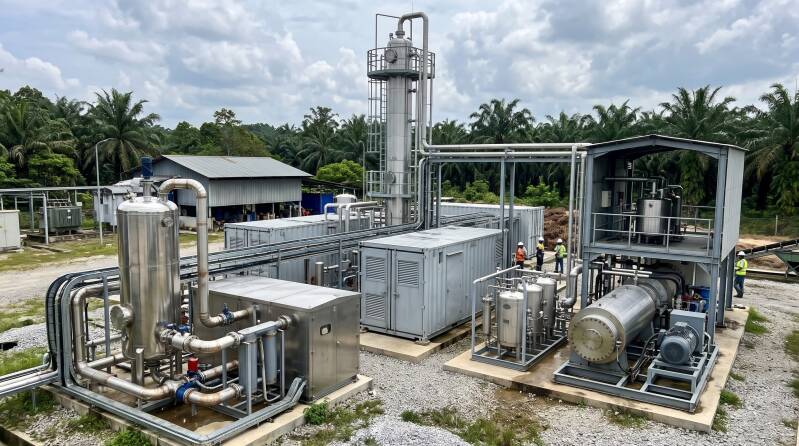
Hydro Puls Systems replaces energy-heavy steam and chemical refining trains with a compact, modular, closed-loop architecture designed for remote plantation and mill sites.
How the HPDD + ACR + VCD Platform Refines Crude Palm Oil
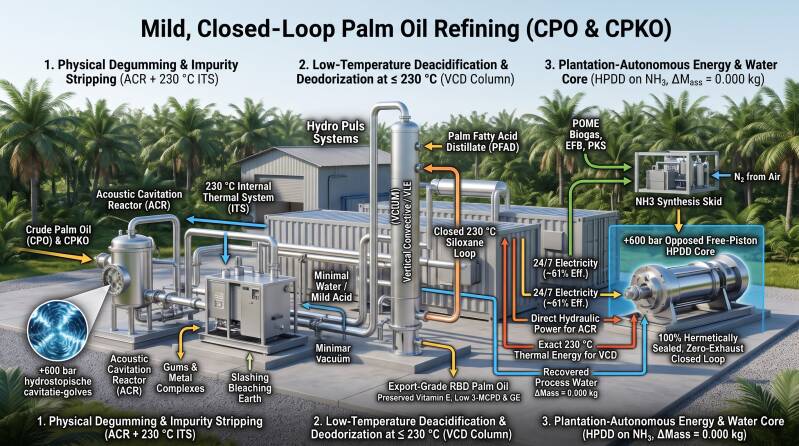
1. Physical Degumming & Impurity Stripping (ACR + 230 °C ITS):
Crude Palm Oil (CPO) and Crude Palm Kernel Oil (CPKO) contain phosphatides (gums), trace metals (iron and copper), and pigments. Routing the feedstock through our Acoustic Cavitation Reactor (ACR), driven by +600 bar hydrostatic pulses and paired with our unpressurized 230 °C Internal Thermal System (ITS), generates intense interfacial micro-cavitation. Hydratable and non-hydratable gums and metal complexes are separated rapidly with minimal water or mild organic acid dosing, eliminating heavy caustic soapstock and slashing bleaching earth consumption.
2. Low-Temperature Deacidification & Deodorization at ≤ 230 °C (VCD Column):
Operating under controlled vacuum, our Vertical Convective / VLE Column (VCD) utilizes cascaded thermal gradients from the closed 230 °C siloxane loop to strip Free Fatty Acids (PFAD) and volatile odor compounds cleanly at or below 230 °C. By avoiding extreme 260 °C+ thermal spikes, the VCD column preserves natural antioxidants (tocotrienols and carotenoids), minimizes neutral oil losses, and significantly suppresses 3-MCPD and glycidyl ester formation.
3. Plantation-Autonomous Energy & Water Core (HPDD on NH3, ΔMass = 0.000 kg):
Remote palm oil mills generate abundant organic residues—including Palm Oil Mill Effluent (POME) biogas, Empty Fruit Bunches (EFB), and Palm Kernel Shells (PKS). These residues provide hydrogen-rich gas that, combined with nitrogen from ambient air, feeds a compact on-site ammonia (NH3) synthesis skid. Our +600 bar opposed free-piston HPDD core (with a frictionless 25-micron gas-curtain seal) runs exclusively on NH3 inside a 100% hermetically sealed, zero-exhaust closed loop, delivering 24/7 electricity (~61% net electrical efficiency), direct hydraulic power for the ACR, exact 230 °C thermal energy for VCD fractionation, and clean recovered process water with zero stack emissions and zero cooling towers.
Strategic Benefits for Palm Oil Mills & Refineries
- Export-Grade Quality & Higher Oil Yield: Lower 3-MCPD/GE levels, preserved Vitamin E fractions, and reduced neutral oil loss.
- Valuable Co-Product Recovery: High-purity Palm Fatty Acid Distillate (PFAD) alongside clean, reusable process water.
- 100% Off-Grid Plantation Autonomy: Turn POME, EFB, and PKS residues into continuous power, 230 °C refining heat, and water without diesel backup or steam boilers.