Direct oil from tyres

Direct Conversion of Tyre Rubber Chips into Clean Fuel Oil & rCB
Bypass conventional 500 °C rotary-kiln pyrolysis: convert steel- and fiber-free rubber chips (5–25 mm) directly into low-sulfur fuel cuts, high-grade rCB, 24/7 off-grid power, and potable water.
Mechanical tyre recycling plants produce vast quantities of clean, steel- and fiber-free rubber chips (5–25 mm) and crumb rubber, typically sold at commodity margins to third-party pyrolysis operators. Meanwhile, conventional high-temperature pyrolysis kilns (450–550 °C) suffer from uncontrolled thermal cracking, high sulfur and gum levels, coking, and heavy energy losses.
Hydro Puls Direct-Drive Systems (HPDD) enables mechanical tyre recyclers to capture the full downstream margin on-site—converting clean rubber chips directly into specification-grade liquid fuels and recovered Carbon Black (rCB) through low-temperature acoustic cavitation depolymerization at ≤ 230 °C.
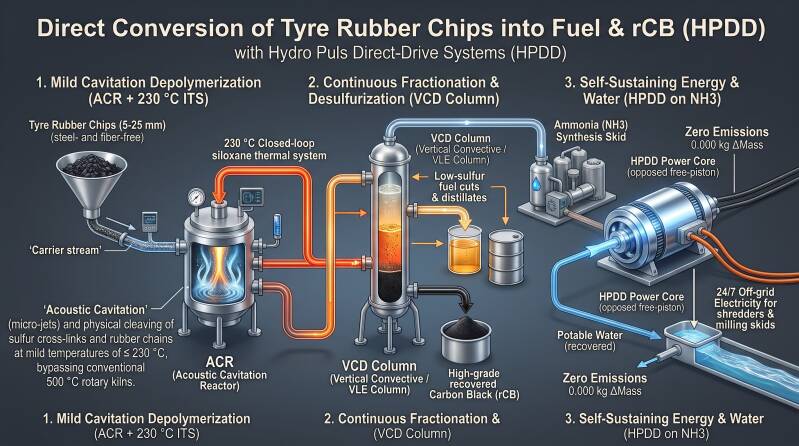
How the HPDD + ACR + VCD Platform Processes Tyre Rubber Chips
1. Mild Cavitation Depolymerization Bypassing Rotary Kilns (ACR + 230 °C ITS):
Instead of roasting dry rubber in high-temperature rotary kilns, clean steel-free rubber chips (5–25 mm) are dispersed into a warm recycled light-hydrocarbon carrier stream heated by our unpressurized 230 °C closed-loop siloxane thermal system. Driven through our +600 bar hydrostatically pulsed Acoustic Cavitation Reactor (ACR), intense cavitation micro-jets and localized shockwaves physically cleave sulfur cross-links (devulcanization) and break down polymer chains at mild temperatures (≤ 230 °C)—eliminating thermal coking and acid-washing sludge.
2. Continuous Fractionation & Desulfurization (VCD Column):
The depolymerized liquid stream enters our Vertical Convective / VLE Column (VCD), which uses cascaded thermal gradients from the closed 230 °C siloxane loop to separate clean, low-sulfur, de-gummed middle distillates and industrial fuel cuts. Simultaneously, the liberated carbon fraction is cleanly separated and conditioned into high-purity recovered Carbon Black (rCB).
3. Self-Sustaining Energy & Water Core (HPDD on NH3, ΔMass = 0.000 kg):
Non-condensable hydrogen-rich light gases released during rubber depolymerization are combined with nitrogen from ambient air in a compact on-site synthesis skid to produce pure ammonia (NH3). That NH3 fuels our hermetically sealed, zero-exhaust +600 bar opposed free-piston HPDD power core (~61% net electrical efficiency, frictionless 25-micron gas-curtain seal), delivering 24/7 off-grid electricity to power your shredders, cracker mills, and upgrading skids, alongside 230 °C process heat and clean recovered potable water with zero cooling towers or stack emissions.
Key Advantages for Mechanical Tyre Recyclers
- Maximum Margin Capture On-Site: Convert low-margin 5–25 mm rubber chips directly into high-value clean fuel cuts and specification-grade rCB without building a conventional rotary-kiln pyrolysis plant.
- Complete Power Autonomy for Shredding & Milling: Run heavy primary/secondary shredders and cracker mills 24/7 on self-generated off-grid power with zero grid outages or diesel backup.
- Zero Chemical Waste & Zero Exhaust: Purely physical cavitation and closed-loop thermodynamics eliminate sulfuric acid sludge, cooling towers, and flue-gas emissions.