Glycerin Pitch Valorization: Clean Biofuels & Fertilizers

Glycerin Pitch Valorization: Clean Biofuels & Fertilizers
100% Chemical-Free Hydrodynamic Separation & Upgrading
Glycerin pitch is one of the most stubborn and viscous residual waste streams generated by the oleochemical and biodiesel industries. Characterized by extreme viscosity, heavy polymer oligomers, and elevated concentrations of inorganic salts (such as sodium and potassium chlorides or sulfates), this material has historically been incinerated as low-value waste or disposed of at high operational cost.
The Hydro Puls Direct-Drive (HPDD) platform transforms this industrial liability directly on-site into two high-value commercial commodities: clean, drop-in biofuel components and purified mineral fertilizer fractions—entirely without chemical additives, acids, or toxic solvents.
Why Conventional Treatment Fails
• High Chemical OPEX: Traditional treatment relies heavily on aggressive acids and solvents to crack polymers and precipitate salts, generating hazardous secondary waste streams.
• Severe Coking & Fouling: Thermal cracking furnaces suffer from coking, fouling, and frequent shutdowns caused by the thermal breakdown of glycerin.
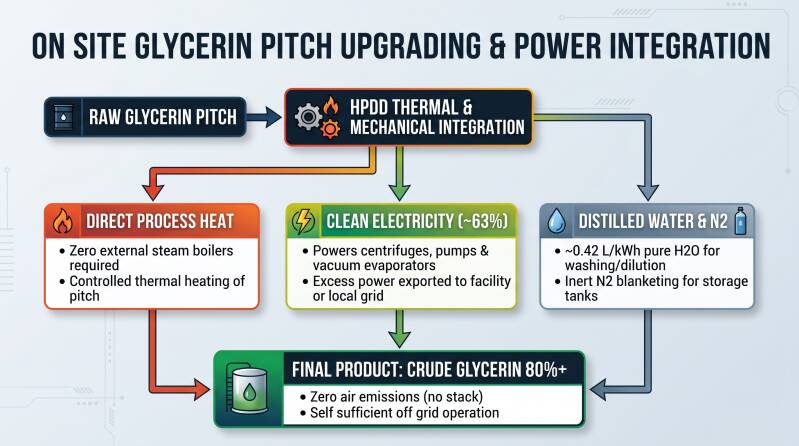
• Energy-Intensive Footprint: Dewatering and phase separation traditionally require massive external steam boilers and high parasitic electric loads.
The HPDD Solution: Purely Mechanical & Thermodynamic
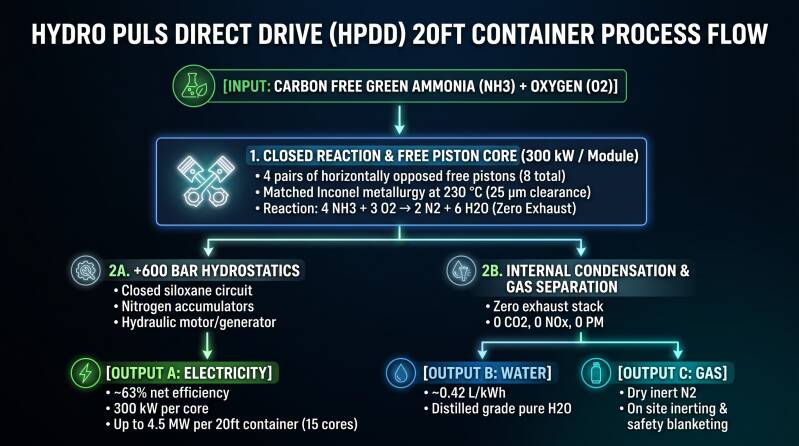
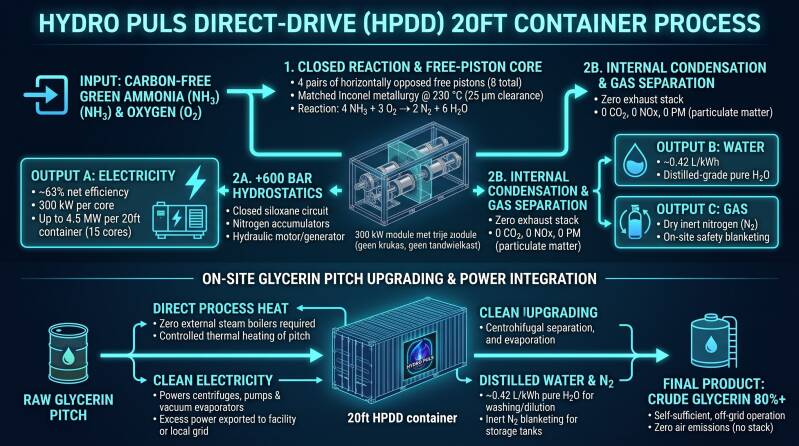
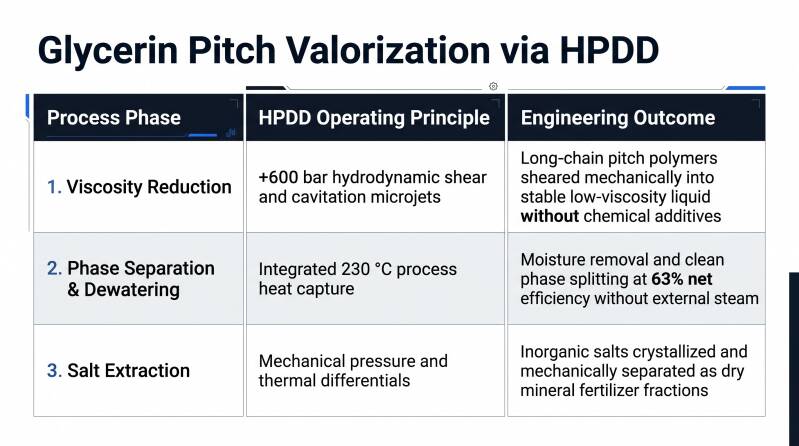
Instead of adding chemical agents, HPDD leverages a continuous direct physical processing loop:
[See visual table below]
Two High-Value End Products
1. Stabilized Biofuel Fraction:
• Low-viscosity, free of abrasive inorganic salts, and clean-burning.
• Ready for direct use in industrial boilers and heavy engines, or as a pretreated drop-in feedstock for advanced biorefineries.
2. Mineral Fertilizer Output:
• Concentrated, dry mineral salts rich in potassium and organic complexes.
• Ready for direct integration into agricultural fertilizer blends.
Key Commercial Advantages
• 100% Chemical-Free: Eliminates acid handling, chemical catalysts, and dangerous secondary effluents.
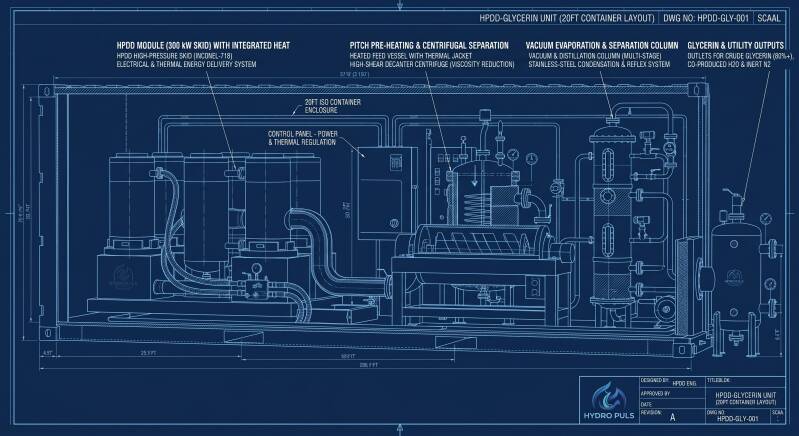
• Modular Skid-Mounted Architecture: Standard factory-tested containers installed directly alongside your existing oleochemical or biodiesel plant.
• Minimal OPEX: Driven by mechanical direct-action pulses and internal heat regeneration.
• Turn Waste Into Margin: Eliminates disposal and environmental liabilities while generating two immediate revenue streams.
Process Your Glycerin Pitch On-Site
Is your facility managing glycerin pitch, heavy fatty acids, or viscous bio-slurries? Contact our engineering team to arrange a feedstock evaluation and bench-scale feasibility study.
Frequently Asked Questions (FAQ): Industrial Glycerin Pitch Valorization
Q1: Does the final product maintain a normal, neutral pH?
Answer:
Yes, absolutely. Conventional treatment typically relies on aggressive chemical acidulation or caustic additives, resulting in sharp pH swings and corrosive effluent. Because the Hydro Puls Direct-Drive (HPDD) platform operates purely through physical and thermodynamic mechanisms (+600 bar hydrodynamic shear and cavitation microjets), no external chemicals, acids, or solvents are introduced. The processed output maintains a stable, near-neutral pH (typically 6.5 – 7.5), eliminating equipment corrosion risks and hazardous chemical residues.
Q2: What processing capacities and throughput volumes are supported?
Answer:
HPDD is engineered for continuous 24/7 industrial deployment. A benchmark volume of 1,000 metric tons per month (~33 tonnes per day) aligns ideally with our standardized, containerized skid modules. Thanks to this plug-and-play architecture, the system installs directly adjacent to existing biodiesel or oleochemical facilities, allowing modular scaling without heavy civil construction or lengthy plant shutdowns.
Q3: Can the process produce commercial-grade 80% crude glycerin?
Answer:
Yes. By pairing mechanical salt crystallization with integrated 230 °C thermal dewatering, our system provides precise control over moisture content and organic impurity separation (MONG). This enables the liquid fraction to be concentrated directly to the commercial benchmark of 80%+ crude glycerin, ready for commodity off-take or downstream chemical processing.
Q4: What feedstock data or lab tests are required to initiate a feasibility assessment?
Answer:
To generate an exact mass-energy balance, yield forecast, and skid footprint, we require a recent Certificate of Analysis (CoA) or laboratory profile of your glycerin pitch. The primary parameters include:
1. Glycerol & Moisture Content (% water): Dictates the precise thermal duty required for concentration.
2. Ash & Salt Profile (% ash, NaCl vs. K2SO4): Determines the chemical grade, yield, and off-take market for the extracted mineral fertilizer.
3. Free Fatty Acids (FFA) & MONG (Matter Organic Non-Glycerol): Establishes the separation split between liquid biofuel and purified glycerin.
4. Viscosity & Delivery Temperature: Informs the inlet conditioning requirements.
Q5: How does the system handle high viscosity or solidification at ambient temperatures?
Answer:
Glycerin pitch is notoriously viscous and prone to solidifying when cooled. The HPDD containerized skid is designed to connect directly to heated plant storage (typically maintained at 50–70 °C). When necessary, an integrated thermal trace using recaptured process heat conditions the inlet manifold. Once inside the processing core, +600 bar hydrodynamic shear and cavitation microjets mechanically disrupt polymer structures, permanently lowering fluid viscosity without chemical thinners or dilution water.
Q6: Can the skid be tuned for specific commercial outputs (Biofuel vs. Crude Glycerin)?
Answer:
Yes. The operating parameters can be tailored based on local market economics:
• Crude Glycerin Maximization (80%+): Prioritizes selective inorganic salt crystallization and thermal dewatering to produce commodity-grade crude glycerin for oleochemical trading.
• Biofuel Maximization: Enhances hydrodynamic mechanical shear to crack heavy pitch polymers into a clean, low-viscosity, ash-free liquid fuel suitable for on-site industrial boilers or heavy machinery.
Q7: What site utilities are required to operate the modular skid?
Answer:
The system is delivered fully pre-assembled within a standard ISO container footprint. Site requirements are minimal:
• Standard industrial electrical hook-up (with low parasitic draw due to 63% core net efficiency).
• Direct flange connections to feedstock and discharge storage tanks.
• Zero external steam generation, acid/caustic storage, chemical metering skids, or complex civil foundations are required.