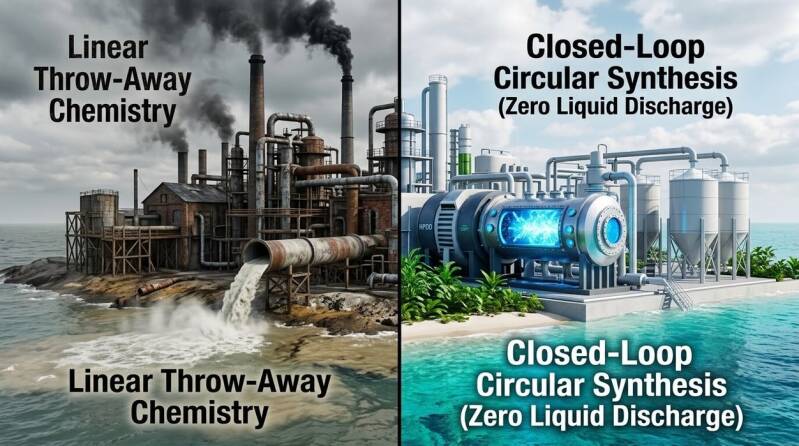
Solvay Process
The End of Linear Chemistry: Disrupting the Solvay Process
Transforming Soda Ash Production from a 19th-Century Waste Stream into a Closed-Loop Circular Asset
* The 160-Year-Old Bottleneck: Throw Away and Burn
Sodium carbonate (soda ash) is an irreplaceable cornerstone of modern industrial manufacturing, essential for flat glass, container glass, detergents, and high-purity precursors for EV lithium batteries.
Yet the predominant global manufacturing route, the Solvay Process, remains fundamentally tethered to 19th-century linear thermodynamics:
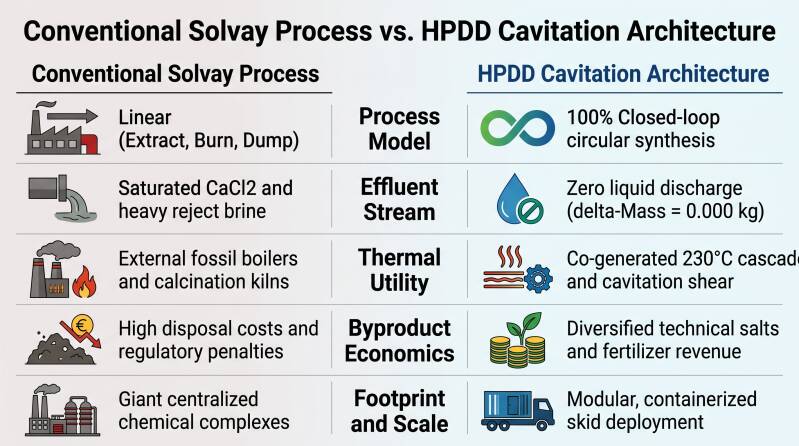
* Colossal Marine Pollution: For every metric ton of soda ash produced, Solvay plants generate multi-ton effluent streams of saturated calcium chloride (CaCl2) and concentrated reject brine, severely salinizing marine ecosystems and freshwater basins.
* Extreme Steam and Calcination Penalties: Driving ammonia recovery and chemical equilibrium shifts consumes millions of gigajoules in fossil-fired steam boilers and limestone calcination kilns.
* Escalating Regulatory and Disposal Liabilities: Stricter environmental mandates, carbon penalties, and water-abstraction restrictions are making legacy Solvay operations financially precarious.
* A Closed Thermodynamic Alternative: HPDD and Acoustic Cavitation
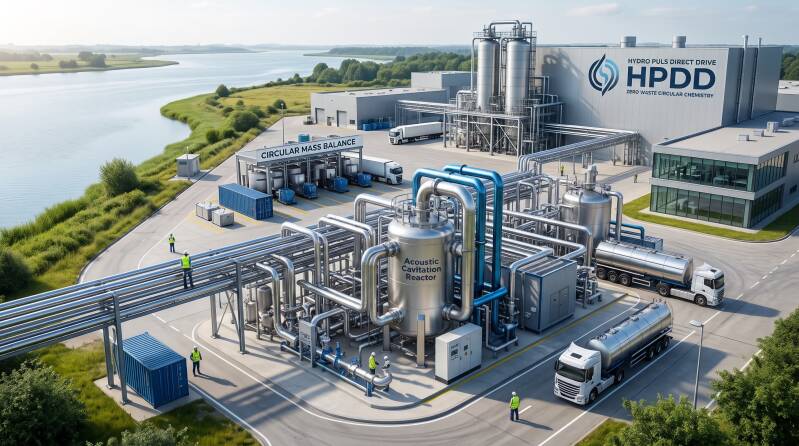
The Hydro Puls Direct-Drive (HPDD) architecture, coupled with an inline Acoustic Cavitation Reactor (ACR), replaces brute-force thermal calcination with direct mechanochemical shear and high-pressure fluid dynamics.
Instead of treating the chemistry as an open-ended disposal problem, the system enforces a strict mass balance: delta-Mass = 0.000 kg.
Raw Brine and Mineral Salts enter the system. Inside the HPDD and Acoustic Cavitation Reactor skids, 600-bar direct hydrostatic work, inline acoustic micro-cavitation, and synchronous 230°C waste-heat integration process the feed. This outputs three distinct streams:
* High-Purity Technical Soda Ash (Na2CO3)
* Valorized Magnesium and Calcium Mineral Salts
* Demineralized Closed-Loop Reaction Water
* Core Technological Advantages
Zero-Waste Circular Mass Balance (delta-Mass = 0)
Rather than discharging reject brine to the ocean, extreme hydrodynamic shear and cavitation fields isolate and precipitate every ionic component. Magnesium, calcium, and sodium fractions are cleanly partitioned into technical-grade industrial minerals and specialized fertilizers, engineering waste completely out of the equation.
Bypassing External Thermal Boilers
Traditional distillation and stripping towers require continuous low- and medium-pressure steam. HPDD supplies activation energy directly at the molecular level through localized cavitation hotspots and co-generated 230°C jacket enthalpy, eliminating external fossil steam boilers.
Direct Hydrostatic Fluid Work (+600 bar)
Brine slurries and reaction matrices are handled directly by the core expansion cycle. This bypasses the compounding electrical, mechanical, and maintenance losses of standalone high-pressure pumps and motor drives.
* Commercial Industrialization
In collaboration with strategic industrial partners and foundational cavitation research, the HPDD platform transitions soda ash synthesis from an environmental liability into a modular, high-margin asset.
Accelerate your chemical plant modernization.
Schedule a Technical Consultation
(c) 2026 Hydro Puls Direct Drive (HPDD). All rights reserved.