

Locomotive with HPDD
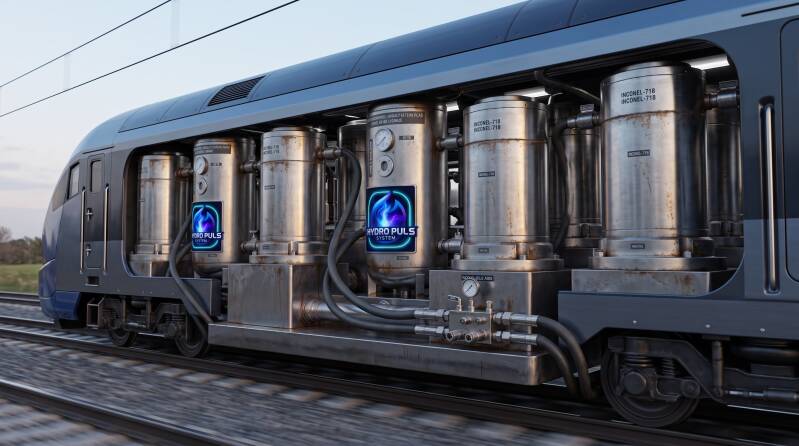
HPDD Railway Technology: The Clean Traction Standard for Heavy Haul
The Challenge: Decarbonization Beyond the Catenary
While passenger rail is largely electrified, heavy freight and regional operations on non-electrified corridors remain locked into legacy diesel-electric locomotives. For continuous multi-megawatt duty cycles, battery systems impose severe weight penalties, while conventional fuel cells struggle with thermal management, vibration, and high lifecycle replacement costs.
The Hydro Puls Direct-Drive (HPDD) provides the clean power solution: a carbon-free, crankless fluidic power core combining the energy density of liquid fuels with electric drive efficiency.
Why HPDD Powers the Future of Rail:
Direct-Drive Generation Efficiency (62% LHV):
Operating via opposed-piston dynamics at +600 bar, the HPDD converts green fuels directly into onboard electrical power with industry-leading efficiency, bypassing the parasitic conversion losses of conventional gensets.
Zero External Cooling Required (Active Thermal Output):
Unlike diesel engines that require extensive radiator compartments, cooling water loops, and heavy fans, the HPDD operates without external liquid cooling. Thermodynamic expansion natively provides active chilling to stabilize onboard power electronics and battery buffers.
Massive Weight Reduction for Payload Capacity:
Engineered with high-temperature Inconel 718 and eliminating 85% of conventional moving components (no crankshaft, no connecting rods, no valvetrain), HPDD frees up critical axle-load capacity for freight payloads or extended fuel ranges.
First-Order Vibration Cancellation (Sum F = 0):
The perfectly balanced, opposed-piston architecture eliminates structural harmonics and mechanical vibration. This dramatically reduces fatigue stress on locomotive bogies and running gear while lowering noise pollution in urban terminals and classification yards.
Hermetic Siloxane Fluidic Barrier:
A non-pressurized siloxane barrier isolates the mechanical drive from the process fluid, delivering 100% oil-free operation and eliminating routine oil changes.
Technical Integration & Repowering:
Modular Scalability: Parallel packaging of standardized HPDD power cores allows seamless scaling from 300 kW regional shunting units to multi-megawatt mainline freight consists.
Fuel: Direct compatibility with clean carriers, ZERO-emission liquid ammonia.
Infinite Life Regime (10^11 Cycles): Engineered for industrial longevity with minimal downtime and no reciprocating side-thrust loads.
Drop-In Diesel Repowering: Ultra-compact dimensions enable direct retrofits within existing locomotive engine hoods, minimizing civil redesign for fleet operators.
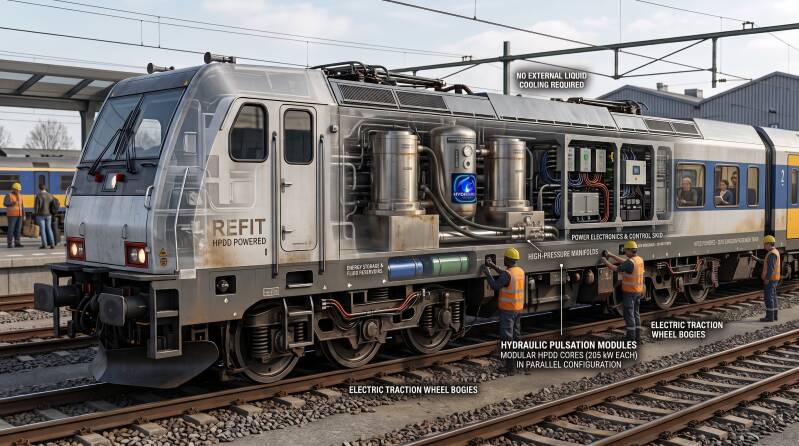
Dual Traction Architecture: Matching Powertrain to Duty Cycle
The inherent modularity of the Hydro Puls Direct-Drive (HPDD) platform allows tailored powertrain integration across two distinct railway segments:
1. Passenger Rail & Fleet Retrofits: HPDD-Electric Integration
For regional passenger rail and rolling stock retrofits, coupling modular HPDD units to an electric traction bus delivers the optimal balance of agility, noise mitigation, and zero-emission compliance:
• Drop-In Repowering: Directly interfaces with standard electric wheel bogies and onboard DC-bus architectures, preserving existing chassis electronics and braking systems.
• Urban Compliance & Passenger Comfort: First-order vibration cancellation (Sum F = 0) and low-noise acoustic profiles make it ideal for high-frequency passenger corridors and terminal stations.
• Auxiliary Stabilization: The HPDD’s active thermodynamic cooling natively stabilizes onboard power electronics and passenger HVAC systems without external parasitic cooling loops.
2. Heavy-Haul Locomotives: Direct HPDD-Hydraulic Drive (+7% Net Energy Gain)
For heavy freight, shunting yards, and steep gradient corridors, eliminating electric conversion steps in favor of a direct HPDD-hydraulic motor powertrain represents the thermodynamic peak:
• +7% Net Energetic Gain: Bypassing generator-inverter-electric traction motor stages eliminates compounding electrical conversion and copper losses, routing +600 bar fluidic power directly to heavy-duty hydraulic wheel motors.
• Maximum Low-End Tractive Effort: Delivers 100% full torque instantly from a dead standstill, eliminating the thermal overload and burnout risks typical of electric traction motors during low-speed, high-load pulling.
• Unmatched Power Density: Reduces drivetrain mass by cutting heavy copper coils, iron stators, and complex power inverters, converting saved tare weight directly into higher trailing tonnage capacity.
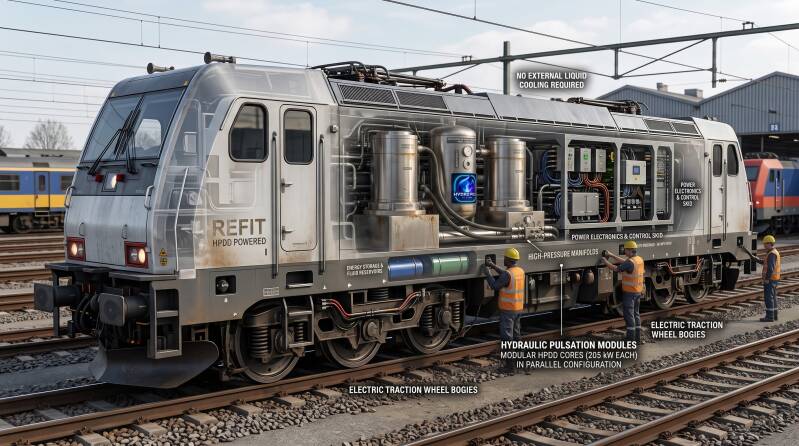
Frequently Asked Questions (FAQ)
Q: Why are there two distinct architectures (HPDD-Electric vs. HPDD-Hydraulic)?
A: Passenger trains and standard freight retrofits rely heavily on existing electric bogies and distributed traction electronics, making an HPDD-Electric configuration the fastest, lowest-capex drop-in replacement. For dedicated heavy-haul locomotives, bypassing the electrical conversion steps entirely and coupling HPDD directly to hydraulic wheel motors captures a +7% net energetic gain, delivering immense low-speed torque without electrical overheating.
Q: How does the HPDD operate without external cooling water?
A: Unlike conventional combustion engines or large fuel cells that lose massive amounts of energy as waste heat requiring external radiators and cooling fans, HPDD leverages internal thermodynamic expansion. This process natively absorbs thermal energy and delivers active cold output, eliminating external cooling water loops and cooling towers.
Q: Can HPDD run on multiple types of zero-emission fuels?
A: Yes. The system is inherently fuel-agnostic. The high-pressure, opposed-piston fluidic architecture is designed to handle clean liquid energy carriers (such as green ammonia) as well as compressed hydrogen without requiring fundamental mechanical redesigns.
Q: How does the system achieve vibration-free operation inside passenger and freight trains?
A: Traditional reciprocating engines generate severe secondary and rotational imbalances. HPDD uses a crankshaft-free, opposed-piston layout where opposing masses cancel each other out dynamically (Sum F = 0). This first-order balance protects locomotive structural integrity and ensures quiet operation through stations and urban freight yards.
Q: How does retrofitting work for existing diesel fleets?
A: Thanks to its modular power-core design (using parallel 300 kW units), HPDD skids fit directly into standard locomotive engine hoods. Legacy diesel prime movers and massive cooling radiators are removed, freeing up interior space and reducing axle loads while retaining the locomotive frame and wheel interfaces.