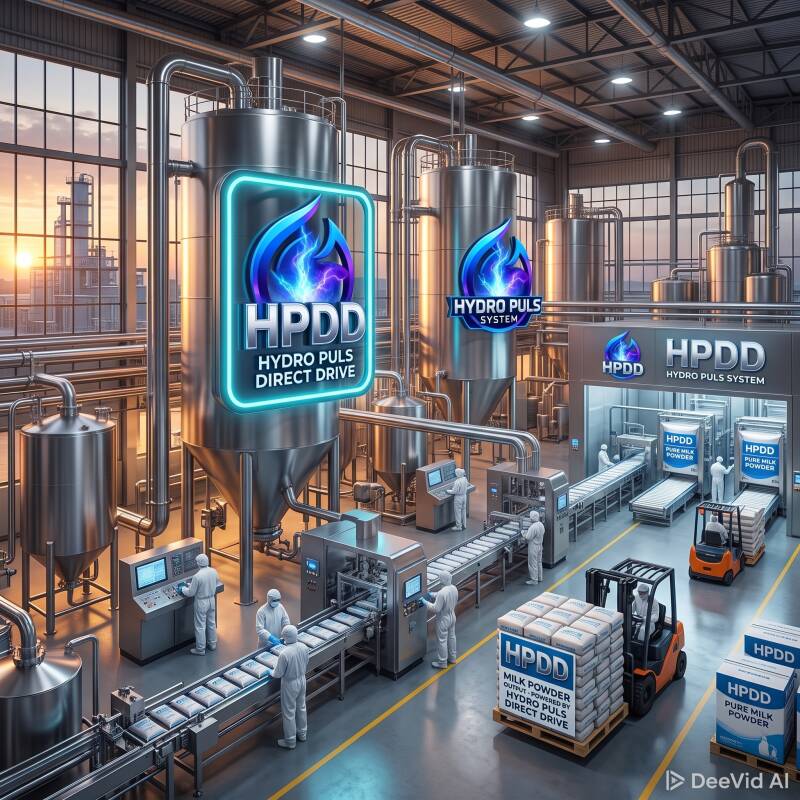
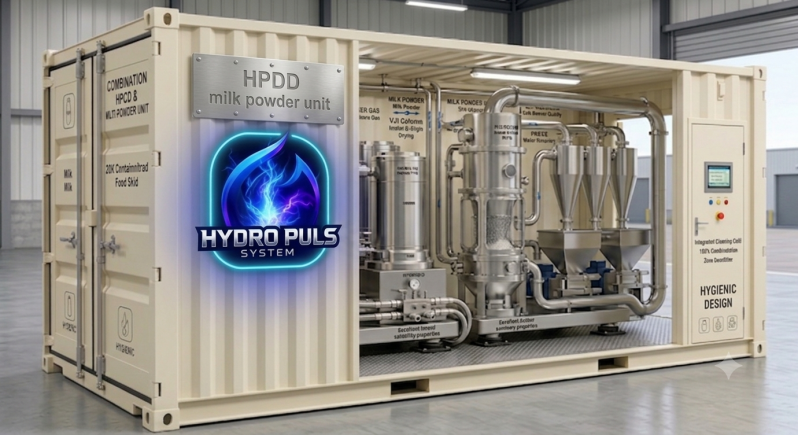
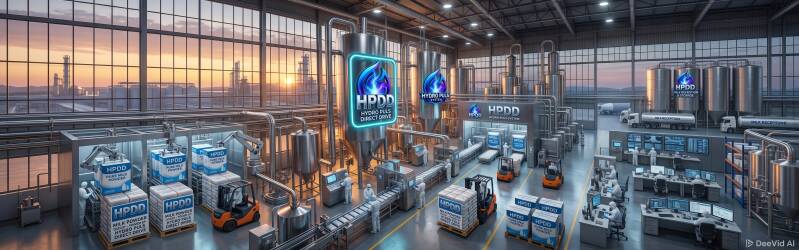
HPDD Milk Powder Unit
Dairy Processing Breakthrough: Hydro Puls Direct-Drive Transforms Milk Powder Production and Protein Valorization
The global dairy processing sector faces a persistent thermodynamic barrier: conventional spray-drying towers up to 40 meters tall consume massive amounts of fossil fuel while prolonged heat exposure denatures hyper-sensitive protein structures.
The introduction of the modular Hydro Puls Direct-Drive (HPDD) platform, the HPDD Molecular Eraser, disrupts this paradigm.
By replacing conventional thermal spray drying with software-defined gas-phase transport kinetics past Mach 2.5, the system establishes a new benchmark for protein quality, energy efficiency, and operational uptime.
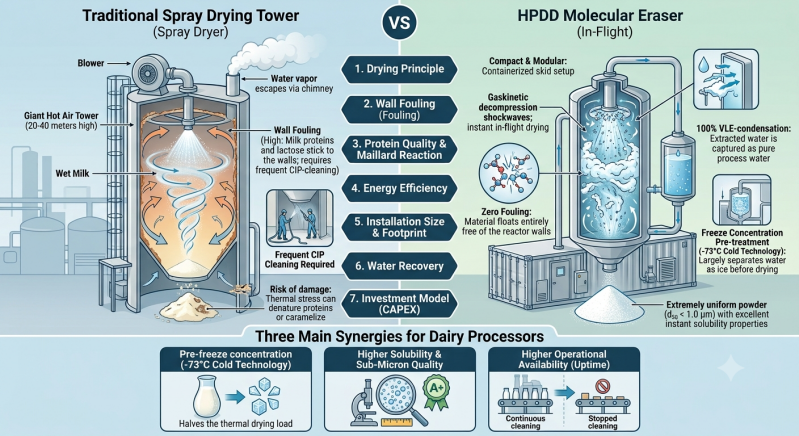
Conventional Spray Tower vs. HPDD Molecular Eraser
The Protein Bottleneck: Why Conventional Spray Drying Fails
When processing high-value streams such as whey protein and milk concentrates, traditional gas-fired drying towers hit structural limits.
Thermal profiles exceeding 160°C denature delicate protein chains, trigger unwanted Maillard reactions (caramelization), and degrade premium streams into low-value waste.
Furthermore, sugars and proteins adhere continuously to hot inner surfaces (wall coking and fouling), necessitating frequent, costly Cleaning-In-Place (CIP) downtime.
The HPDD Molecular Eraser resolves this through supersonic kinetic decompression. Raw feed concentrate is pre-cooled via the sub-zero Nitrogen gas byproduct generated by the closed ammonia fuel loop, then subjected to an instantaneous single-stage pressure expansion. Mid-air acoustic shockwaves flash-shatter and micronize the particles in suspension within a 1.5-second residence time.
By stabilizing the process at an optimized thermal sweet spot of +180°C with zero wall contact, the platform yields a uniform sub-micron powder (d_50 < 1.0,mu) that fully preserves native protein structures and bioactivity, 100% oil- and grease-free under strict HACCP and GMP compliance.
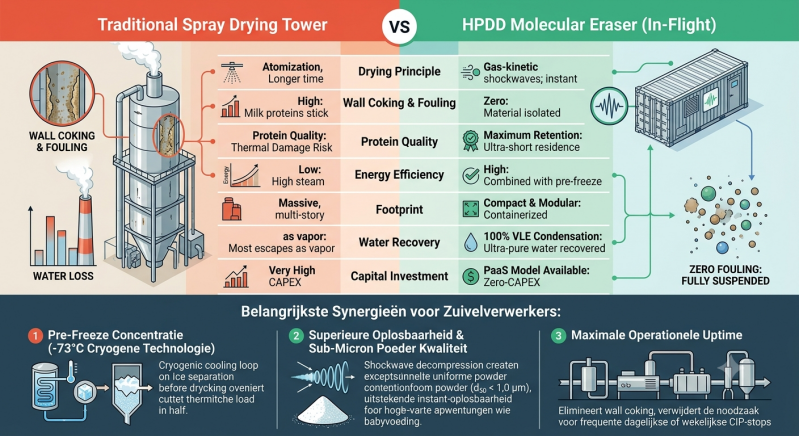
Modular Scalability and Process Capacity
Engineered under the leadership of Co-Principal Process Architect Dr. Mohamed Amin El-Badry (Associate Professor of Process Engineering, Al-Azhar University), the HPDD-Dairy architecture delivers rigorous operational scalability:
- Containerized 40-Foot Skids: Each system is shop-fabricated and pre-commissioned as a multi-vector cogeneration block, delivering process drying heat, off-grid electricity, sterile CIP washdown water, and MAP-grade Nitrogen packaging gas simultaneously.
- Continuous Throughput Range: A single 10-MW modular core handles a baseline mass flow velocity up to 400,000 kg/hour of concentrated raw solids (locking in exactly 9,600,000 kg per 24-hour manufacturing cycle at Delta\Mass = 0.000 kg). For localized facilities, automated software layers dynamically downscale processing to 100 kg/hour.
- Parallel N+1 Expansion: Scaling up capacity requires no civil facility extensions; additional 40-foot modules integrate in parallel arrays directly alongside existing plant intake walls.
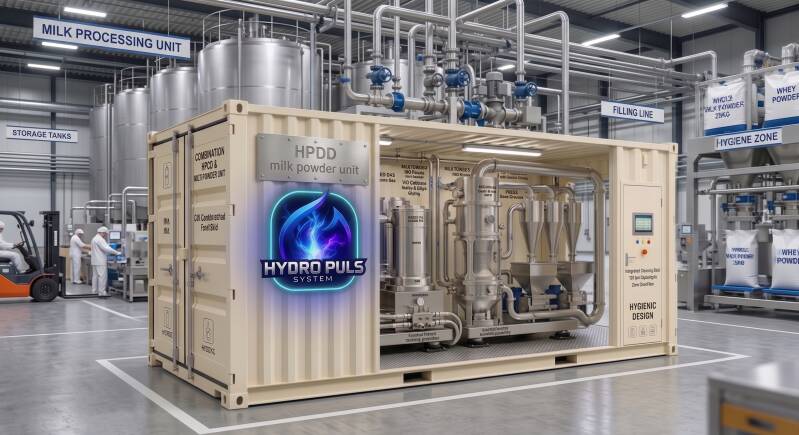
Integrated Cheese Slicing & Whey Valorization
The HPDD platform supports simultaneous multi-vector processing in dairy plants. Leveraging direct linear hydraulic power, the core drives 600-bar contact-free cryogenic micro-slicing of fresh cheese blocks, eliminating mechanical blade wear and cross-contamination.
Concurrently, the co-generated Nitrogen stream supplies an on-demand Modified Atmosphere Packaging (MAP) blanket to prevent product oxidation on packaging lines, while high-grade process enthalpy routes directly to pasteurization loops and CIP sanitization skids.
By combining zero wall coking, full water recovery, and a CAPEX-free PaaS framework, the HPDD platform provides an ultra-low-emission, high-yield blueprint for the future of industrial dairy manufacturing.
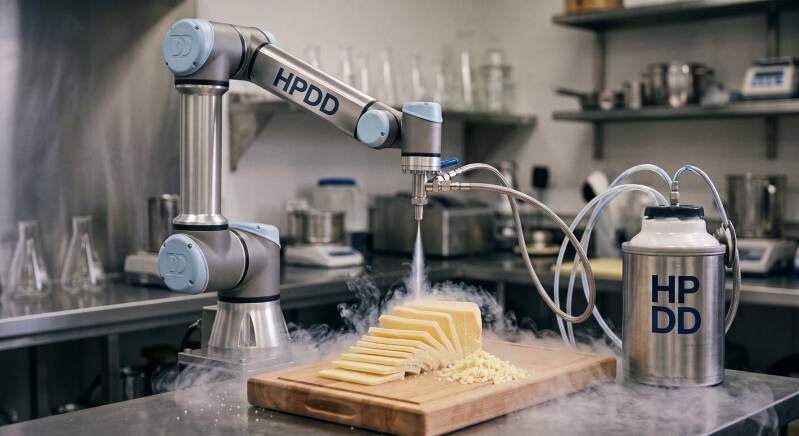
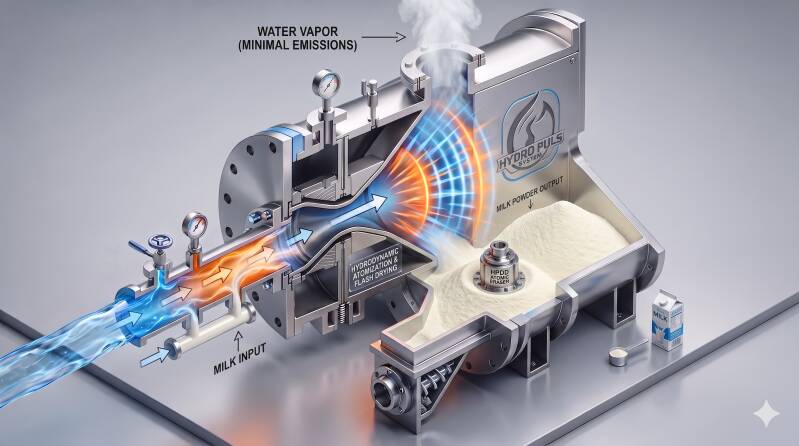
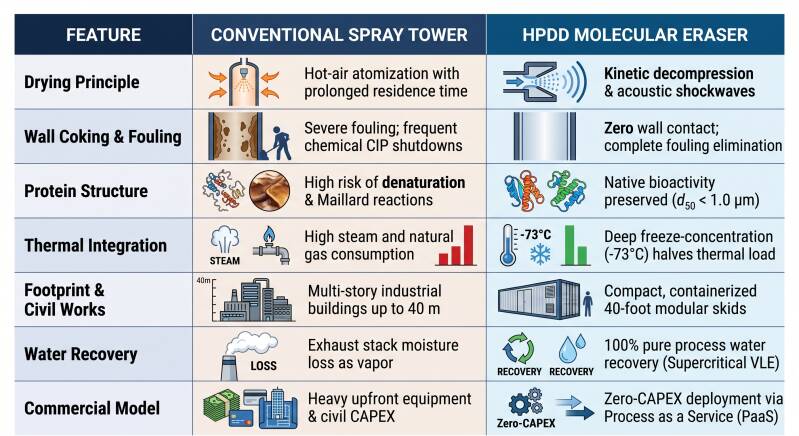
Conventional Spray Drying Tower vs. HPDD Molecular Eraser for Milk Powder Production.
Drying Principle and Speed
Conventional spray dryers rely on atomizing concentrated milk inside a massive hot-air tower with a relatively long drying residence time.
In contrast, the HPDD Molecular Eraser uses gas-kinetic decompression shockwaves to achieve instantaneous mid-air drying while the material remains fully in suspension.
Wall Coking and Fouling
Traditional towers suffer from high rates of wall fouling as milk proteins and lactose stick to the internal hot surfaces, requiring frequent and costly Cleaning-In-Place (CIP) downtime.
The HPDD Molecular Eraser achieves zero wall contact during the flash-drying phase, completely preventing material adhesion.
Protein Quality and Thermal Damage
In standard dryers, prolonged thermal exposure risks protein denaturation and unwanted Maillard reactions (caramelization).
The HPDD platform preserves the natural structure and bioactivity of sensitive dairy proteins (such as whey and caseins) due to its sub-second processing time and controlled thermal profiles.
Energy Efficiency and Thermal Integration
Conventional spray drying requires massive steam and natural gas inputs to evaporate water.
HPDD significantly reduces overall thermal energy demand by coupling deep cryogenic freeze-concentration (down to -73C prior to drying with integrated heat recovery.
Footprint and Equipment Dimensions
Standard drying plants demand huge multi-story industrial buildings to house towers up to 40 meters tall.
HPDD delivers equivalent drying capacity within a compact, modular, containerized skid layout.
Water Recovery
Traditional evaporators and spray towers vent significant amounts of moisture through the exhaust stack as lost vapor.
The HPDD system utilizes supercritical Vapor-Liquid Equilibrium (VLE) separation to condense and recover 100% of the extracted water as ultra-pure process water for factory reuse.
Capital Expenditure and Deployment
Building a standard spray drying plant requires massive upfront CAPEX for civil works and heavy equipment.
The HPDD platform can be deployed under a Process as a Service (PaaS) framework, allowing dairy processors to scale production capacity with zero initial equipment CAPEX.
Key Advantages for Dairy Processors
Freeze-Concentration Integration: Utilizing -73Ccryogenic cooling to freeze-concentrate raw milk before drying halves the thermal evaporation workload.
Sub-Micron Instant Powder Quality: Shockwave decompression yields highly uniform sub-micron powder d_50 < 1.0 with superior solubility, ideal for premium infant formula and protein isolates.
Maximized Operational Uptime: Eliminating wall coking removes the need for daily or weekly chemical CIP downtime, maximizing continuous plant operation.