Flaring
From Stranded Capital to High-Value Commodities: Wellhead Flare Gas Valorization via HPDD
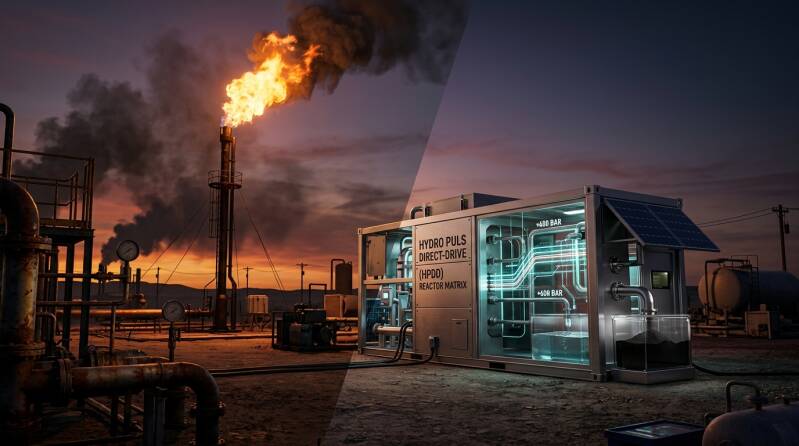
Globally, over 140 billion cubic meters of associated petroleum gas (APG) are combusted at the flare tip each year. Beyond releasing millions of tons of CO_2 and uncombusted fugitive methane into the atmosphere, flaring represents the destruction of valuable chemical feedstock at remote or off-grid wellheads.
For decades, upstream operators faced an unyielding mechanical bottleneck: associated gas surfaces at low, erratic flow rates and fluctuating pressures. Conventional multi-stage reciprocating compressors, pipeline tie-ins, and centralized chemical synthesis plants are capital-intensive, mechanically complex, and operationally unviable for remote deployment.
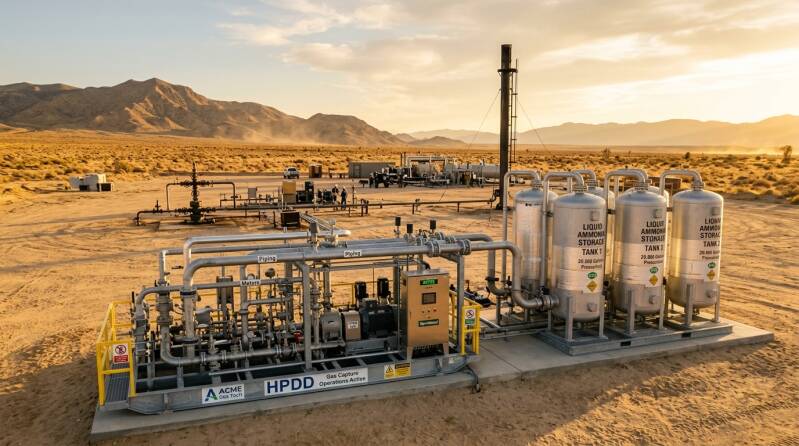
The Hydro Puls Direct-Drive (HPDD) process platform solves this mechanical constraint at the wellhead—converting flared hydrocarbons into transportable liquid energy carriers, engineered nanomaterials, and dispatchable power within an airtight, skid-mounted footprint.
The Mechanical Bottleneck of Associated Gas
Remote flaring is not a lack of chemical potential; it is a limitation of conventional rotary compression:
- Variable Inflow Pressures: Associated gas volumes fluctuate wildly based on production cycles, overwhelming traditional fixed-displacement rotating compressors.
- Severe Mechanical Drag & Maintenance: Conventional multi-stage compressor skids suffer from valve wear, ring degradation, and seal blowout under sour or wet gas conditions.
- Pipeline Stranding: Building gathering pipelines to tie distant wellheads into regional grids requires substantial capital expenditure that marginal or remote assets cannot justify.
The default operational outcome has been simple: burn the gas to avoid overpressuring the gathering system. HPDD replaces this destructive cycle with deterministic, closed-loop conversion.
Core Process Architecture
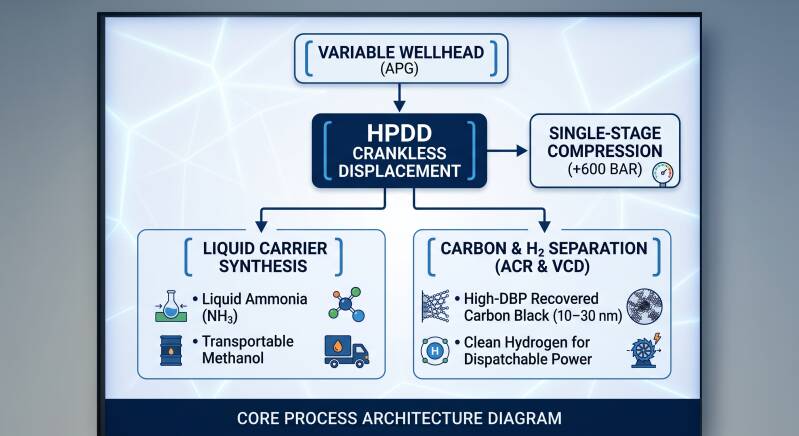
1. Crankless Direct Displacement (+600 bar)
The foundation of the platform is the crankless Hydro Puls Direct-Drive core. Utilizing stiff, closed-loop linear hydraulic displacement, the HPDD captures raw, low-pressure flare gas and elevates it directly to high reaction pressures (+600 bar) in a single compact stage.
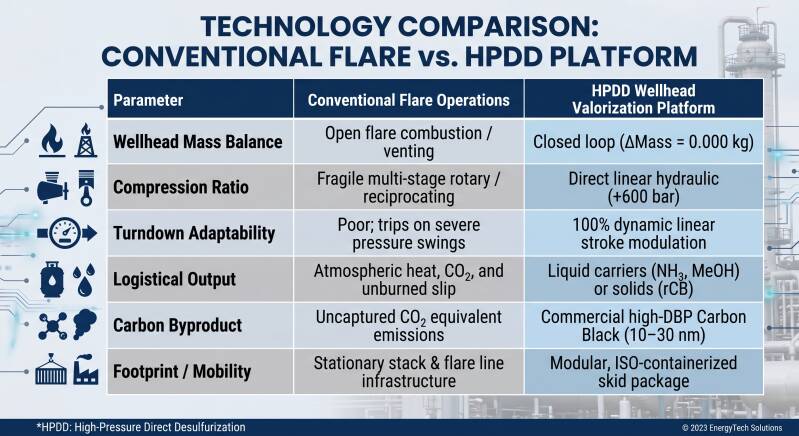
By eliminating the rotary crankshaft, crosshead bearings, and dynamic mechanical linkages, the HPDD core removes the primary failure modes of high-pressure gas handling. The system dynamically modulates its displacement stroke to match fluctuating wellhead flows in real time, maintaining high isentropic efficiency across wide turndown ratios.
2. On-Site Synthesis of Liquid Energy Carriers
Transporting raw gas requires pressurized pipelines or cryogenic LNG logistics. HPDD circumvents this logistics barrier by pairing high-pressure displacement with modular, wellhead-scale chemical reactors:
- Liquid Ammonia (NH_3): Synthesizing transportable green/blue ammonia directly at the pad for agricultural or industrial distribution.
- Methanol & Syngas: Catalytic conversion into ambient-temperature liquid fuels that integrate directly into existing liquid trucking logistics.
3. Clean Hydrogen & Nanoscale Carbon Harvesting (ACR & VCD)
For operators targeting zero-carbon power and high-margin industrial materials, the HPDD routes pressurized gas streams into integrated non-thermal decomposition stages:
- Acoustic Cavitation Reactor (ACR): High-intensity acoustic cavitation fields crack the CH bonds of methane without requiring open combustion or high-pressure oxygen infrastructure.
- Vertical Convective Decoupler (VCD): The carbon phase is decoupled in-flight, precipitating pure, high-structure recovered Carbon Black (rCB) with primary particle sizing held strictly to 10–30 nm.
- Zero-Emission Hydrogen: Pure hydrogen is separated concurrently to fuel continuous, 24/7 on-site power generation or local fuel cells, delivering prime dispatchable power to field operations.
Technical & Commercial Specifications
Operational Impact for Upstream Operators
- Complete Regulatory Compliance & Elimination of Penalties: Achieve zero-routine-flaring targets ahead of tightening World Bank and regional emissions mandates, eliminating carbon tax exposure and flaring fines.
- Immediate Valorization of Stranded Assets: Shift flared gas from an operational overhead line-item into truckable, high-density liquid chemicals and premium nanomaterials with established global markets.
- Rugged, Autonomous Skid Deployment: Built around an opposed linear hydraulic geometry designed for unmanned, harsh-environment wellheads, delivering maximum uptime regardless of gas-slugging or ambient variations.
Turn Stranded Gas Into Bankable Production
The era of burning energy at the flare tip is closing. The Hydro Puls Direct-Drive platform delivers the mechanical stiffness, modularity, and thermodynamic precision required to turn marginal gas streams into industrial-grade assets.