

Premium Nitrates via HPDD
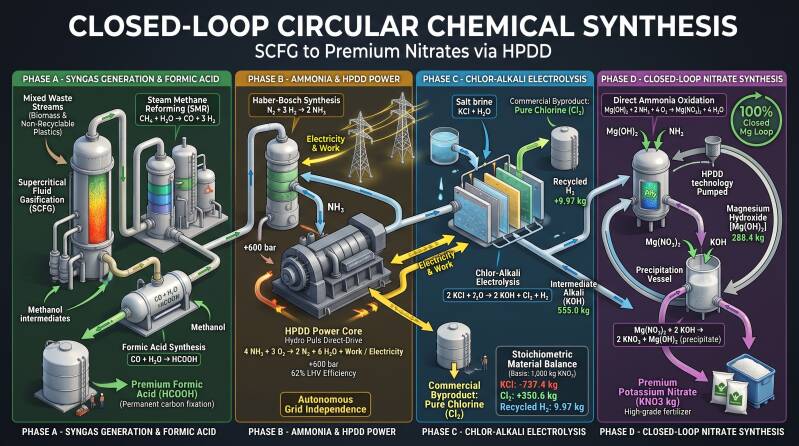
Closed-Loop Circular Chemical Synthesis: SCFG to Premium Nitrates via HPDD
This integrated chemical architecture transforms mixed waste streams (biomass and non-recyclable plastics) into high-value specialty chemicals and fertilizers. By coupling Supercritical Fluid Gasification (SCFG) and Steam Methane Reforming (SMR) with the high-efficiency Hydro Puls Direct-Drive (HPDD) platform, this multi-stage system eliminates fossil carbon emissions, recovers internal chemical vectors, and operates a closed-loop magnesium cycle.
1. Process Chemistry & Reaction Pathways
Phase A: Syngas Generation & Formic Acid Route
• Supercritical Fluid Gasification (SCFG): Feedstock (mixed biowaste and end-of-life plastics) produces an energy-dense synthesis gas stream rich in methane (CH4), hydrogen (H2), and light hydrocarbons.
• Steam Methane Reforming (SMR):
CH4 + H2O -> CO + 3 H2
• Methanol Intermediate & Formic Acid Synthesis:
- Methanol synthesis: CO + 2 H2 -> CH3OH
- Carbonylation to methyl formate: CH3OH + CO -> HCOOCH3
- Hydrolysis to formic acid: HCOOCH3 + H2O -> HCOOH + CH3OH
- Net reaction (carbon capture into high-value chemical):
CO + H2O -> HCOOH
Phase B: Ammonia Synthesis & HPDD Power Generation
• Haber-Bosch Synthesis:
N2 + 3 H2 -> 2 NH3
• HPDD Power Core (Ammonia Cycle):
The HPDD platform burns clean ammonia under high pressure (+600 bar) at a 62% LHV net efficiency to generate dispatchable power and high-pressure fluid work:
4 NH3 + 3 O2 -> 2 N2 + 6 H2O + Work / Electricity
Phase C: Chlor-Alkali Electrolysis (Powered by HPDD)
Using on-site power generated by the HPDD core, salt brines (KCl or NaCl) undergo membrane electrolysis:
2 KCl + 2 H2O -> 2 KOH + Cl2 + H2
(Or sodium equivalent: 2 NaCl + 2 H2O -> 2 NaOH + Cl2 + H2)
• Commercial Byproducts: Pure chlorine gas (Cl2) for chemical synthesis or water treatment, industrial alkali (KOH/NaOH), and clean hydrogen (H2) recycled directly back to ammonia production.
Phase D: Closed-Loop Nitrate Synthesis & Magnesium Hydroxide Shuttle
• Direct Ammonia Oxidation to Magnesium Nitrate via HPDD:
Ammonia is oxidized and reacted with recycled magnesium hydroxide inside the controlled thermodynamic environment of the HPDD reactor:
Mg(OH)2 + 2 NH3 + 4 O2 -> Mg(NO3)2 + 4 H2O
• Precipitation of Potassium/Sodium Nitrate & Mg(OH)2 Regeneration:
Reaction with the in-house alkali stream:
Mg(NO3)2 + 2 KOH -> 2 KNO3 + Mg(OH)2 (precipitate)
(Or: Mg(NO3)2 + 2 NaOH -> 2 NaNO3 + Mg(OH)2)
• 100% Closed Loop: Insoluble Mg(OH)2 precipitates, is filtered, and returns continuously to the oxidation step.
2. Stoichiometric Material Balance (Basis: 1,000 kg KNO3)
• Primary End Product (KNO3): +1,000.0 kg (9,891 mol) - Finished technical/agricultural fertilizer
• Chlor-Alkali Salt Feed (KCl): -737.4 kg - External feedstock input
• Intermediate Alkali (KOH): 555.0 kg - Consumed internally in Step D
• Commercial Byproduct (Cl2): +350.6 kg - Merchant product (water treatment / chemicals)
• Recycled Electrolytic H2: +9.97 kg (4,945 mol) - Direct recycle to Haber-Bosch reactor
• NH3 for Nitrate Loop: -168.4 kg (9,891 mol) - Nitrate nitrogen carrier
• Net H2 Required for NH3: -19.94 kg - Net hydrogen make-up from SCFG/SMR
• Mg(OH)2 Carrier Loop: 288.4 kg - 100% Recycled (zero net consumption)
3. Energy Integration & Balance of Plant
• Chlor-Alkali Power Demand: Modern membrane cell electrolysis requires 2.1 to 2.4 kWh per kg of Cl2 generated. To produce 350.6 kg of Cl2, the cell stack consumes approximately 770 to 840 kWh of electric power.
• HPDD Power Generation: Operating with clean ammonia at an LHV of 18.6 MJ/kg (5.17 kWh/kg) and an HPDD net electrical efficiency of 62%, the unit yields approximately 3.20 kWh of electricity per kg of NH3.
• Power-Core Ammonia Requirement: Generating the ~800 kWh required for chlor-alkali electrolysis consumes approximately 250 kg of NH3.
• Total Combined Ammonia Budget: ~418.4 kg of NH3 per metric ton of KNO3 produced (covering both chemical fixation and electrochemical power demands).
4. Key Architectural Advantages
• Zero Magnesium Loss: Magnesium hydroxide acts solely as an internal chemical carrier between oxidation and precipitation stages, maintaining a closed recycling loop.
• High-Margin Co-Product Portfolio: In addition to premium KNO3, the plant outputs pure formic acid (HCOOH) from captured syngas carbon and commercial chlorine gas (Cl2).
• Permanent Carbon Fixation: Carbon contained in waste biomass and discarded plastics is locked into high-purity formic acid and formate derivatives rather than vented as greenhouse gas.
• Autonomous Grid Independence: Integrated HPDD units run directly on produced ammonia, supplying steady power and hydraulic pressure without relying on grid capacity.