

Acid oil to SAF
Sustainable Aviation Fuel (SAF) from Acid Oil & Low-Cost Fats
Unlocking High-Yield SAF Production through Integrated HPDD Direct-Drive & Acoustic Cavitation (ACR)
Executive Summary
Acid oil, soapstock, and high-FFA (Free Fatty Acid) residues are among the most economically viable and lowest-ILUC feedstocks available for Sustainable Aviation Fuel. However, processing them with conventional hydroprocessing (HEFA) architectures introduces severe operational penalties: rapid catalyst fouling, poor hydrogen mass transfer, and excessive balance-of-plant electrical consumption.
By combining the Hydro Puls Direct-Drive (HPDD) hydraulic core with our Acoustic Cavitation Reactor (ACR), we turn difficult, heavy-bottom waste oils into prime aviation fuel—without the need for heavy chemical washing or parasitic auxiliary compressor trains.
The Feedstock Dilemma: Why Acid Oil Stalls Conventional SAF Plants
While triglycerides (used cooking oil, animal tallow) are becoming increasingly scarce and expensive, acid oil remains abundant. Yet traditional refinery flowsheets struggle with three critical barriers:
- Catalyst Poisoning & Gum Obstruction: High levels of phospholipids, soaps, and trace metal complexes rapidly foul and deactivate sensitive hydrotreating catalysts.
- The H_2 Mass-Transfer Bottleneck: The high viscosity of acid oils severely restricts hydrogen gas dissolution, requiring extreme reactor pressures and temperatures that accelerate coking.
- Parasitic Conversion Losses: Multi-stage motor-driven compressors and auxiliary utility skids consume up to 25% of the plant’s electrical power simply to lift hydrogen and feedstocks to reaction pressure.
The Integrated Solution: HPDD + ACR
Our platform bridges the gap between raw, contaminated waste streams and high-yield catalytic conversion by coupling mechanochemical pre-treatment with direct-drive hydraulic power.
[ Raw Acid Oil ] ➔ [ ACR Acoustic Cavitation ] ➔ [ HPDD Direct Intensification ] ➔ [ Hydrotreating / SAF ] (High FFA / Metals) (De-gumming & H2 Dispersion) (No Parasitic Motors) (ASTM D7566 Compliant)
1. Mechanochemical Feedstock Pre-Treatment (ACR)
Instead of consuming massive volumes of bleaching earth and corrosive mineral acids, the Acoustic Cavitation Reactor (ACR) utilizes intense acoustic cavitation, extreme fluid shear, and ultrasonic micro-jets:
- Non-Chemical Demetallization: Strips hydration shells from trace metal ions and breaks soapstock emulsions purely through mechanical energy.
- Instantaneous Phospholipid Degradation: Non-hydratable gums and phospholipids are disrupted at the molecular level, shielding downstream catalytic beds.
- Accelerated Pre-Esterification: Reduces free fatty acids into processable methyl/ethyl esters in a fraction of traditional residence times.
2. Sub-Micron Gas-Liquid Dispersion
Dissolving gaseous hydrogen (H_2) into thick, viscous lipids is typically the rate-limiting step of hydrodeoxygenation (HDO).
- The ACR forces high-pressure hydrogen into sub-micron and nano-scale gas dispersions within the liquid feedstock.
- By expanding the interfacial contact surface exponentially, reaction kinetics accelerate dramatically.
- Cavitational localized "hotspots" supply transient activation energy, enabling downstream catalytic hydrotreating to run at milder bulk temperatures with reduced coking risk.
3. Crankshaft-Free Direct Hydraulic Pumping & Compression (HPDD)
Feedstocks and hydrogen must enter the synthesis loop at pressures ranging from 40 to over 100 bar.
- The Hydro Puls Direct-Drive (HPDD) core replaces bulky electric induction motors, speed-reducing gearboxes, and multi-stage mechanical compressors.
- Linear hydraulic pulses drive direct fluid and gas intensifiers, cutting mechanical transmission losses by up to 80%.
- Integrated thermal balancing absorbs hydrotreating reaction heat directly, eliminating parasitic chilling loops.
Ready to Upgrade Your SAF Economics?
Whether designing a greenfield Power-to-Liquid / HEFA facility or revamping an existing hydroprocessing unit to process low-cost acid oils, the HPDD + ACR architecture delivers lower CAPEX, reduced LCOF (Levelized Cost of Fuel), and full compliance with aviation fuel standards.
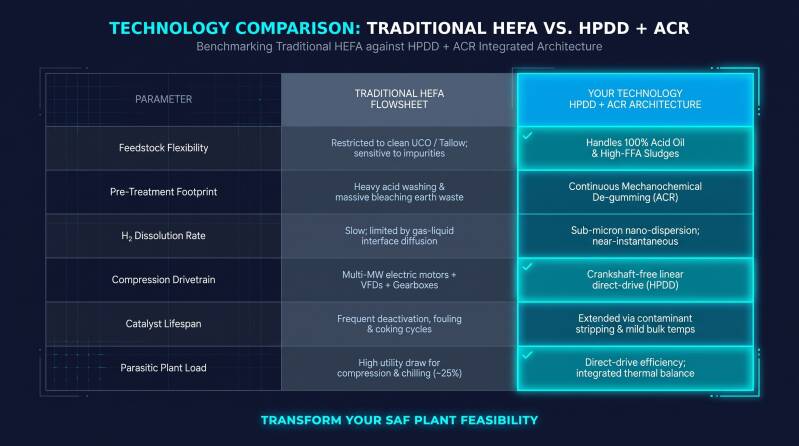
Sustainable Aviation Fuel (SAF) Production Comparison
Benchmarking Traditional HEFA against HPDD + ACR Integrated Architecture
| Parameter | Traditional HEFA Flowsheet | HPDD + ACR Architecture |
|---|---|---|
| Feedstock Flexibility | Restricted to clean UCO / Tallow; sensitive to impurities | Handles 100% Acid Oil & High-FFA Sludges |
| Pre-Treatment Footprint | Heavy acid washing & massive bleaching earth waste | Continuous Mechanochemical De-gumming (ACR) |
| H2 Dissolution Rate | Slow; limited by gas-liquid interface diffusion | Sub-micron nano-dispersion; near-instantaneous |
| Compression Drivetrain | Multi-MW electric motors + VFDs + Gearboxes | Crankshaft-free linear direct-drive (HPDD) |
| Catalyst Lifespan | Frequent deactivation, fouling & coking cycles | Extended via contaminant stripping & mild bulk temps |
| Parasitic Plant Load | High utility draw for compression & chilling (~25%) | Direct-drive efficiency; integrated thermal balance |