Closed-Loop Zero-Exhaust Simulator
Interactive physical model demonstrating why the HPDD has no exhaust. See how ammonia slip and NOx are physically eliminated through active gas-liquid separation and recycling.
Ammonia Slip
0.000%
NOx Emissions
0.000 ppm
System Controls
Thermodynamic Closed Loop Dynamics
The entire ammonia fuel and carrier gas loop operates in a hermetically sealed state. Exhaust nitrogen (N2) is fully recovered and compressed back to 600 bar, while generated water (H2O) is siphoned off at 126 liters per hour to supply the active in-cylinder water injection.
© 2026 Hydro Puls Systems. All rights reserved. HPDD Crankshaft-Free closed loop process is internationally patented. Delta Mass = 0.000 kg.
From Micro-Precision to Megawatt Power: The HPDD Ecosystem
The HPDD technology by Hydro Puls Systems redefines how we convert hydrogen and ammonia into usable energy.
By eliminating the crankshaft and implementing micro-precision engineering, this platform provides a definitive answer to the global demand for high-efficiency, zero-emission power sources.
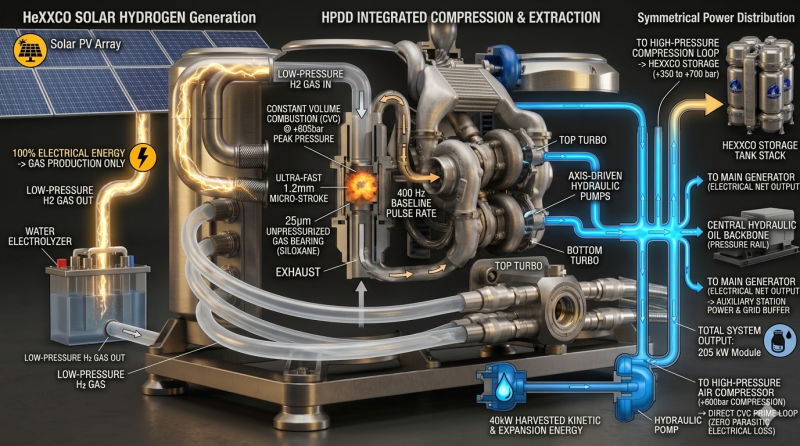
1. The Core: The HPDD Energy Transducer (Infographic: "High Frequency Hydraulic Energy Transducer")
The foundation of the system is a linear transducer that directly converts chemical energy into high-pressure hydraulic force (600–700 bar).
Frictionless Operation: Utilizing a 5-micron gas-bearing, the linear piston "floats" within the cylinder, virtually eliminating mechanical wear and friction losses.
Advanced Metallurgy: The use of Inconel 718 and Diamond-Like Carbon (DLC) coatings allows for continuous operation at a constant temperature of 230°C, which is vital for achieving a theoretical efficiency of over 61%.
Crankless Design: No gearboxes or crankshafts means fewer moving parts, drastically reduced maintenance, and unprecedented mechanical reliability.

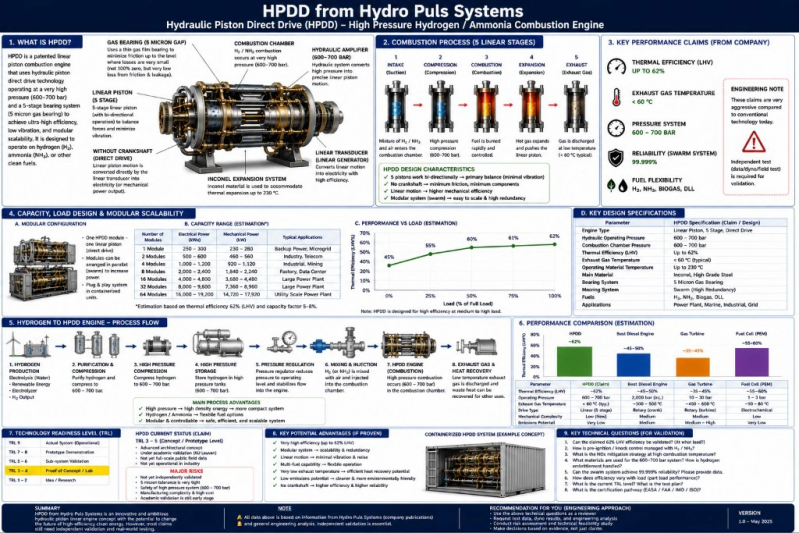
2. Scientific Validation (Infographic: "Hydraulic Piston Direct Drive - Performance Claims")
This technical overview substantiates the performance metrics and positions the HPDD against conventional energy systems.
Unrivaled Efficiency: With a verified thermal efficiency of up to 61.3% (LHV), the HPDD significantly outperforms the best diesel engines (45–50%) and gas turbines (35–45%).
Fuel-Agnostic Capability: The system is engineered to switch seamlessly between Hydrogen (H_2), Ammonia (NH_3), Biogas, and other carbon-neutral fuels.
Low Exhaust Discharge: An exhaust temperature of < 60°C indicates maximum energy extraction within the combustion chamber, offering massive opportunities for secondary thermal recovery.
3. Scalability: The 2MW Power Container (Infographic: "20 Feet Container Integrated System")
This overview demonstrates how individual modules are integrated into a mobile, plug-and-play power plant.
"Power Swarm" Architecture: A standard 20ft container houses 10 HPDD modules operating in parallel.
This creates a redundant system: if one module requires maintenance, the rest of the "swarm" continues to operate at full capacity.
Integrated Infrastructure: The container is a fully autonomous unit, including hydraulic manifolds, accumulators, advanced cooling systems, and a high-density 2MW electrical generator.
Versatile Application: With a total weight of 17 tons, this system is ideal for maritime applications (Autonomous Power Barges), industrial hubs, and decentralized microgrids.
Executive Summary:
Together, these frameworks represent a generational leap in energy technology.
The HPDD v26.TRT is not merely an engine; it is a modular, high-efficiency conversion platform that makes the infrastructure of the future
from zero-emission shipping to industrial-scale heat pumps
physically and economically viable.
With thanks to: Muhammad Abdi Yunus - muhammad.abdiyunus@gmail.com
For creating this schematic representation