HPDD Waterless Fracking
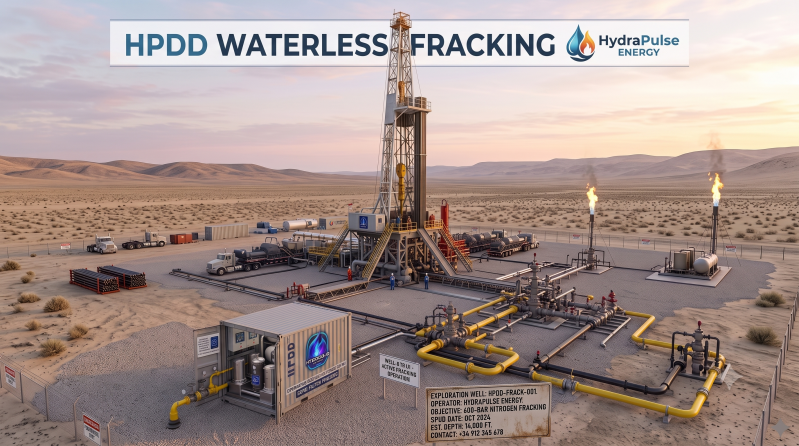
Hydro Puls Systems Unveils Waterless 600-Bar Nitrogen Fracking Platform:
A Breakthrough in Eco-Friendly Geothermal and Gas Recovery
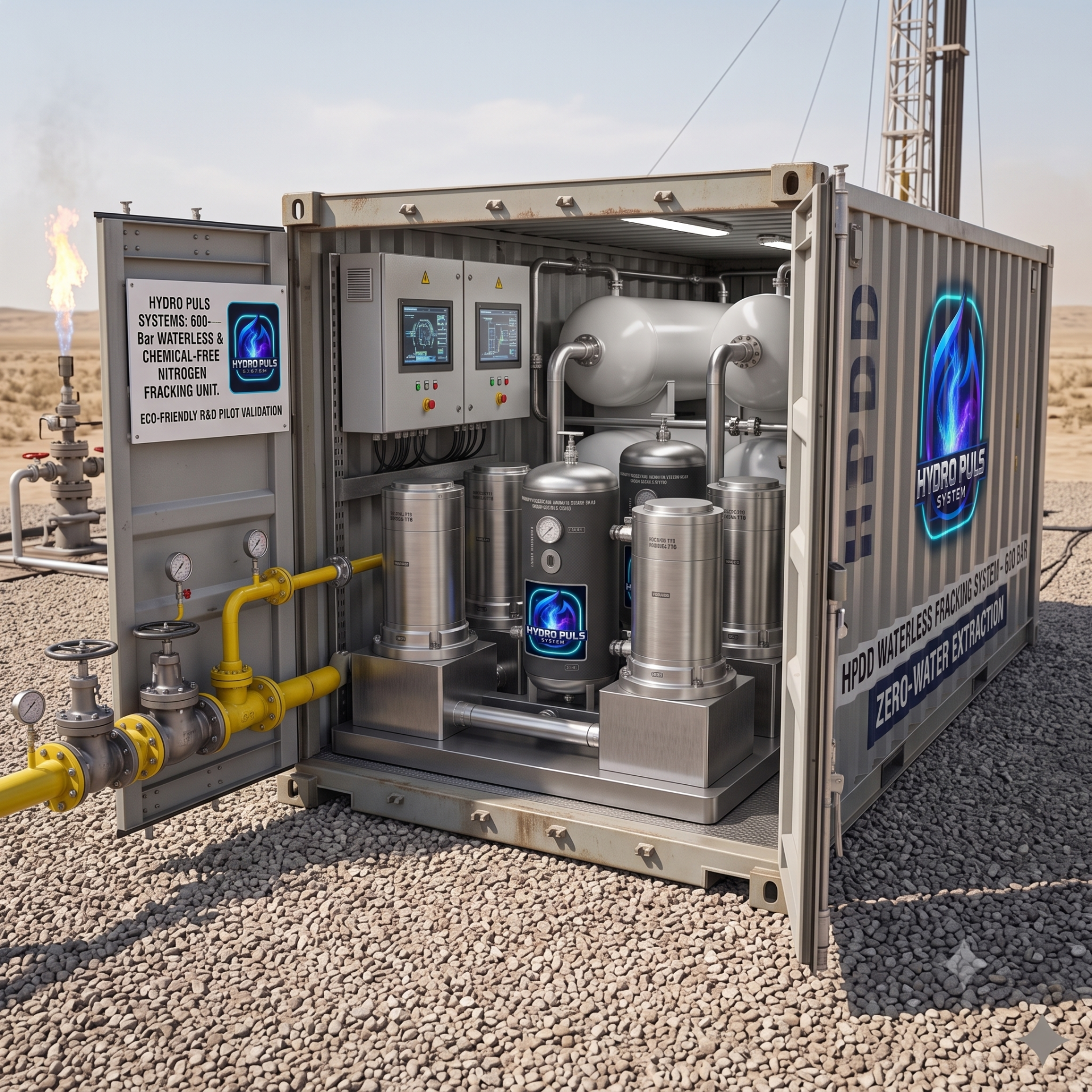
Hydro Puls Systems, today announced a major R&D milestone in sustainable subsurface engineering: the adaptation of its core 600-bar Hydro Puls Direct-Drive for Waterless & Chemical-Free Nitrogen Fracturing.
By deploying a closed-loop, supercritical nitrogen stream at 600 bar, this new R&D framework provides a clean, zero-water alternative to conventional hydraulic fracturing, eliminating environmental liabilities while unlocking vast reserves in water-scarce regions.
Solving the Environmental and Operational Bottlenecks of Fracking
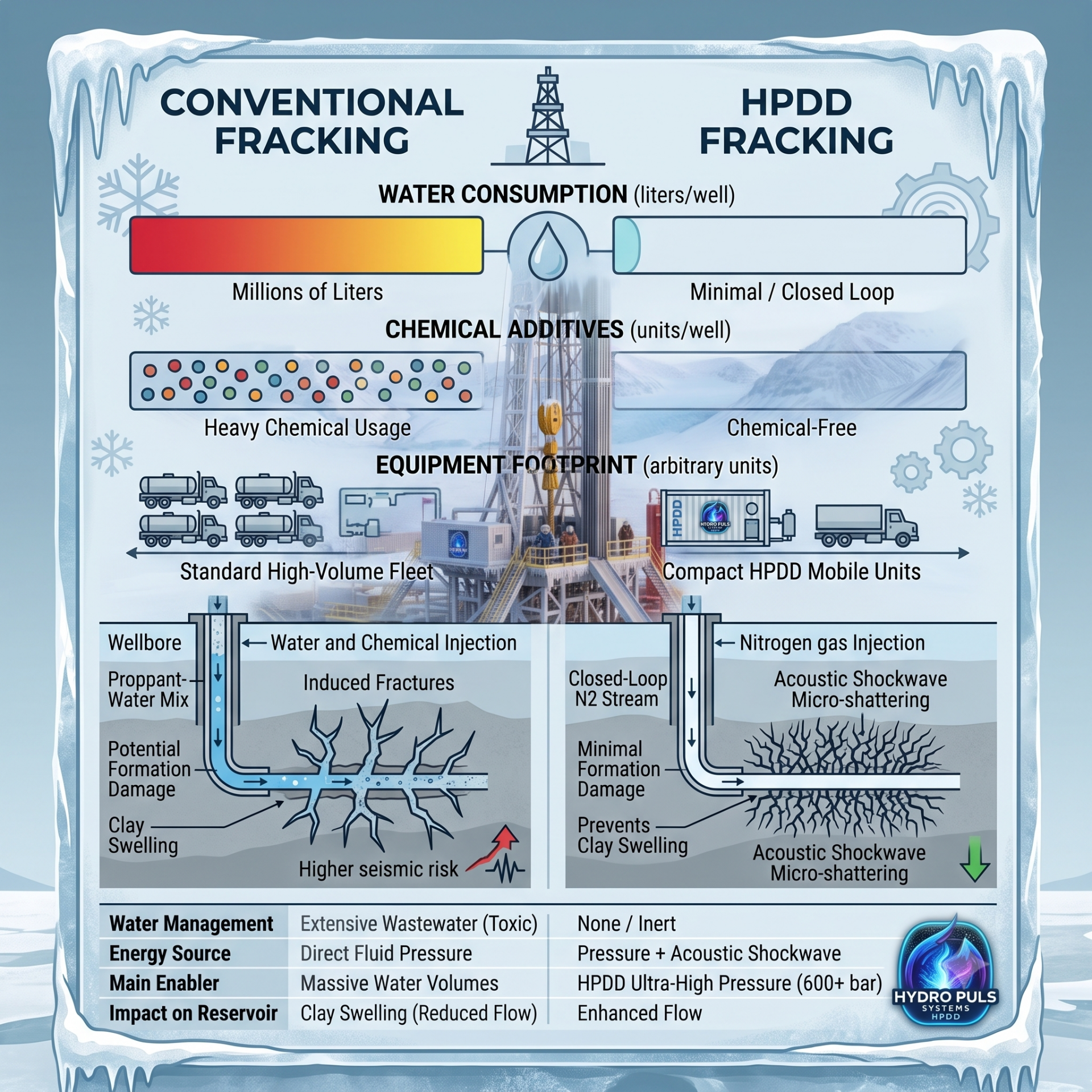
Traditional hydraulic fracturing consumes millions of gallons of fresh water per well and relies on chemical additives that pose significant environmental risks.
Furthermore, heavy proppant-laden fluids cause catastrophic mechanical wear on conventional pump equipment, driving up operational expenditure (OPEX).
💧 100% Water-Free Execution: Utilizes high-pressure inert nitrogen gas, eliminating fresh water consumption and the need for toxic flowback wastewater management.
⚡ Acoustic & Decompression Shockwaves: Combines 600-bar fluid pressure with acoustic shockwaves generated by the direct-drive matrix, micro-shattering hard rock and granite without chemical solvents.
🟢 Zero Equipment Degradation: By replacing metal-to-metal contact with nitrogen gas-film bearings and a frictionless isotherm core, the HPDD pump core operates with zero mechanical wear, even under continuous high-pressure pulsing.
📈 Preventing Clay Swelling: Unlike water-based fluids, pure nitrogen prevents subsurface clay swelling and formation damage, resulting in significantly higher well yield and faster gas/geothermal flow recovery.
Extending Impact to Enhanced Geothermal Systems (EGS)
Beyond conventional energy recovery, this R&D breakthrough serves as a vital enabler for Enhanced Geothermal Systems (EGS) and subsurface hydrogen/CO₂ storage.
The HPDD can shatter deep crystalline rock formations to create clean heat-exchange networks without triggering the seismic risks or environmental contamination associated with massive water injection.
"The energy sector no longer has to choose between environmental responsibility and high-yield subsurface extraction.
Commercial & Pilot Integration
Hydro Puls Systems is currently finalizing pilot validation models and technical integration dossiers for Tier-1 energy operators, geothermal developers, and EPCM partners looking to retrofit existing well pad infrastructure.
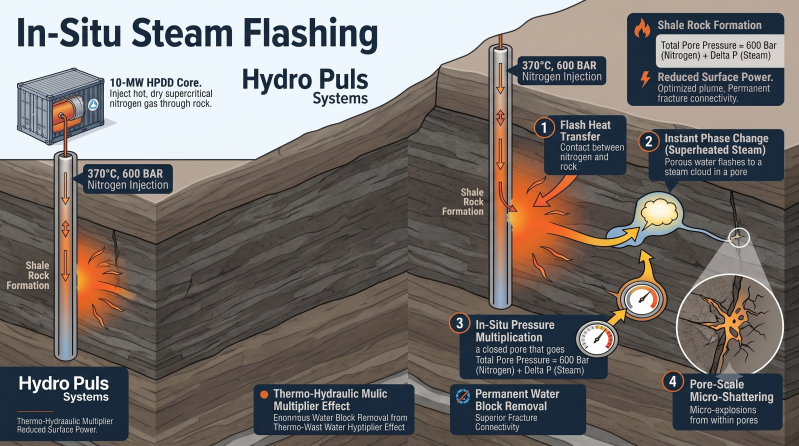
In-Situ Steam Flashing: The Thermo-Hydraulic Multiplier of HPDD
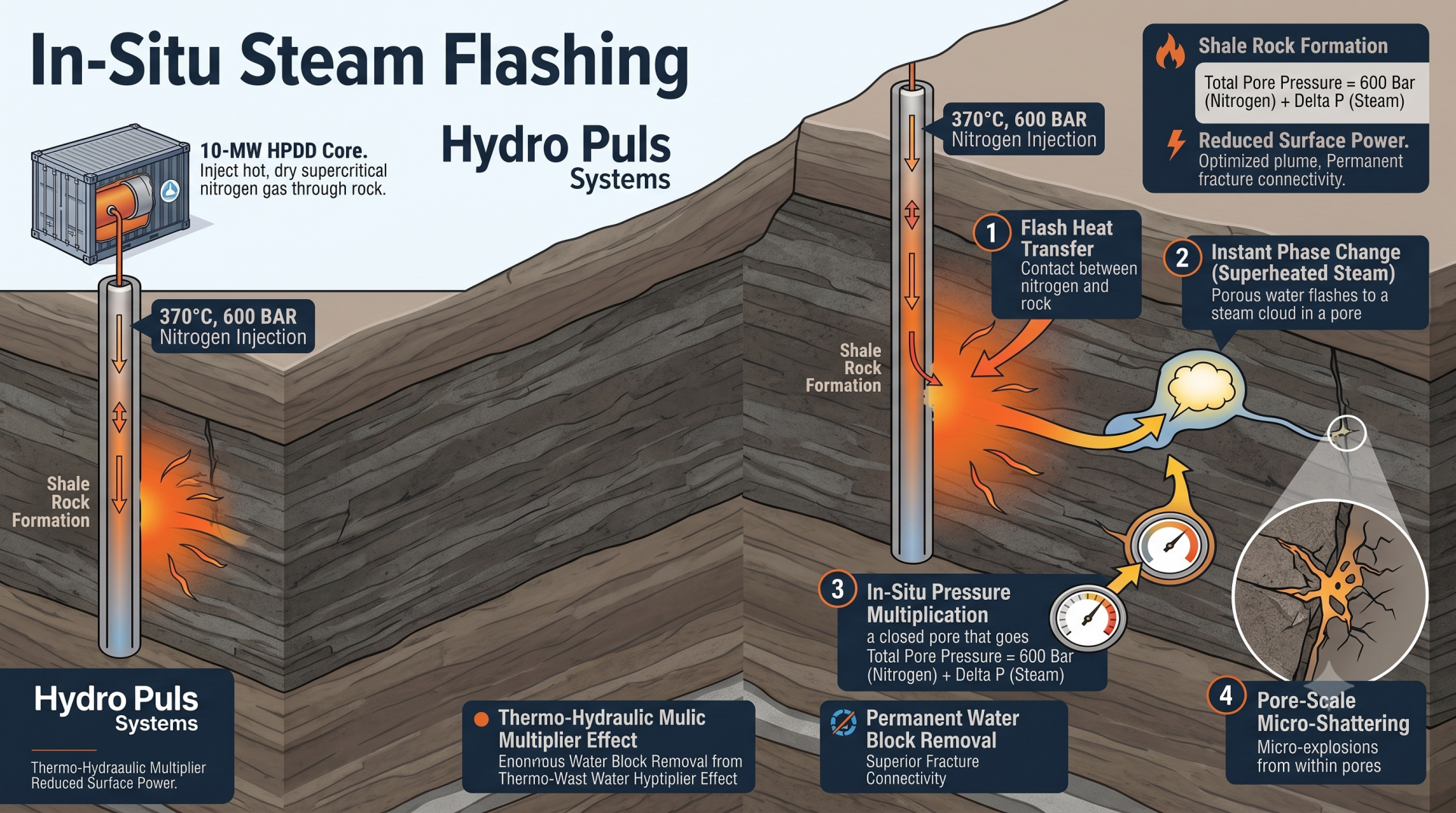
When dry, supercritical nitrogen is injected into shale formations at 370°C and 600 bar, it triggers a powerful secondary physical mechanism: In-Situ Thermal Decompression and Phase-Change Expansion.
This phenomenon turns the reservoir's native water into a mechanical asset, dramatically amplifying fracturing efficiency beyond the initial surface pump pressure.
How the Mechanism Works
- Flash Heat Transfer: Shale formations natively contain trapped pore water and capillary fluids. Upon contact with the 370°C nitrogen stream, extreme thermal energy is transferred to the fluid within milliseconds.
- Instant Phase Change (Superheated Steam): Under these extreme thermodynamic conditions, the confined pore water instantly flashes into superheated steam.
- In-Situ Pressure Multiplication: Because the rock matrix acts as a confined volume, the massive expansion force of steam cannot immediately dissipate. This generates a localized secondary pressure surge that stacks directly on top of the 600-bar baseline, driving the total pore pressure well above 600 bar.
- Pore-Scale Micro-Shattering: While conventional hydraulic fracturing relies solely on external fluid force to wedge rock open, this localized steam expansion creates micro-explosions from within the pore network itself, shattering the rock matrix at the microscopic level.
Strategic & Economic Advantages
- Reduced Surface Energy Demand: By leveraging the thermal energy transferred to native pore water, the HPDD system achieves deeper rock displacement without requiring higher mechanical pressure from the surface skid.
- Enhanced Permeability: Vaporizing and driving out native pore fluids cleanses the matrix pathways, eliminating water blockages and permanently boosting gas permeability.
- Superior Fracture Networks: The synergy between HPDD acoustic shockwaves, 600-bar nitrogen kinetics, and internal steam expansion produces a highly complex, interconnected micro-fracture network for maximum long-term well yield.
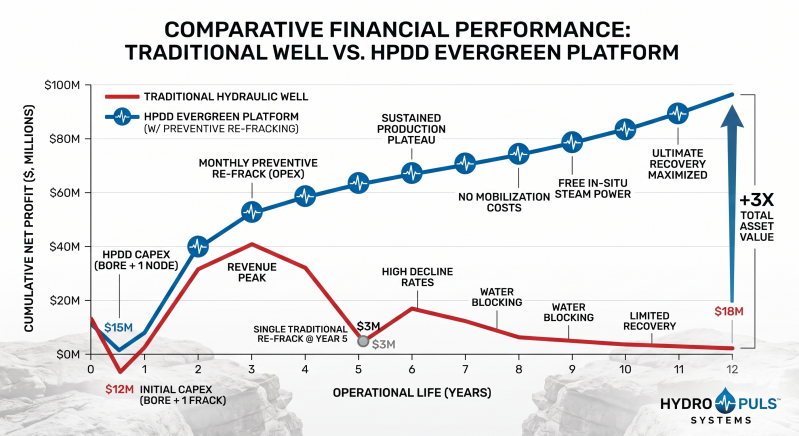
Preventive Re-Fracking with HPDD: From Steep Decline Curves to an Evergreen Reservoir
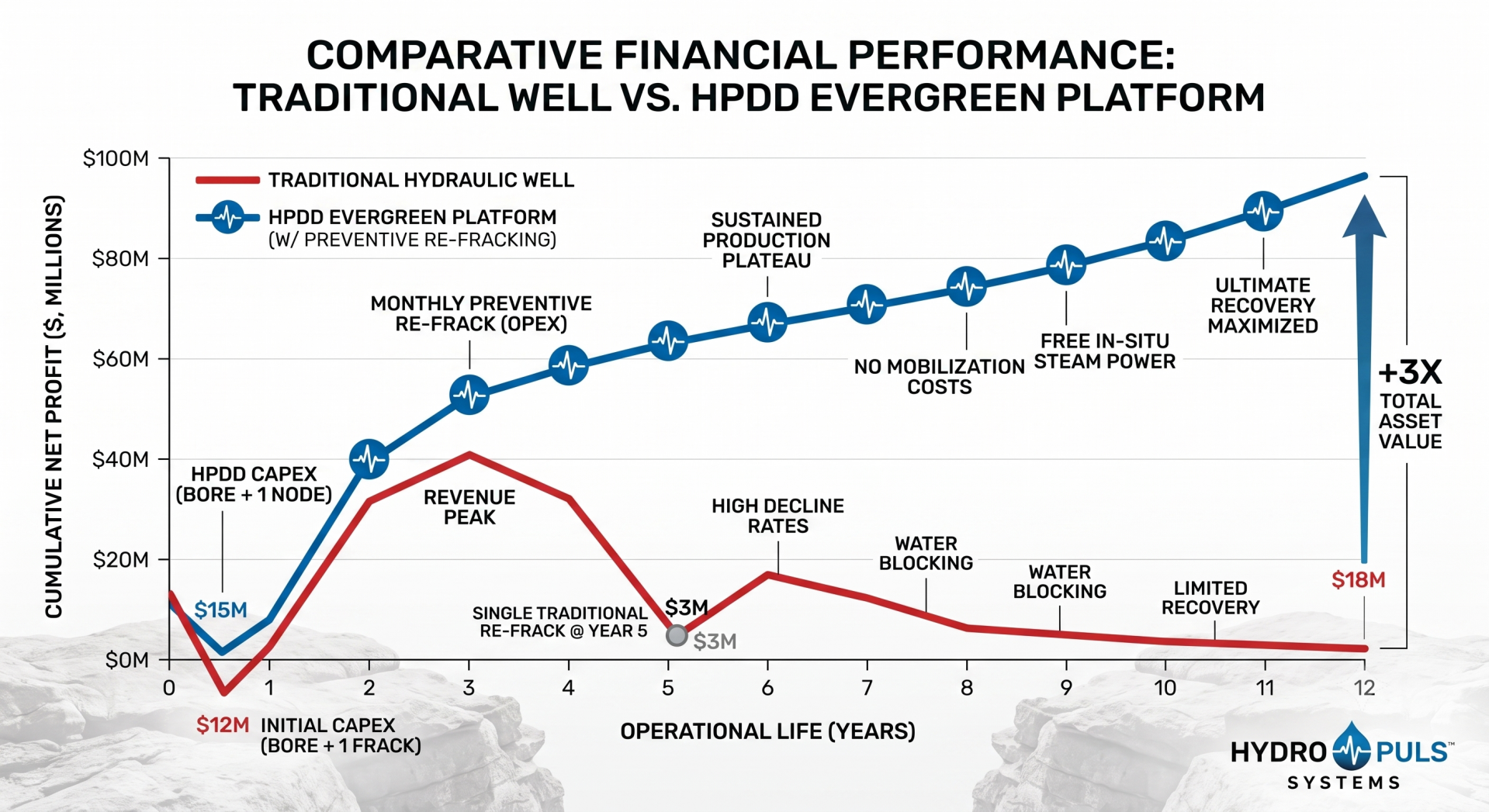
In the conventional shale industry, the infamous decline curve is an accepted reality. A traditional well starts with a high initial flow rate but experiences a steep drop within 12 to 24 months. This rapid decline occurs not because the gas is depleted, but because the micro-fractures close up, formation clay swells, and injected water blocks the pores (water locking). As a result, the Ultimate Recovery Factor (URF) of a traditional shale well remains capped at a low 10% to 15%.
Re-fracking with conventional hydraulic fleets is financially and logistically unviable on a frequent basis. Mobilizing dozens of heavy diesel trucks, hundreds of tons of proppants, and millions of gallons of water costs millions of dollars per intervention.
The HPDD Breakthrough: Continuous Reservoir Optimization
The modular Hydro Puls Direct-Drive (HPDD) architecture transforms this paradigm entirely. Because the HPDD node remains permanently stationed on the wellpad as a mobile, multi-functional unit, 'fracking' shifts from an expensive, disruptive, one-off construction project into an automated, preventive maintenance loop.
How Preventive Re-Fracking Works:
- Zero Mobilization Costs: Because the HPDD unit is already on-site handling flowback processing, power generation, or local hydrogen/ammonia synthesis, the mobilization cost to initiate a re-frack is zero.
- Short, Frequent Stimulations: Instead of waiting years for production to collapse, the system executes short, preventive injection cycles—on a monthly or quarterly schedule.
- In-Situ Steam Flashing: The HPDD core injects dry nitrogen at full pressure ($600\text{ bar}$) and temperature ($370^\circ\text{C}$). This instantly vaporizes native pore water. The resulting rapid volumetric steam expansion micro-shatters the rock matrix directly from within the pores.
- Permanently Clean Pore Networks: Operating entirely waterless and chemical-free, the hot nitrogen stream continuously dries out the micro-channels, eliminating water blockages and maintaining permeability at peak levels.
Commercial Impact for Field Operators
- Sustained Production Plateau: Eliminates sharp decline curves, securing a stable, predictable, and long-term production flow.
- Drastic CAPEX Reduction: Significantly reduces the need for expensive infill drilling ($6M to $10M per new well) to maintain overall field production targets.
- 3x Asset Valuation: Increasing the reservoir's recovery factor from 15% to 35–40% doubles or triples the balance-sheet valuation of proven reserves (P1/P2).
The HPDD platform turns every shale well into an Evergreen Asset, delivering a long-life, highly profitable energy source with a minimal surface footprint.