Brine desalination
Brine Desalination: Transforming Waste Streams into Valuable Minerals and Fresh Water
Global demand for fresh water is accelerating, yet conventional seawater reverse osmosis (SWRO) faces a severe ecological and operational bottleneck: the disposal of concentrated brine. For every liter of potable water produced, standard desalination plants generate an average of 1.0 to 1.5 liters of hypersaline reject brine.
Discharging this hypersaline effluent back into sensitive coastal ecosystems causes local benthic hypoxia, thermal disruption, and toxic biocide accumulation. Consequently, moving toward Minimal Liquid Discharge (MLD) and Zero Liquid Discharge (ZLD) is no longer an optional sustainability goal—it is a binding regulatory and commercial requirement for industrial operators.
Treating hyper-concentrated brine, however, demands an entirely different operating pressure envelope and thermal balance than baseline seawater desalination.
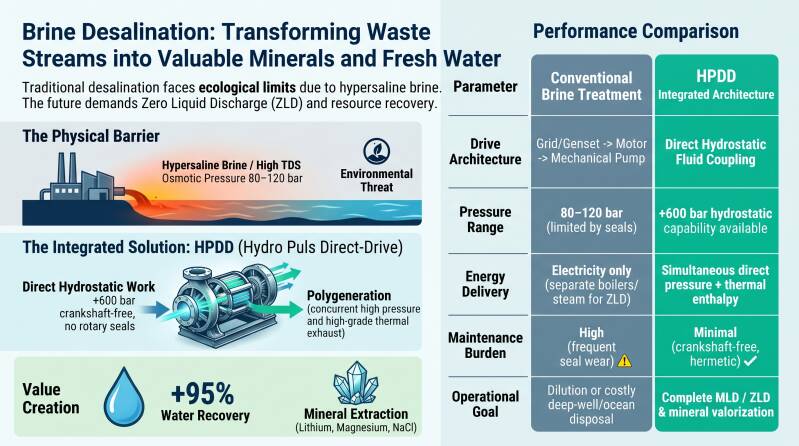
The Physical Barrier: Extreme Osmotic Pressure
Standard seawater typically carries a total dissolved solids (TDS) level of roughly 35,000 ppm, requiring operating feed pressures between 60 and 70 bar. As brine concentration escalates toward 70,000 to over 150,000 ppm TDS, the osmotic back-pressure escalates exponentially:
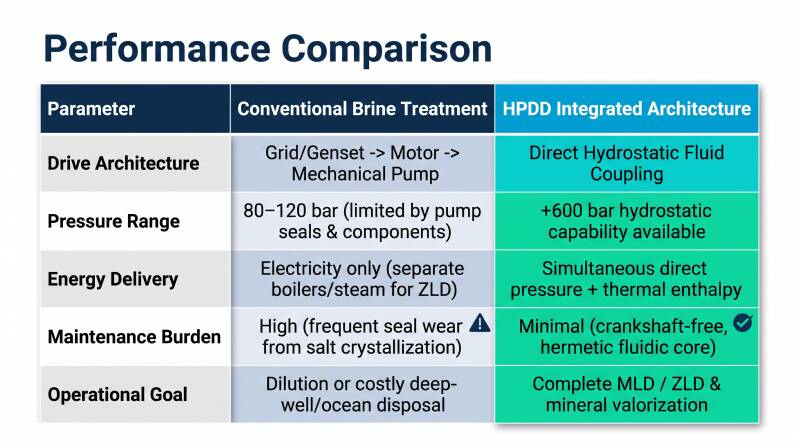
• Conventional Membrane Limits: Standard composite polyamide membranes and multi-stage centrifugal pumps hit mechanical safety limits around 80 to 85 bar.
• Ultra-High Pressures Required: Forcing water through Ultra-High-Pressure Reverse Osmosis (UHP-RO) modules to dewater dense brine requires working pressures of 120 to well over 200 bar.
• Thermal Energy Penalties: Final thermal crystallization (brine concentrators and crystallizers) demands intensive thermal energy (tens of kilowatt-hours per cubic meter), making standalone ZLD economically unviable without directly coupled process heat.
The Integrated Solution: Hydro Puls Direct-Drive (HPDD)
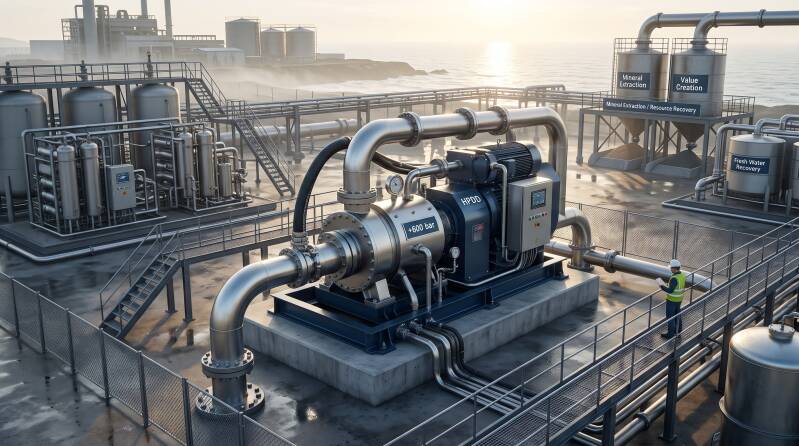
The Hydro Puls Direct-Drive (HPDD) architecture bypasses the operational bottlenecks of brine treatment by directly pairing high-density hydrostatic force with integrated thermal energy generation.
1. Direct Hydrostatic Work Without Intermediate Electrical Losses
Legacy high-pressure pumping depends on an inefficient conversion train: fuel/thermal energy -> rotating shaft -> electrical generator -> variable-frequency drive -> electric motor -> high-pressure positive displacement pump.
• The HPDD core generates continuous hydrostatic force directly (+600 bar rated capability), supplying UHP-RO membrane skids and high-pressure nanofiltration loops directly without intermediate motor stages.
• Bypassing mechanical-to-electrical-to-mechanical conversion stages slashes parasitic loads, dramatically lowering the specific energy consumption (kWh/m3) of deep brine concentration.
2. Polygeneration: Concurrent Pressure and Thermal Enthalpy
Achieving true ZLD requires both mechanical force (for membrane pre-concentration) and thermal enthalpy (for the final crystallization phase):
• HPDD supplies high-pressure fluid drive and high-grade thermal exhaust concurrently, powering membrane separation stages and thermal crystallizer circuits from a single modular prime mover.
• High-purity process water is generated directly as an operational synthesis by-product within the isolated combustion core, contributing positively to net facility water recovery.
3. Seal-Less Reliability Under Harsh Saline Environments
Hyper-concentrated brine is notoriously aggressive toward dynamic mechanical seals, packing glands, and rotating pump shafts:
• The crankshaft-free, hermetically isolated design of HPDD eliminates dynamic rotary shaft seals, removing the primary leakage and crystallized-salt abrasion failure points.
• Symmetrical thermal management across high-temperature Inconel alloys ensures operational fluidic clearances remain balanced under extreme differential pressure, eliminating mechanical binding and wear.
Value Creation: Unlocking "Brine Mining"
Pairing high hydrostatic pressure with thermal efficiency shifts brine management from a disposal cost into a commercial resource stream:
• Maximum Water Recovery: Exceeds 90–95% net water recovery from high-TDS industrial effluents and concentrated desalination reject streams.
• Mineral Extraction: Enables cost-effective selective recovery of high-value commodities, including lithium, magnesium salts, calcium sulfate (gypsum), and industrial-grade sodium chloride (NaCl).
• Closed-Loop Flexibility: Eliminates coastal marine outfall reliance, allowing desalination and heavy chemical processing facilities to operate inland under strict zero-discharge permits.