HPDD Acoustic Cavitation Reactor

This application is in collaboration with Professor Mohamed Amin - Associate Professor at Al-Azhar University , Rutgers University, USA, University of Debrecen, Hungary.
His knowledge and experience in these fields has led to this discovery and application.
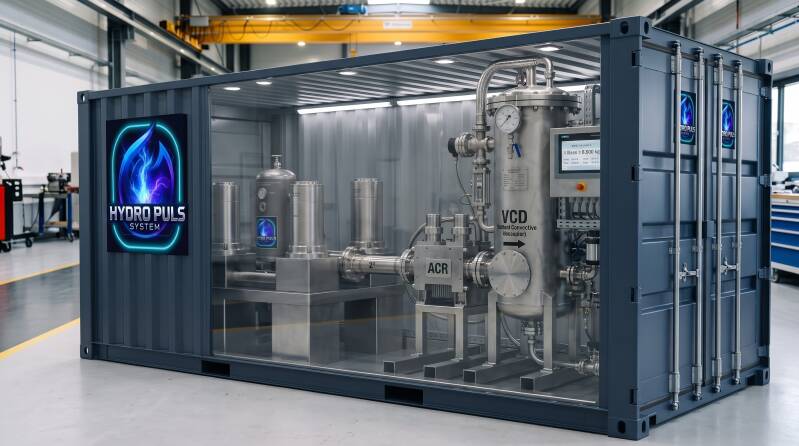
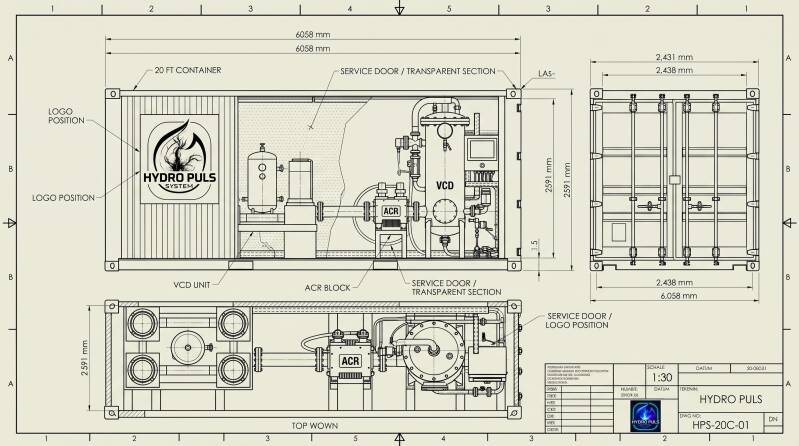
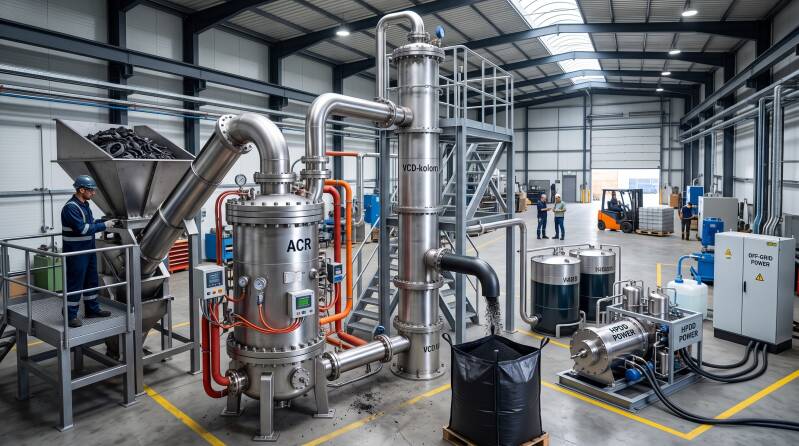
The Acoustic Cavitation Reactor (ACR) is a motionless, continuous-flow intensification unit that replaces conventional high-pressure pumps, heating boilers, and mechanical agitators with fluid dynamics and sonochemistry.
How it works in the HPDD setup:
1. Supersonic Jet Expansion:
High-pressure, inert nitrogen from the HPDD expands through a convergent-divergent De Laval nozzle, converting static pressure into a supersonic gas stream.
2. Bernoulli Suction (Zero Moving Parts):
The extreme gas velocity drops static pressure below atmospheric at the nozzle throat, passively entraining heavy, abrasive slurries (such as black liquor or distillery spent wash) directly into the stream without high-pressure slurry pumps or dynamic packing.
3. Acoustic & Hydrodynamic Cavitation:
As the supersonic jet collides with the entrained liquid, violent shockwaves trigger micro-bubble cavitation. When these micro-bubbles collapse in nanoseconds, they create localized extreme temperatures and ultrasonic micro-jets. This mechanically shears and sonochemically cracks complex lignin, tar, and organic chains into syngas, hydrogen, and clean intermediates at moderate bulk temperatures.
4. Direct Separation:
The aerosolized, sonochemically reacted stream discharges straight into a Vertical Convective Decoupler (VCD) for instantaneous phase separation, floating light gases (H₂/syngas/N₂) and dropping concentrated mineral salts (sodium/potassium salts) for chemical recovery.
🌐 Sovereign Infrastructure, Global Health, & the HPDD Acoustic Cavitation Reactor (ACR) 🚜🧬
Developed alongside Prof. Dr. Mohamed Amin, the Hydro Puls Direct-Drive (HPDD) platform achieves what was previously deemed impossible on a commercial scale: the absolute molecular destruction of per- and polyfluoroalkyl substances (PFAS) and microplastics natively at the source.
Instead of filtering and concentrating "forever chemicals" onto membranes that must be buried, the HPDD core uses extreme process intensification to rip toxic atomic bonds apart mid-air, converting dangerous pollutants into safe, tradable minerals.
🚨 The Global PFAS Crisis
PFAS and microplastics are detected in global rainfall, agricultural soils, and 99% of human blood. Because the Carbon-Fluorine (C-F) bond is the strongest single bond in organic chemistry, these compounds do not degrade, causing bioaccumulation and regulatory gridlock. Traditional multi-billion-dollar filtration merely transfers the poison from one tank to another.
The HPDD Acoustic Cavitation Reactor resolves this by replacing filters with an automated, single-stage, non-equilibrium supercritical fluid loop processing 240,000 kg of daily mass throughput under a perfect mass lock (Delta Mass = 0.000 kg).
⚡ The 3-Step Atomic Dissociation
-
Supersonic Shock Cleavage (600 bar / 1,000°C): Contaminated water is cross-injected into a superheated Nitrogen carrier loop accelerated past Mach 2.5 through custom ceramic De Laval nozzles. Acoustic decompression shockwaves flash-explode the fluid in milliseconds, utilizing kinetic shear force to snap C-F molecular bonds mid-air before scaling can form on the metals.
-
Supercritical Fluorine Sinking (230 bar / 330°C): The dissociated gasses ascend into vertical convective separation columns under strict Supercritical Vapor-Liquid Equilibrium (VLE) parameters. Released Fluorine ions are natively cross-reacted with calcium stabilizers, dropping out as safe, inert crystalline Calcium Fluoride (CaF2) minerals, while pure water vapor density-decouples.
-
Cold Collapse & Pure Distilled Siphon: Water vapor enters our active Rankine condenser, triggering a phase-collapse down to sub-60°C that creates a near-vacuum, dropping auxiliary pump loads to 1% to 2% and yielding 4,158 L/h of ultra-pure process water completely cleared of toxic molecular traits.
💰 The 24-Hour Sovereign Ledger (Per 10-MW Node)
- Clean, PFAS-Free Distilled Water: 99.8 Metric Tons
- Inert Commercial Calcium Fluoride Minerals: 120 kg
- Non-Hazardous Elemental Carbon Powder: 45 kg
- Toxic Sludge Retainers / Environmental Penalties: Zero / 100% Eliminated
🚀 Transitioning from TRL 5 to TRL 6
Fully validated via aerospace-grade transient Digital Twin simulations, this configuration proves the global water crisis can be solved through software-defined atomic manipulation. DM us to review our environmental remediation data rooms.
#PFAS #ForeverChemicals #ZeroLiquidDischarge #ProcessIntensification #Thermodynamics #GlobalHealth #NobelPrize #HPDDNexus
Molecular Eraser Simulator
Scientific real-time visualization of the atomic destruction of PFAS (strong C-F bonds).
System Controls
Thermodynamic Dissociation Dynamics
In this zone, nitrogen expands through the ceramic de Laval nozzle to Mach 2.5+. This generates high-frequency acoustic decompression shockwaves that flash-explode the liquid matrix and physically rip the strong C-F bonds apart mid-air.
© 2026 Hydro Puls Systems. All rights reserved. The HPDD Molecular Eraser is protected by international patents. Mass Balance lock: Delta Mass = 0.000 kg.