From gas to clean water
HPDD v26: Autonomous Industrial Desalination & Clean Energy
Transforming Natural Gas into Zero-Emission Fresh Water, Export-Grade Ammonia, and Net Power
The Paradigm Shift in Water Security
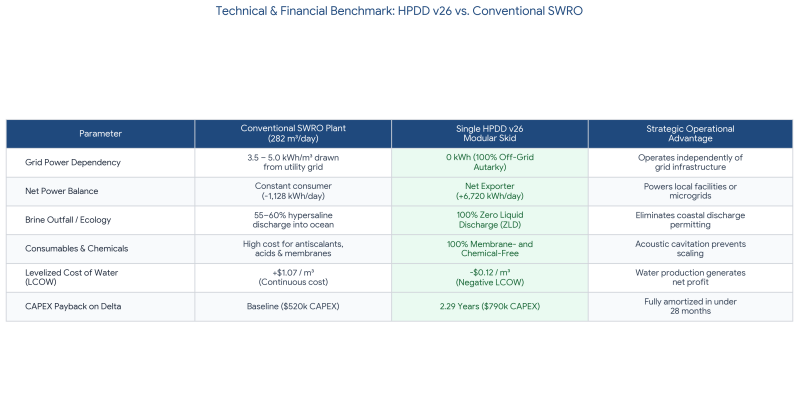
Traditional Seawater Reverse Osmosis (SWRO) operates as an unsustainable cost center: it consumes massive amounts of electricity from strained utility grids, relies on fragile membranes requiring toxic chemical flushes, and discharges hypersaline brine that threatens coastal marine ecosystems.
The Hydro Puls Direct-Drive (HPDD v26) platform redefines industrial desalination. Operating directly from abundant local natural gas with 63% net thermal efficiency, a single containerized HPDD skid converts raw hydrocarbons into clean ammonia fuel on-site, driving desalination at a negative Levelized Cost of Water (-$0.12/m³) with True Zero Liquid Discharge (ZLD).
How It Works: The Closed-Loop Architecture
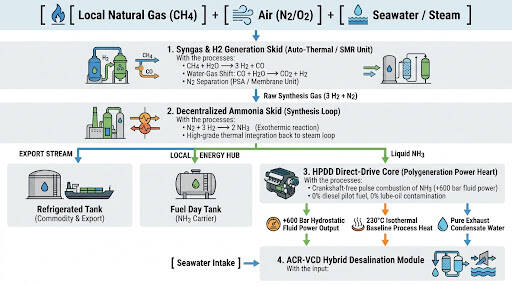
[ Natural Gas (CH4) + Air + Seawater ]
│
▼
1. On-Skid SMR/PSA Reforming ──> Concentrated CO2 Capture (Zero Venting)
│
▼
2. Catalytic Ammonia Synthesis (NH3) ──> [ Dual Offtake: Export / Power ]
│
▼
3. HPDD Direct-Drive Pulse Core (+600 Bar Hydrostatic Power & 230°C Heat)
│
▼
4. ACR-VCD Desalination Skid (Acoustic Cavitation & Vapor Compression)
│
▼
[ 282,000+ L/day Pure Water ] + [ 9.77 t/day Dry Salt ] + [ +6,720 kWh/day Net Power ]
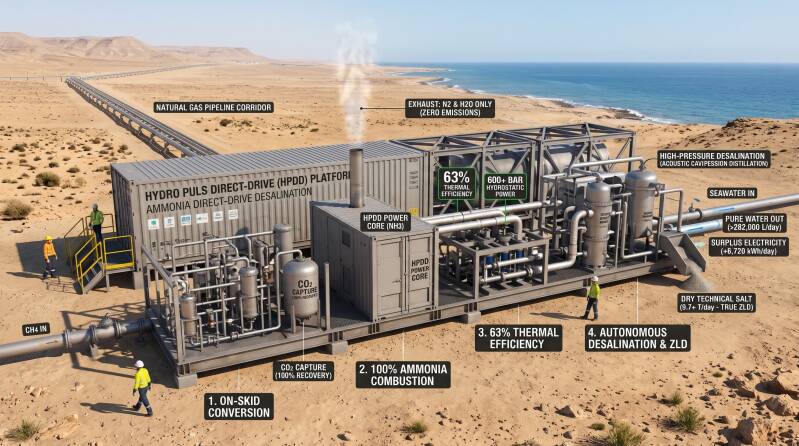
1. On-Skid Reforming & Ammonia Synthesis: Natural gas is reformed locally into hydrogen and synthesized with atmospheric nitrogen into anhydrous ammonia (NH3). The concentrated CO2 slipstream is captured directly at the source, preventing atmospheric release.
2. Crankshaft-Free Pulse Combustion: The HPDD core operates directly on synthesized ammonia without diesel pilot fuel or engine lube oil. The reaction produces only nitrogen and water vapor.
3. Direct Hydrostatic & Thermal Coupling: Chemical energy is converted directly into +600 bar fluid power and 230°C closed-loop thermal baseline, bypassing mechanical crankshafts, gearboxes, and electrical conversion losses.
4. Acoustic Cavitation & Distillation: High-energy acoustic pulses disrupt ionic lattices to eliminate scaling, while mechanical vapor compression (VCD) processes seawater into ultra-pure water and crystallized minerals.
1 Standard HPDD v26 Skid: Daily Deliverables
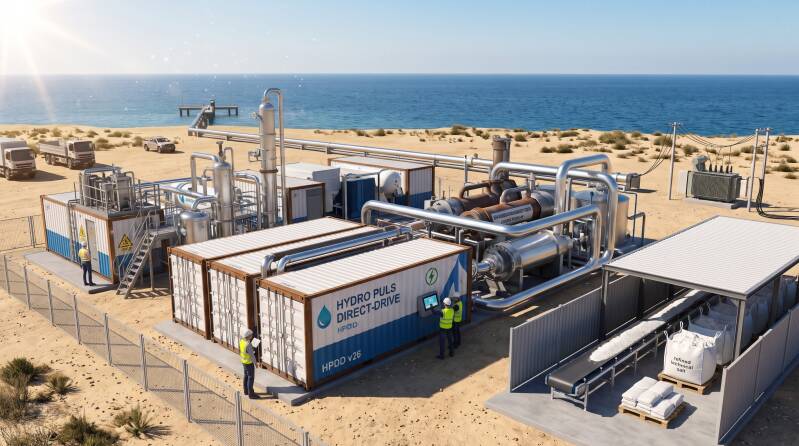
Every modular 40-foot containerized unit functions as an autonomous polygeneration hub:
• Dual-Stream Fresh Water Yield: 282,199 Liters / Day (~282.2 m³/day)
- Marine Distillate (ACR-VCD): 279,175 L/day
- Distilled Combustion Reaction Condensate: 3,024 L/day
• Mineral Valorization (ZLD): 9,771 kg / Day (~9.77 Metric Tons/day)
- Dry, high-purity industrial-grade salt for chlor-alkali or chemical applications. Zero brine dumped into coastal waters.
• Net Clean Electricity Export: +6,720 kWh / Day
- Generates 6,960 kWh/day against a 240 kWh/day internal pumping parasitic load, exporting firm surplus power to adjacent facilities or local microgrids.
• Industrial Nitrogen: 11,167 kg/day pure N2 (at 1 bar).
Strategic Value for Gas-Rich Coastal Regions
• Value-Added Gas Monetization: Converts low-value pipeline gas into high-value potable water, exportable green ammonia, and refined commercial salts.
• Rapid Deployment & Autarky: Avoids multi-year grid-interconnect queues. Ideal for remote coastal gas hubs, industrial zones, and coastal agricultural developments.
• Fouling-Immune Operation: Completely unbothered by algal blooms (red tides), heavy silt, or hydrocarbon traces that regularly shut down conventional RO membranes.
• Modular Swarm Scalability: Start with a single skid pilot and scale linearly to municipal or mega-industrial scale by adding standardized modules in parallel.
Ready to Deploy Autonomous Water Sovereignty?
Explore our engineering mass balances, download the full financial model, or schedule a technical briefing with our systems engineering team.
Hydro Puls Direct-Drive Systems — Autonomous, High-Efficiency Industrial Infrastructure.