

Mississippi River
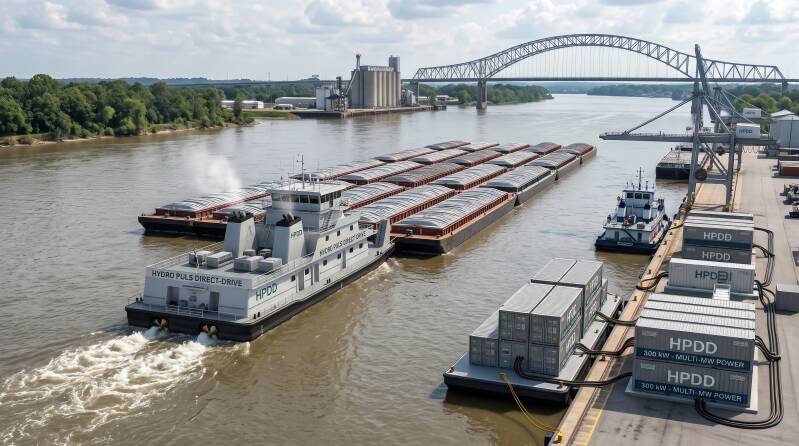
MISSISSIPPI RIVER BASIN & INLAND MARITIME PROPULSION
Decarbonizing High-Torque Commercial Towboats, Quayside Logistics, and Resilient River Municipalities
The Mississippi River Basin is the commercial circulatory system of North America. Transporting more than 500 million tons of essential cargo annually, including 60% of US grain exports, key industrial petrochemicals, and bulk agricultural inputs—the waterway is a cornerstone of global supply chain efficiency.
However, operating along this massive natural system exposes a severe technological and environmental paradox:
• Continuous Extreme Drag: Line-haul towboats pushing flotillas of 20 to 40+ loaded barges upstream against strong river currents require uninterrupted, multi-thousand-horsepower output for days on end.
• The Battery-Electric Bottleneck: Standard lithium-ion battery energy storage systems (BESS) cannot solve upstream river logistics. Bridging multi-day propulsion demands would require thousands of tons of battery cells, severely eroding revenue-generating freight capacity.
• Severe Air Quality & Community Impact: Aging Tier 2/3 marine diesel engines discharge concentrated plumes of NOx, particulate soot, and CO2 into river communities, directly impacting urban corridors represented by initiatives such as the Mississippi River Cities and Towns Initiative (MRCTI).
• Landside Grid Congestion at River Ports: Developing shore power (cold ironing) and heavy automated cargo cranes frequently overwhelms rural electrical substations, triggering multi-year utility interconnect queues.
The Hydro Puls Direct-Drive (HPDD) platform eliminates the trade-off between power density, operational range, and clean air. Engineered as a modular, crankshaft-free polygeneration engine, HPDD provides continuous zero-emission thrust and containerized terminal microgrids running on high-density green fuels like green ammonia and hydrogen.
CORE ARCHITECTURAL ADVANTAGES FOR RIVER LOGISTICS
1. Crankshaft-Free Direct Hydrostatic Thrust (+600 Bar)
• Continuous High-Torque Direct Drive: Heavy river propulsion requires immediate, high-torque responsiveness to navigate lock chambers, tight river bends, and fluctuating hydraulic currents.
• Eliminating Gearbox Wear & Mechanical Losses: Bypassing legacy marine crankshafts, connecting rods, and multi-stage reduction gears, the HPDD core translates combustion energy directly into positive-displacement hydrostatic fluid power at +600 bar.
• Over 60% Net Efficiency: Delivering fluid power with frictionless magnetic-nitrogen piston levitation achieves superior mechanical efficiency, eliminating lubricating oil inside the combustion envelope and cutting thermal wear.
2. True Energy Density: Green Ammonia & Hydrogen Fuel Agnosticism
• Unrestricted Operational Range: Operating natively on clean chemical energy carriers, specifically green ammonia (NH3) and hydrogen, HPDD delivers the operational endurance required for cross-state transits without deadweight penalties.
• Hermetic Fluid Separation (Inconel Bellows): High safety margins are essential on commercial inland waterways. Patented Inconel bellows provide a 100% hermetic mechanical barrier, making fuel slip or leakage into engine rooms and water environments physically impossible.
3. Modular Quayside Swarms: Grid-Independent Port Power
• Software-Defined Microgrid Swarms: High-frequency 300 kW HPDD generation modules deploy directly on floating fuel barges or quayside terminals. Units operate in dynamically managed swarms, spooling up instantly to meet transient crane lift loads and shore-power demands.
• Bypassing Substation Delays: River ports can deploy independent, containerized shore power immediately, eliminating diesel engine idling at the dock while avoiding multi-million-dollar utility grid upgrades.
4. Closed-Loop Thermodynamics & Net-Positive Water Generation
• Zero Liquid Discharge (ZLD): Unlike conventional marine diesels or evaporative industrial cooling circuits that consume or heat local river water, HPDD runs an entirely closed-loop thermodynamic cycle.
• Active Water Harvesting: Clean hydrogen and ammonia combustion inherently yields water vapor. Active exhaust condensation skids recover thousands of liters of technical-grade, distilled water per operating cycle, transforming working vessels into net-positive freshwater assets for municipal utility zones.
HEAD-TO-HEAD COMPARISON: MISSISSIPPI LOGISTICS
• Line-Haul Vessel Propulsion:
- Conventional Marine Diesel: Heavy soot, high NOx, strict EPA regulatory exposure, continuous lube oil consumption.
- Pure Battery-Electric (BESS): Impractical deadweight penalty (>2,500 metric tons of cells), days-long recharge downtime, lost freight capacity.
- HPDD Architecture: Continuous +600 bar hydrostatic thrust; zero diesel particulate matter; multi-day endurance on green ammonia/H2.
• Vessel Maintenance & Availability:
- Conventional Marine Diesel: Overhauls required every 3,000–5,000 hours; continuous vibration fatigue on hull and mounts.
- HPDD Architecture: Crankshaft-free, frictionless floating piston architecture designed for 20,000+ hour maintenance-free intervals.
• Port & Terminal Infrastructure:
- Conventional Shore Power: Multi-year utility substation expansion approvals; high capacity demand tariffs.
- HPDD Microgrid Swarms: Rapid-deployment ISO container skids providing autonomous, dispatchable power right at the water's edge.
SUPPORTING RESILIENT RIVER CORRIDORS (MRCTI ALIGNMENT)
As municipal leaders and port authorities along the Mississippi River advance clean corridor initiatives, infrastructure investments must withstand natural climate disruptions, including drought-induced low water levels and seasonal flooding.
HPDD’s containerized, modular footprint is inherently flood-resilient and deployable on floating infrastructure. By eliminating diesel fuel bunkering spills, hazardous battery thermal runaways, and freshwater consumption, the platform equips commercial operators and municipal stakeholders with a viable path toward net-zero freight transport.
Engineering Partnerships & Project Inquiries
Explore technical integration models, vessel retrofits, and containerized port electrification deployments with our application engineering group.
Hydro Puls Direct Drive (HPDD)
Engineering the Future of Clean Fluid Power