Next-Gen Solvent Stripping & Kinetic Dehydration
This process was developed in collaboration with Chemical Engineer Srivathsan R.
Kinetic Dehydration & Continuous Solvent Recovery (ACR-VCD)
Decoupling Chemical Separation from Thermal Boilers
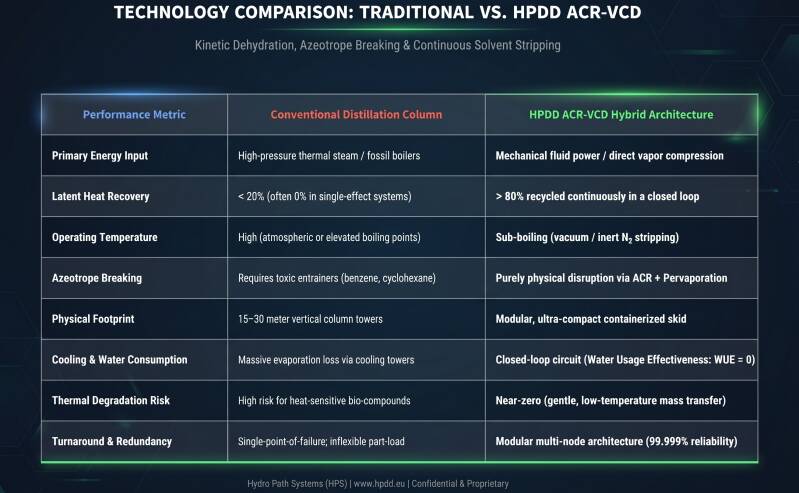
Traditional distillation columns are thermodynamic energy sinks. Boiling water to break azeotropes, concentrate dilute organic acids, or recover industrial solvents squanders up to 80% of process energy through cooling towers and atmospheric heat rejection.
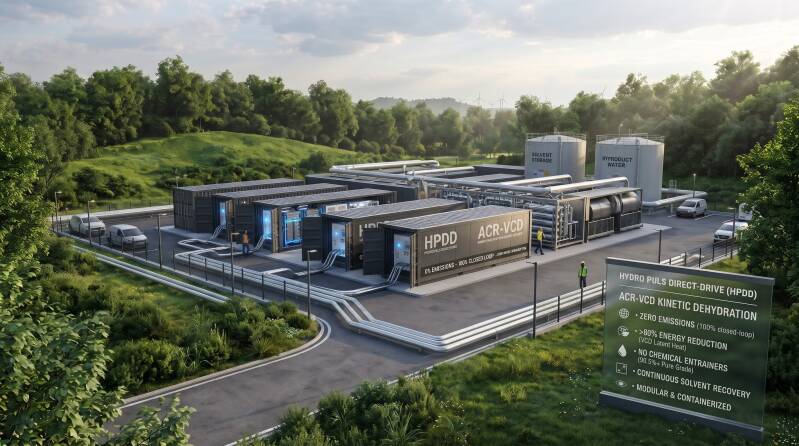
The Hydro Puls Direct-Drive (HPDD) platform merges Acoustic Cavitation (ACR), closed-loop inert gas (N_2) stripping, and Vapor Compression Distillation (VCD) into a modular, containerized architecture that converts chemical separation from a thermal burden into an efficient kinetic process.
The Industrial Bottleneck: The Thermal Limits of Distillation
Legacy evaporation and multi-story rectification columns hit severe physical and economic walls:
- Severe Latent Heat Losses: Water vaporization demands approximately 2,26 kJ/kg} of steam energy, which is subsequently lost to cooling circuits and cooling towers.
- Azeotropic Barriers: Binary mixtures like ethanol/water (at 95.6%) or dilute acetic acid develop dense hydrogen-bonding networks that traditionally require toxic chemical entrainers (benzene, cyclohexane) or complex multi-pressure columns to break.
- Thermal Degradation & Massive Footprint: 20- to 30-meter distillation columns subject heat-sensitive bio-fermentation broths, enzymes, and active pharmaceutical ingredients (APIs) to prolonged high temperatures, degrading product quality and consuming valuable industrial real estate.
Architectural Mechanics: How Kinetic Separation Works
1. Acoustic Cavitation (ACR) & Inert Nitrogen Stripping
Instead of heating a stationary liquid inventory, feedstocks are pressurized and directed through an active cavitation zone with micro-dosed nitrogen (N_2):
- Hydrogen Bond Disruption: High-intensity acoustic shockwaves and micro-implosions generate localized shear forces that tear boundary layers apart and decouple inter-molecular hydrogen bonds.
- Sub-Boiling Mass Transfer: Dispersed nitrogen nanobubbles serve as nucleation sites and depress the partial pressure of the volatile solvent to near zero. Rapid stripping and phase separation occur at temperatures well below atmospheric boiling points.
- Inert & ATEX Compliant: Complete oxygen exclusion eliminates flammability hazards and prevents oxidative degradation of volatile compounds.
2. Closed-Loop Vapor Compression Distillation (VCD)
The vapor phase released during cavitation is immediately drawn into a mechanical compressor:
- Latent Heat Recycling: Slight mechanical compression raises the vapor’s pressure and saturation temperature. Upon condensation, the vapor returns its latent heat of vaporization directly into the incoming feedstock loop.
- >80% Energy Reduction: Latent energy remains trapped in a closed thermodynamic circuit. The plant requires only mechanical compression work, reducing energy demand by up to 80% compared to single-effect thermal evaporation.
3. Hydrostatic Pervaporation Polishing (Up to 99+%)
For final dehydration beyond the azeotropic threshold, the pre-concentrated stream is swept across hydrophilic zeolite or ceramic membranes under oil-free hydrostatic flow:
- Zero Boundary Layer Resistance: Continuous, pulse-balanced flow prevents concentration polarization on the membrane surface, maximizing flux rates.
- Affinity-Driven Dehydration: Separation occurs via preferential molecular sorption and vapor-pressure differentials, not boiling point hierarchies.
- Pure Output: Reaches 99.5%+ anhydrous grade without chemical entrainers or toxic additives.
Primary Industrial Deployments
- Bio-Ethanol & Fermentation Broths: Continuous dewatering from 10–12% raw beer directly to 98–99% fuel/industrial anhydrous grade without rectification towers.
- Pharmaceutical & Industrial Solvent Recovery: High-yield purification of isopropyl alcohol (IPA), acetone, methanol, and acetonitrile at low operating temperatures.
- Organic Acid Concentration: Energy-efficient concentration of dilute acetic and formic acid streams without corrosive high-temperature vaporization.
- Wastewater & Brine Minimization: Zero-liquid-discharge (ZLD) concentration of contaminated industrial effluents with complete water recovery and zero cooling-tower makeup requirements.
Ready to Decouple Your Separation Trains from Expensive Process Steam?
Submit your stream specifications (feedstock composition, flow rate, and target purity) to receive an engineered mass-and-energy balance model:
Request a Technical Feasibility Assessment Direct engineering inquiries: info@hpdd.eu
Performance & Technology Comparison