

Rare Earths
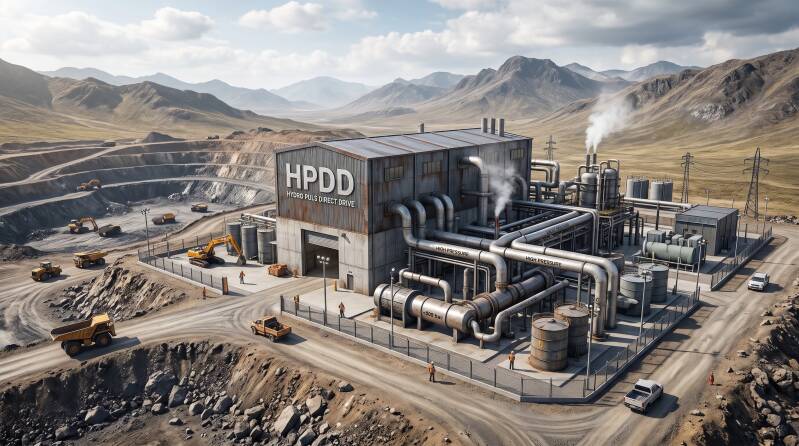
Why the Rare Earth Bottleneck Isn't in the Mines, but in the Thermodynamics
Breaking the China Refining Monopoly with Autonomous Mine-Mouth Polygeneration
1. The Geopolitical Reality: Mines Don't Solve the Crisis
Rare earths are not rare in the Earth’s crust. Deposits exist across North America, Europe, Africa, and Australia.
The bottleneck is downstream refining.
Over 90% of global capacity to refine mixed ores into magnet-grade purities, such as Neodymium (Nd), Dysprosium (Dy), and Terbium (Tb), sits in a single country. Opening new extraction sites simply means mining raw rock only to ship intermediate concentrate right back into foreign supply chains.
True mineral sovereignty requires domestic, on-site refining at the mine mouth. Yet conventional hydrometallurgy makes off-grid refining virtually impossible under legacy economics.
2. The Hidden Thermodynamic Tax of Solvent Extraction (SX)
Traditional solvent extraction forces projects to run trains of hundreds of sequential mixer-settlers. This architecture imposes severe balance-of-plant penalties:
* Massive Pumping & Hydraulic Losses: Pumping aggressive solvents and aqueous phases through endless separation stages burns gigawatt-hours through pumps, electric motors, and mechanical gearboxes.
* Continuous Thermal Stripping (200–230°C): Stripping loaded extractants and regenerating chelating agents requires continuous process steam, demanding auxiliary fossil boilers.
* Extreme Demineralized Water Footprint: Preventing cross-contamination between adjacent lanthanides requires millions of liters of demineralized wash water, a non-starter in remote, water-stressed mining basins.
3. The Solution: HPDD Mine-Mouth Polygeneration
Next-generation separation routes, such as supercritical hydrothermal precipitation, high-pressure chromatography, and intensified liquid-liquid extraction, become viable when coupled directly to a Hydro Puls Direct-Drive (HPDD) thermodynamic core:
Direct Hydrostatics (+600 bar)
Hydraulic working pressure is delivered directly from the core's expansion cycle. High-pressure columns, ultra-filtration, and dense slurry circuits are driven without parasitic electric motor and gearbox losses.
Integrated 230°C Thermal Cascade
Waste heat recovery from the thermal jacket provides continuous 200–230°C process enthalpy behind the meter. Solvent stripping and chelate regeneration circuits run with zero auxiliary fossil fuel.
High-Purity Reaction Water
Clean fuel conversion - generates demineralized reaction water on-site. Pure wash water is supplied directly to precipitation circuits without reverse-osmosis pre-treatment or local aquifer depletion.
4. Conventional Refining vs. HPDD Mine-Mouth Microgrid

5. Industrial Sovereignty at the Mine Mouth
Securing critical materials for permanent magnets, wind turbines, and defense systems cannot stop at digging ore out of the ground.
By unifying 600-bar fluid dynamics, 230°C process enthalpy, pure reaction water, and firm baseload power into a modular skid, HPDD enables mining operators to refine NdFeB and SmCo precursor oxides locally, cleanly, and profitably.
Deploy autonomous refining infrastructure.
Schedule a Technical Consultation
© 2026 Hydro Puls Direct Drive (HPDD). All rights reserved.
