LAES
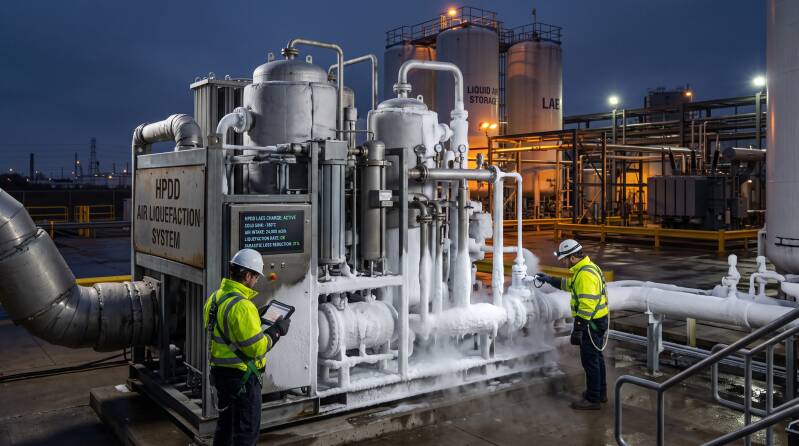
Liquid Air Energy Storage (LAES): Unlocking higher Round-Trip Efficiency at the liquefaction stage.
Liquid air is one of the most scalable answers to long-duration energy storage (LDES). It requires no rare minerals like lithium and stores gigawatt-hours of renewable energy by chilling ambient air down to -196 degrees C.
Yet conventional LAES faces a stubborn thermodynamic bottleneck:
- Practical Round-Trip Efficiency (RTE) often stalls between 50% and 60%.
- The dominant losses occur right at the liquefaction stage, where heavy rotating compressors and complex refrigeration cascades consume massive amounts of parasitic power.
- These upfront conversion penalties limit large-scale commercial bankability.
The HPDD Breakthrough: Direct Pulse Compression & Native Cryogenic Cold
Hydro Puls Direct-Drive (HPDD) fundamentally rewires the charging thermodynamics:
- Direct Reactive Drive: Ambient air is compressed without crankshafts, crossheads, or rotating machinery, cutting mechanical friction losses at the source.
- Inherent -180 degrees C Thermal Sink: HPDD delivers deep cryogenic cooling natively as a direct process byproduct, chilling air down to near-liquefaction temperatures with minimal auxiliary power.
- Breaking the RTE Ceiling: Slashing compression and precooling penalties during the charge cycle lifts the overall round-trip efficiency to commercially compelling levels.
- Modular Skid Architecture: Replaces sprawling, centralized cryogenic plants with modular units deployed directly beside wind farms, solar assets, and industrial substations.
True grid-scale energy storage succeeds when we eliminate parasitic losses on the cold side of the cycle.