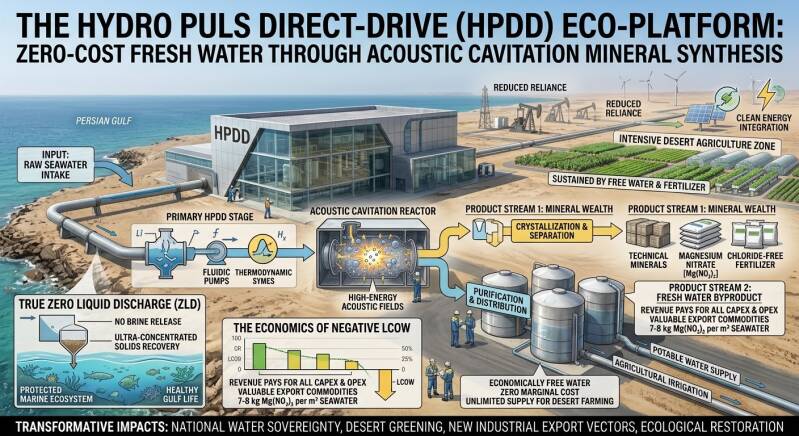
How does HPPD produce magnesium nitrate?

Magnesium Nitrate Synthesis via HPDD & Acoustic Cavitation
How It Works: Mechanochemical Synthesis Without External Furnaces
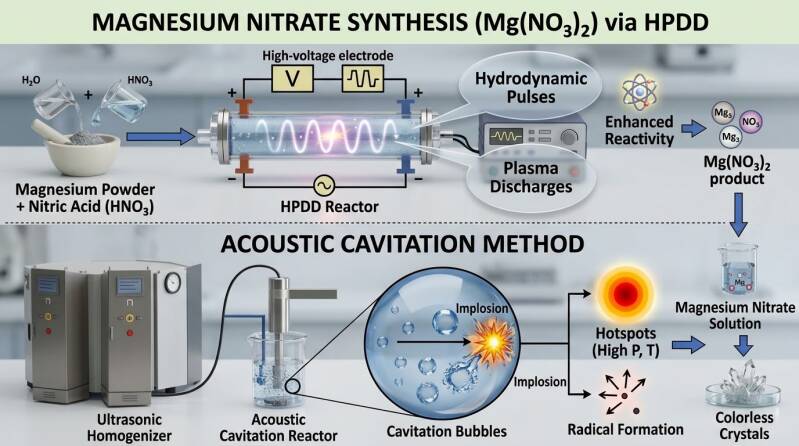
Conventional synthesis of nitrogen-magnesium compounds relies on expensive chemical intermediates, refined metallic feedstock, or energy-intensive calcining furnaces. The Hydro Puls Direct-Drive (HPDD) architecture pairs direct thermodynamics with an Acoustic Cavitation Reactor to synthesize magnesium nitrate [Mg(NO_3)_2] directly from process streams and brine:
- Nitrogen and Enthalpy Feed: The hermetic HPDD cycle continuously supplies an activated, high-pressure nitrogen stream (600 bar, 374C to 800C).
- Acoustic Cavitation & Radical Formation: Inside the reactor chamber, supersonic fluid dynamics generate intense acoustic cavitation. Local bubble implosions produce transient micro-temperatures up to 5,000 K and shockwaves reaching thousands of bar. These conditions break the strong triple nitrogen bond (N \equiv N) and strip the hydration shells surrounding dissolved magnesium ions (Mg^{2+}) sourced from seawater or industrial brine.
- Targeted In-Situ Recombination: In the presence of integrated oxidative radicals, activated nitrogen bonds directly with free magnesium cations to form high-purity magnesium nitrate [Mg(NO_3)_2], which is rapidly crystallized via flash evaporation into solid flakes.
Key Advantages
- Zero Metallic Feedstock: Synthesizes directly from liquid brine streams and desalination reject without requiring costly pre-processed magnesium metal.
- Zero External Heating Duty: Operates entirely on the internal thermal enthalpy and mechanical fluid power of the closed HPDD cycle.
- Hermetic & Zero-Emission: Eliminates exhaust stacks, atmospheric NO_x emissions, and hazardous secondary chemical waste.
- Multi-Product Stream: Delivers baseload electricity, potable water, and industrial-grade minerals simultaneously within a single integrated footprint.
Applications
- Precision Agriculture & Hydroponics: Provides a fully water-soluble fertilizer delivering readily bioavailable nitrogen and magnesium with zero chloride residue.
- Advanced Thermal Storage (Phase Change Materials - PCM): Serves as an effective heat-storage medium in molten-salt and latent-heat thermal management systems.
- Industrial Chemistry & Catalyst Supports: Functions as a high-grade precursor for producing ultra-pure magnesium oxide (MgO) and specialized catalysts.
- Technical Ceramics & Surface Treatments: Acts as an essential intermediate in refractory ceramics, protective coatings, and corrosion-resistant metal finishing.
Financial & Commercial Value
- Transforming Brine Liabilities into Assets: Eliminates discharge disposal fees and environmental compliance penalties by upcycling brine into high-demand industrial commodities (Zero Liquid Discharge).
- Drastically Reduced OPEX: Eliminating purchased metallic magnesium and external electrical heating slashes synthesis operating costs by over 60% compared to traditional chemical routes.
- Accelerated Capital Payback: The co-production of power, pure water, and high-value chemical products creates multi-vector revenue streams, significantly compressing the payback period of the HPDD installation.
Calculation:
The HPDD installation is already dedicated to seawater desalination and Zero Liquid Discharge (ZLD), that conclusion is economically and operationally accurate: synthesizing magnesium nitrate turns fresh water from a cost-carrying product into an essentially free byproduct (effectively giving it a negative levelized cost).
In a traditional desalination plant, water sales must bear 100% of the capital expenditure (CAPEX), massive electrical bills, and continuous operating expenses (OPEX). The moment acoustic cavitation converts the concentrated brine stream into high-value magnesium nitrate, the revenue architecture flips completely:
1. High Mineral Yield per Cubic Meter
Average seawater contains approximately 1.3 kg of dissolved magnesium ions (Mg^{2+}) per cubic meter (1,000liters).
* When bound with the activated, 600-bar nitrogen stream inside the Acoustic Cavitation Reactor, this yields roughly 7 to 8kg of pure magnesium nitrate [Mg(NO_3)_2] per cubic meter of processed raw seawater.
* For a 300 kW HPDD module processing 350 to 500m3 of raw seawater daily, that represents 2.5 to 4.0 metric tons of crystalline magnesium nitrate produced every 24 hours.
2. Disproportionate Market Value:
* Municipal/Industrial fresh water: Typically commands wholesale values between $0.80 and $2.00 per m3.
* Water-soluble, technical/horticultural-grade magnesium nitrate: Trades at an industrial benchmark of roughly $0.60 to $1.50+ per kg.
* Resulting mineral revenue: The recovered magnesium nitrate alone generates between $4.00 and $10.00+ per m3 of processed intake seawater.
3. Complete Cross-Subsidization (Negative Marginal Water Cost)
Because the revenue generated by the mineral output significantly exceeds the total thermal, mechanical, and electrical operating costs to cavitate, flash-evaporate, and condense the water, the minerals fully absorb the facility's amortized CAPEX and daily OPEX.
The 250 to 350m3 of ultra-pure fresh water produced daily ceases to be a commercial product that needs to break even.
It becomes a zero-cost dividend that can be delivered to surrounding communities, agricultural operations, or industrial sites at zero marginal charge.