

Dairy industry
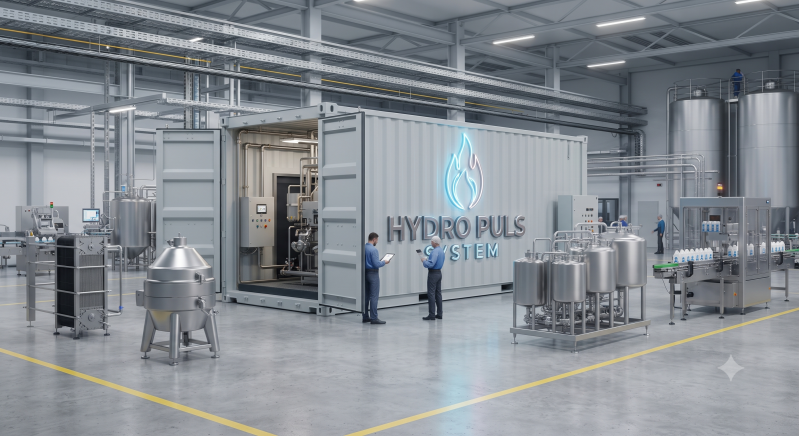
HPDD-NEXUS 10 MW Dairy Array: Turning High-COD Whey Liabilities into €70M/Yr Pharma Assets 🚜🥛
Developed in collaboration with Prof. Dr. Mohamed Amin, this modular, containerized process intensification loop offers a highly lucrative alternative to traditional water treatment. Instead of treating cheese whey and CIP effluents at a loss, the HPDD converts organic waste directly into high-purity, bio-active agricultural and pharmaceutical assets natively on the floor.
This HPDD platform proves that agro-industrial compliance can be transformed into a high-margin revenue engine rather than a regulatory cost burden.
🚨 The Dairy Sector's Biochemical Bottleneck
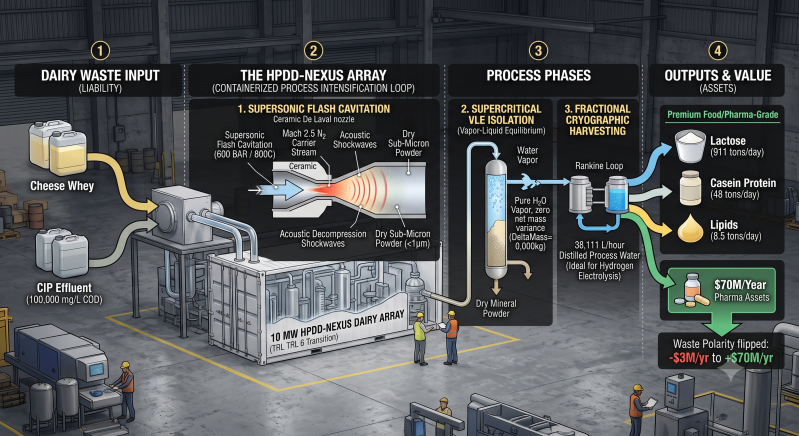
Cheese-making produces over 100 million tons of whey annually. With raw effluent Chemical Oxygen Demand (COD) spiking to 100,000 mg/L (1,000 times over regulatory limits), operators face massive municipal surcharges, environmental fines up to €70,000/day, and high methane emissions. Traditional filtration is a dead end: high-viscosity lactose and emulsified lipids cause instant membrane blinding and severe caramelization scaling across conventional heat exchangers.
The 10 MW HPDD array resolves this by replacing mechanical filters with an automated, waterless, gas-phase thermochemical loop:
⚡ How It Works: Supersonic Shockwaves & Phase-Collapse
The mobile containerized array integrates directly with existing processing lines, operating across three synchronized phases:
Supersonic Flash Cavitation (600 BAR / 800°C): Raw whey is injected mid-air into an oxygen-free Nitrogen stream accelerated past Mach 2.5 through ceramic De Laval nozzles. Acoustic decompression shockwaves flash-explode the fluid in milliseconds, pulverizing compounds into a dry sub-micron powder (less than 1MU) before they can touch a static surface, completely eliminating caramelization.
Supercritical VLE Isolation: Warmed vapors ascend into vertical convective separation columns under strict Supercritical Vapor-Liquid Equilibrium parameters. Pure water vapor experiences rapid gravimetric density decoupling from the gas stream, leaving zero liquid sludge.
Fractional Cryographic Harvesting: Water vapor enters active Rankine loops, forcing an instant liquid phase-collapse that drops backend back-pressure to zero and cuts pump loads to 1% to 2% (yielding 38,111 liters/hour of pure distilled water). Simultaneously, heavy fractions pass through a Joule-Thomson manifold to drop temperatures, freezing out food/pharma-grade casein proteins, lactose, and lipids at maximum purity.
📦 Eliminating Logistics Taxes & Flipping Waste Polarity
"Instead of paying hauling fees, a standard 200-ton plant extracts 911 tons of clean water, 48 tons of lactose, and 8.5 tons of pure casein protein daily,"
"We flip waste polarity from minus (-€3M/yr) to plus (+€70M/yr)."
10+5 Strategic and Technical Advantages of HPDD for the Dairy Industry (Milk Powder Production)
- 1. Massive Reduction in Thermal Energy Consumption
Milk powder production is traditionally energy-intensive due to heavy evaporation and spray drying cycles. HPDD delivers direct, high-efficiency process heat via in-situ thermal recuperation, eliminating the dependence on inefficient fossil gas boilers. - 2. 100% Oil-Free and Hygienic Processing (Food-Grade Assurance)
The hermetically sealed, lubricant-free kinematic design eliminates any risk of contamination from engine oils or chemical lubricants. This guarantees compliance with the highest food safety and quality standards (HACCP/GMP) for infant formula and pharmaceutical-grade milk powder. - 3. Supersonic Homogenization and Micronization
High-frequency, high-pressure fluid kinetic pulses (reaching hundreds of bars) homogenize and micronize dairy concentrates with extreme uniformity. This produces superior particle consistency, rapid wettability, and instant powder dispersion. - 4. Preservation of Heat-Sensitive Dairy Proteins and Nutrients
Dynamic and precise thermal modulation prevents localized hotspots during drying. Functional whey proteins, immunoglobulins, vitamins, and natural flavor profiles remain intact without undesirable denaturation or Maillard browning reactions. - 5. Integrated Multi-Vector Utility (Heat, Deep Cooling & Power)
A single HPDD unit concurrently generates high-temperature drying heat, on-site electrical power for heavy plant drives, and deep process cooling for raw milk intake and intermediate storage, significantly boosting total system COP. - 6. In-Situ Water Harvesting & Zero Liquid Discharge (ZLD)
During the concentration and drying phases, the HPDD condensation loop captures high-purity water without parasitic energy penalties. This harvested water can be recycled immediately into CIP (Clean-in-Place) loops or boiler feed, closing the plant water cycle. - 7. Complete Decarbonization of Dairy Manufacturing
Operating on zero-carbon fuel carriers (such as green ammonia or hydrogen) enables dairy plants to produce milk powder with a net-zero carbon footprint, directly addressing Scope 1 and Scope 2 climate mandates. - 8. Elimination of Complex Central Steam Infrastructure
HPDD replaces sprawling central steam boiler houses, condensate return pipes, and turbine plants with modular, skid-mounted units positioned directly at the production line, reducing line losses and maintenance overhead. - 9. Lower OPEX and Peak-Demand Load Shedding
Direct fluid-power kinetics buffer heavy plant load spikes on demand, insulating dairy operations from grid congestion fees, capacity tariffs, and volatile electricity pricing. - 10. Modular Scalability for Seasonal Milk Peaks
The containerized skid architecture allows dairy processors to scale capacity dynamically during spring milk flushes and dial down during dry seasons with minimal footprint and zero idle degradation.
Additional Strategic and Operational Advantages of HPDD for Milk Powder Production
- 1. On-Site High-Purity Nitrogen (N2) Generation
The HPDD conversion loop continuously yields an isolated stream of pure nitrogen. Dairy processors can directly route this N2 into Modified Atmosphere Packaging (MAP) and storage silos to prevent lipid oxidation and extend shelf life, eliminating the recurring CAPEX and logistics of external nitrogen gas contracts. - 2. 100% CO2-Neutral Manufacturing
Operating strictly on zero-carbon chemical carriers completely eliminates fossil combustion from the dairy processing floor. Plants achieve net-zero Scope 1 emissions, shielding the facility from carbon tariffs, emissions trading penalties (ETS), and regulatory compliance risks. - 3. Complete Grid Independence (Zero Grid Connection Required)
Eliminates the multi-year delays, exorbitant connection fees, and capacity constraints associated with regional grid congestion. HPDD acts as an autonomous on-site micro-utility, allowing milk processing and drying plants to be established directly adjacent to remote dairy farming clusters. - 4. Ultra-Pure Water Production
The integrated vacuum condensation cycle yields high-purity, potable-grade water from ambient moisture and process streams. This provides thousands of liters daily for Clean-in-Place (CIP) sanitization protocols and boiler make-up, drastically reducing reliance on external groundwater or municipal water infrastructure. - 5. Ultra-Low OPEX Driven by Primary Power Generation
Because the HPDD core is architected as a high-efficiency primary electricity generator, high-grade process drying heat and deep sub-zero refrigeration are delivered simultaneously as direct thermodynamic co-products. This minimizes operational expenditure per metric ton of powder, avoiding volatile retail power prices and separate fossil gas heating expenses.
Contact your local representative or consultant