

Transforming Polymer Engineering
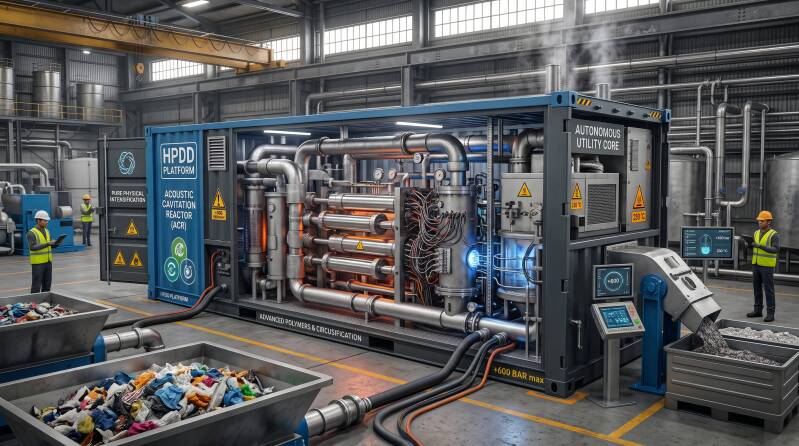
APPLICATION VERTICALS: ADVANCED POLYMERS & CIRCULAR CHEMICALS
Transforming Polymer Engineering: Pure Physical Intensification & Autonomous Processing
Continuous +600 bar direct linear actuation, acoustic cavitation, and chemical-free depolymerization for high-performance polyamides, polyesters, and polymer nanocomposites.
Executive Overview
The polymer and plastics manufacturing industries face persistent thermodynamic and environmental hurdles: severe diffusion bottlenecks in high-viscosity melts, thermal degradation in batch autoclaves, heavy dependence on toxic chemical catalysts, and complex recycling of post-consumer streams.
The Hydro Puls Direct-Drive (HPDD) platform, coupled with the Acoustic Cavitation Reactor (ACR), replaces conventional, chemical-heavy batch operations with continuous, purely physical process intensification. Operating at continuous hydrostatic pressures exceeding +600 bar and closed-loop thermal stabilization at 230 °C, HPDD delivers molecular-level shear, uniform molecular weight distribution, and complete energetic autonomy.
Core Capabilities & Industrial Applications
1. Chemical-Free Depolymerization & Circular Recycling
Purely mechanical monomer recovery without corrosive acids, bases, or solvents.
• High-Shear Molecular Cleavage: The ACR generates focused micro-cavitation shockwaves at gigapascal pressures, mechanically breaking ester and amide bonds in PET, Nylon 6, Nylon 6,6, and polyurethanes.
• Direct Monomer Yield: Recovers high-purity monomers and oligomers without contamination from secondary process chemicals.
• Contaminant & Additive Tolerance: Extreme hydrodynamic shear forces physically detach dyes, pigments, flame retardants, and inorganic fillers from the polymer matrix, enabling direct processing of mixed post-consumer plastic and textile waste.
2. Process Intensification in Polymerization Kinetics
Eliminating mass transfer limits and localized thermal hotspots in viscous melts.
• Microsecond Mixing at +600 bar: The pulsating hydrostatic fluid column ensures continuous, homogeneous mass transfer across high-viscosity melts, eliminating stagnant zones common in traditional reactors.
• Homogeneous Molecular Weight Distribution (MWD): Eliminates thermal hot spots to yield highly consistent chain lengths, directly enhancing tensile strength, impact resistance, and elongation properties.
• Acoustic Dewatering for Polycondensation: Directed acoustic shockwaves continuously strip out micro-water droplets formed during condensation reactions (e.g., polyamides, polyesters), driving chemical equilibrium rapidly toward maximum chain growth.
3. Nanocomposite Dispersion & Immiscible Polymer Blends
Uniform nanomaterial integration without mechanical blade degradation.
• Non-Destructive De-agglomeration: Cavitation shockwaves break up clustered carbon nanotubes, graphene sheets, and mineral nanofillers, dispersing them homogeneously throughout the resin matrix without shear-induced particle degradation.
• Compatibilization of Immiscible Polymers: Mechanically emulsions incompatible polymers (such as PE/PP post-consumer fractions) at the micro-scale, drastically reducing or eliminating the need for expensive chemical compatibilizers.
4. Direct-Drive Linear Actuation for Industrial Processing Equipment
Replacing external hydraulic power units (HPUs) with compact, self-contained force.
• High-Tonnage Extruders & Injection Presses: Delivers direct linear force with millimetric positioning accuracy, eliminating high-wear mechanical crankshafts and high-maintenance hydraulic loops.
• Zero Risk of Fluid Contamination: Frictionless operation via a 5-micron gas curtain labyrinth seal eliminates external oil leaks in sensitive clean-room or optical-grade production environments.
5. Effluent Degradation & Zero Liquid Discharge (ZLD)
Destroying hazardous polymer additives while recovering clean process water.
• Destruction of Persistent Organics: High-pressure cavitation sonochemically degrades toxic amines, phenols, and residual monomers in plant wastewater streams.
• Membrane-Free Salt Separation: Crystallizes dissolved salts into dry-cake discharge, reclaiming 100% of process water for direct plant reuse.
6. Autonomous Utility Core & Heat Integration
Independent off-grid power and thermal baseline directly at the production skid.
• 300 kW Net Autonomous Power: Each modular 20ft containerized skid generates its own continuous baseline electricity, fully isolating critical extrusion lines from grid disruptions.
• 230 °C Thermal Integration: High-grade thermal energy from the internal closed loop provides continuous base heat for resin preheating, moisture flashing, and monomer drying.
Operational Advantages
• Modular Footprint: Standard 20ft and 40ft ISO containerized skids ready for turnkey integration into existing chemical plants.
• Zero Chemical Consumables: Eliminates acids, solvents, and single-use catalysts.
• Full Multi-Carrier Compatibility: Operates off-grid on clean hydrogen (H2), ammonia (NH3), or industrial process off-gases.