HPDD Micronized Coal Waste & Slurry Valorization
Micronized Coal Waste & Coal Slurry Valorization
Turning Mining Liabilities into Clean Off-Grid Power, Methanol, and Ammonia
Across major coal-producing regions worldwide, coal washing, crushing, and handling generate 10 to 20% unmarketable coal fines, washery rejects, and wet coal slurry. Conventional boilers and gasifiers cannot process these streams efficiently due to high moisture levels (30 to 65%), ultra-fine particle sizes, and prohibitive thermal drying costs.
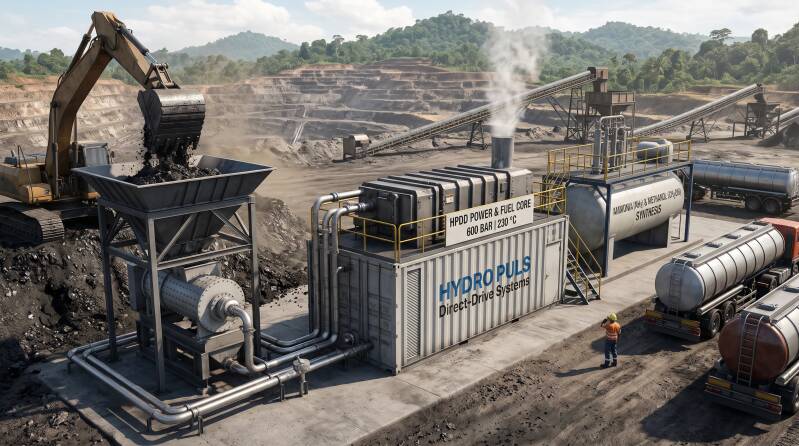
Hydro Puls Direct-Drive (HPDD) turns these moisture and particle-size penalties into a direct operational and economic advantage. By micronizing clean, low-ash coal fines and rejects into ultra-fine carbon particles and injecting them as a pumpable coal-water slurry into our +600 bar, 230 °C hydrostatic core, mining and industrial operators can convert waste stockpiles into high-value energy and clean fuels on-site, 100% off-grid.
Why Conventional Systems Fail on Coal Waste
- High Moisture Penalty: Wet coal slurry and tailings contain 30 to 65% water, meaning thermal pre-drying consumes more energy than the fuel recovers.
- Fine Particle Limitations: Conventional grates and fluidized beds struggle with ultra-fine coal dust, requiring costly briquetting or pelletizing.
- Environmental and Storage Liability: Tailings ponds and coal reject piles create ongoing water management costs, land-use constraints, and regulatory exposure.
How the HPDD +600 Bar Architecture Solves It
1. Zero Thermal Drying Required
In the HPDD core, water is not a contaminant to be evaporated. It serves directly as the pumpable carrier and hydrothermal reaction medium at +600 bar hydrostatic pressure and a controlled 230 °C working temperature.
2. Dual Valorization Pathways in One Modular Platform
Depending on mine-site or regional offtake requirements, a modular HPDD unit converts micronized coal waste via two flexible routes:
- Direct Mine-Site Power, Hydraulic Work and Process Heat: Direct pulse-combustion of micronized coal-water slurry at +600 bar drives hydraulic motors and generators with zero crankshaft or reduction gearbox losses, delivering 4.5 to 5.5 MWe of off-grid power alongside 230 °C process heat for dewatering and mineral processing.
- Hydrothermal Syngas to Green Methanol or Ammonia: Steam reforming and water-gas shift of the micronized carbon stream at +600 bar produce hydrogen-rich syngas for on-site Methanol (CH3OH) or Ammonia (NH3) synthesis, optionally co-fed with wet biomass or glycerin pitch to optimize the hydrogen-to-carbon ratio.
3. Integrated Ash and Sulfur Capture
Inert mineral ash and sulfur compounds are separated through integrated gas scrubbing and mineral ash extraction stages, producing a clean mineral residue suitable for cement and construction material reuse.
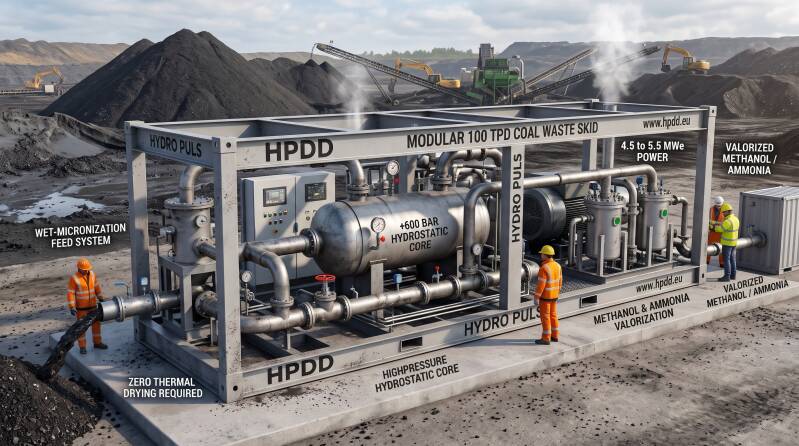
Technical Snapshot: Modular 100 TPD Coal Waste Skid
- Feedstock Input: 100 TPD coal fines or wet coal slurry (dry equivalent, 30 to 65% moisture)
- Feed Preparation: Wet micronization (<50 micron pumpable slurry)
- Operating Regime: +600 bar hydrostatic pressure at 230 °C working temperature
- Option A Output (Power & Heat): ~12 to 15 MWth / 4.5 to 5.5 MWe off-grid power + 230 °C heat
- Option B Output (Clean Fuels): ~35 to 45 TPD Methanol or ~25 TPD Ammonia
- Indicative Unit Economics (8,000 hrs/yr): ~EUR 6,800,000 installed CAPEX, ~EUR 3,230,000/yr EBITDA, and ~2.1 years simple payback on zero-cost waste feedstock
Start a Site Feedstock Evaluation
Every coal seam and washery tailings pond has a unique moisture, ash, and sulfur profile. Share your site's proximate and ultimate analysis with our engineering team to receive a tailored mass-and-energy balance, skid sizing, and project ROI calculation.
Contact: info@hydropulssystems.com | https://www.hpdd.eu/