

Next-Generation Grain & Rice Micronization
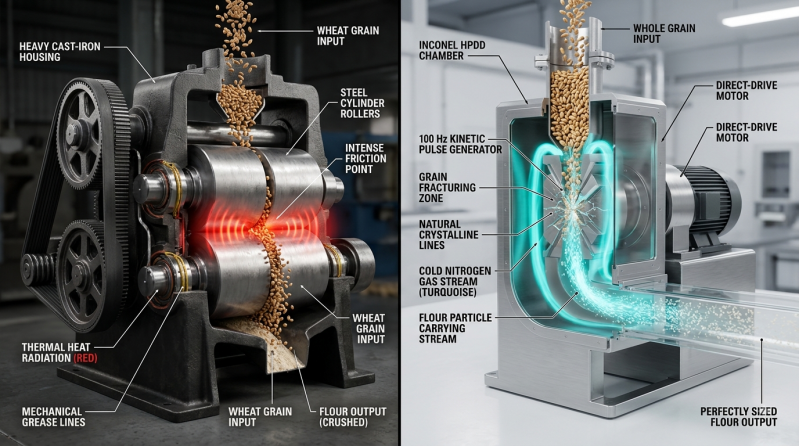
Next-Generation Grain & Rice Micronization: Cold Shockwave Milling with Native Inert Transport
Conventional grain milling and rice processing rely on heavy roller mills and hammer impactors that crush material through mechanical friction. This traditional approach introduces significant operational bottlenecks: thermal starch damage, lipid oxidation, continuous bearing wear, high energy consumption, and constant dust-explosion (ATEX) risks.
The Hydro Puls Direct-Drive (HPDD) architecture transforms dry milling by decoupling particle reduction from thermal friction. By pairing a high-frequency linear kinetic core with a continuous, native nitrogen carrier stream, HPDD delivers precise, cold micronization with zero oil contamination.
The Two Core Dynamics: Mechanical Pulse vs. Continuous Carrier
The HPDD milling zone separates fracture mechanics from material transport:
- 100 Hz High-Frequency Kinetic Cleaving (The Breaker): The linear core generates high-velocity micro-pulses every 10 milliseconds. Because the impact duration is shorter than the plastic deformation threshold of the grain, energy propagates directly along natural crystalline grain boundaries. This cleaves the starchy endosperm cleanly from the bran and germ without crushing or generating thermal friction.
- Permanent, Non-Pulsing Nitrogen (N_2) Stream (The Environment & Carrier): A continuous, steady stream of co-generated nitrogen sweeps through the milling chamber. This inert flow provides immediate cooling, prevents oxidation, eliminates dust explosion hazards, and acts as a steady pneumatic carrier that extracts particles the exact millisecond they reach target size.
Key Processing Advantages
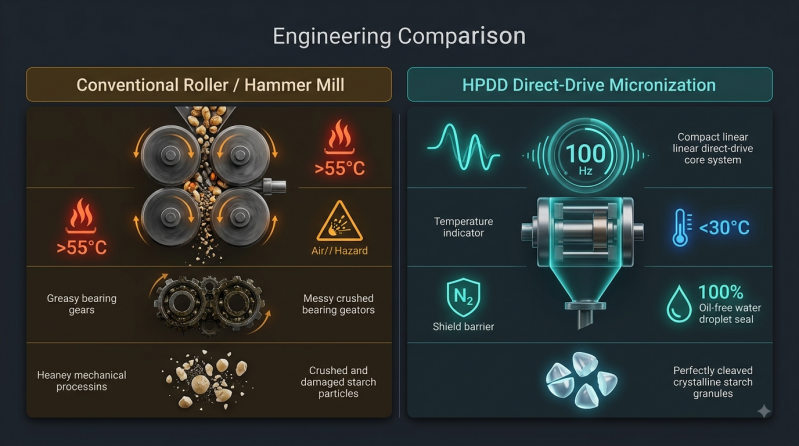
- Cold Isothermal Processing (<30°C): Eliminates frictional heat spikes (>55°C) common in mechanical rollers. Preserves delicate enzymes, natural vitamins, and baking-grade gluten structures while preventing fatty acid degradation in rice bran and wheat germ.
- Continuous Oxidation Prevention: Grinding and pneumatic transfer occur entirely inside a steady nitrogen blanket, preventing lipid oxidation, flavor loss, and rancidity during processing.
- Inherently ATEX Safe: Constant displacement of atmospheric oxygen by the steady nitrogen flow keeps dust concentrations below explosive oxygen limits, removing the need for complex explosion suppression infrastructure.
- Narrow Particle Size Distribution (PSD): Immediate pneumatic extraction by the steady N_2 flow prevents over-milling and excessive fines, yielding an ultra-consistent grist with intact starch granules.
- 100% Oil-Free & Hygienic: Floating entirely on a hydrodynamic water-bearing matrix, the linear drive operates with zero grease or hydrocarbon lubricants near the food stream, ensuring full compliance with stringent food-safety standards.
System Comparison: Conventional Milling vs. HPDD
Engineering Sustainable, High-Yield Food Processing
From high-protein flour production and baby-food-grade rice milling to precision seed processing, HPDD replaces sprawling, energy-intensive roller lines with a compact, cold, and intrinsically safe direct-drive unit.
Contact our application team at info@hpdd.eu to explore integration data, particle size analysis, and pilot testing parameters.