Revolutionizing Oil Refining

Revolutionizing Oil Refining & Hydroprocessing
Contactless Sub-Micron Hydrocracking and Ultra-Deep Desulfurization with the Atomic Eraser
In modern petroleum refining, roughly 40–45% of total industrial hydrogen consumption is dedicated to hydrotreating (desulfurization) and hydrocracking heavy oil fractions.
Conventional hydroprocessing relies on massive capital equipment: multi-stage hydrogen compressors, expansive catalyst beds, extreme thermal inputs (400–450°C), and pressures exceeding 150–200 BAR. These systems suffer from severe mass-transfer bottlenecks, rapid catalyst coking, and massive parasitic power consumption.
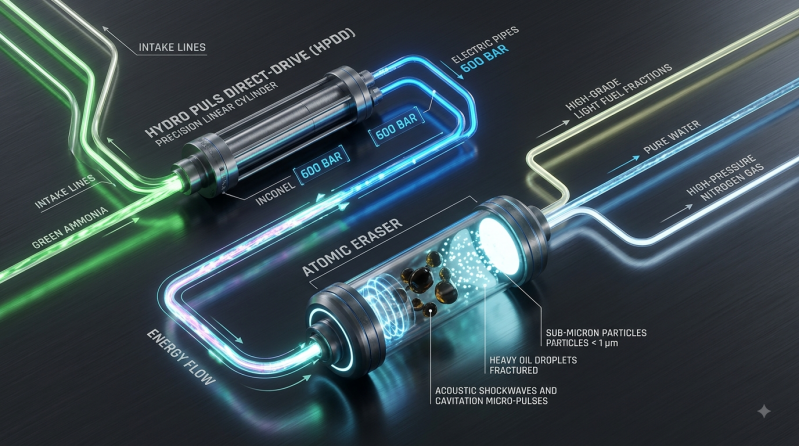
The Atomic Eraser transforms this paradigm by shifting hydrocracking from a slow, thermal-bulk process to a rapid, non-mechanical, contact-free mechanochemical reaction.
The Key Technological Breakthroughs
1. Direct Mechanochemical Cleaving of C-C and C-S Bonds
- The Problem: Heavy atmospheric and vacuum residue streams contain complex, high-molecular-weight asphaltene matrices that demand extreme thermal energy and expensive catalysts to break down.
- The Solution: The Atomic Eraser utilizes intense acoustic energy, shockwaves, and controlled micro-cavitation to mechanically cleave strong carbon-carbon (C-C) and carbon-sulfur (C-S) bonds.
- The Benefit: By lowering the initial activation energy barrier at the molecular level, cracking kinetics accelerate without requiring extreme thermal overshoots.
2. Contactless Sub-Micron Emulsification (< 1 µm)
- The Problem: Heavy crude fractions exhibit high viscosity and mix poorly with gaseous hydrogen, creating severe mass-transfer resistance at catalyst surfaces.
- The Solution: The Atomic Eraser disperses heavy hydrocarbon feeds into uniform, sub-micron droplets (< 1 µm) without mechanical grinding or physical contact.
- The Benefit: The active phase-boundary contact area between hydrogen and the hydrocarbon feed increases by several orders of magnitude (10^4 to 10^6), enabling near-instantaneous hydrogen saturation.
3. Ultra-Deep Desulfurization (HDS Acceleration)
- The Problem: Refractory sulfur compounds (such as dibenzothiophene derivatives) are notoriously difficult to treat and frequently cause catalyst deactivation via heavy coke laydown.
- The Solution: Focused molecular excitation opens recalcitrant aromatic rings, exposing trapped sulfur atoms for immediate binding with active hydrogen to form extractable H_2S.
- The Benefit: Achieves ultra-low sulfur levels while drastically extending downstream catalyst service life.

The System Synergies: Atomic Eraser + HPDD Power Core
When paired with the Hydro Puls Direct-Drive (HPDD) architecture, refining operators gain a self-sustaining, modular hydroprocessing solution:
Zero Parasitic Compression: HPDD generates pressure natively up to 600 BAR and delivers in-situ dissociated hydrogen directly to the reaction zone, completely eliminating multi-stage reciprocating compressors.
Integrated Process Energy: Thermal energy from the core supplies active heat for hydrotreating, while isentropic expansion yields cold vectors for condensation and gas separation.
Co-Generated Inerting Gas: Clean nitrogen produced during fuel dissociation provides on-demand purge gas for refinery safety protocols at zero additional cost.
Core Industrial Advantages
Up to 40% Reduction in hydroprocessing balance-of-plant footprint.
Elimination of Sliding Mechanical Wear and compressor maintenance cycles.
Drastically Reduced Catalyst Poisoning via continuous sub-micron homogenization.
Modular Deployment capable of processing low-value bottom-of-the-barrel residues into high-value transport fuels and chemical feedstocks on-site.
| Parameter / Function | Conventional Refinery (Hydrocracking & HDS) | HPDD + Atomic Eraser Solution |
|---|---|---|
| Pressure Generation & Compression | Heavy multi-stage reciprocating compressors (prone to H₂ leaks, high mechanical wear). | Direct-drive pressure generation up to 600 BAR with zero multi-stage compressors. |
| Molecular Cleaving Mechanism | Bulk thermal cracking (400–450°C) over fixed catalyst beds. | Contactless mechanochemical & acoustic cleaving of C-C and C-S bonds. |
| Droplet Size & Dispersion | Macroscopic mixtures with high mass-transfer resistance. | Sub-micron homogenization (< 1 µm) increasing active phase contact area by 10⁴ to 10⁶. |
| Desulfurization (HDS) | Slow diffusion in refractory aromatic rings; requires large excess H₂. | Ultra-fast ring opening via focused cavitation pulses for immediate H₂S formation. |
| Catalyst Poisoning (Coking) | Rapid deactivation caused by heavy carbon and metal deposition on catalyst beds. | Drastically reduced coking via continuous sub-micron fluid homogenization. |
| Hydrogen Supply & Reformers | Dependent on external H₂ grids or large SMR units (high CO₂ footprint). | In-situ H₂ generation (e.g., via ammonia dissociation) delivered directly at process pressure. |
| Auxiliary Streams / By-products | Requires standalone Air Separation Units (ASUs) and boilers for plant inerting. | Co-generated 600 BAR N₂ on-demand for vessel purging and refinery safety. |
| Maintenance & Mechanics | Hundreds of rotating components, frequent lube-oil changes, and overhauls. | Oil-free linear direct-drive core with floating hydrodynamic bearings. |
| Footprint & Scalability | Massive centralized plant footprints with high CapEx and OpEx. | Modular, decentralized units deployable directly at local residue streams. |
| Parameter / Cost Item | Conventional (per bbl) | HPDD + Atomic Eraser (per bbl) | Savings |
|---|---|---|---|
| CapEx (Amortization) | $14.00 | $6.00 | 57% |
| OpEx (Operational Expenditure) | |||
| ↳ Hydrogen Supply (SMR vs. In-situ) | $12.00 | $5.00 | 58% |
| ↳ Compression & Electricity | $6.00 | $1.50 | 75% |
| ↳ Catalyst Replacement & Make-up | $5.50 | $2.00 | 64% |
| ↳ Maintenance & Lubricants | $4.00 | $1.00 | 75% |
| ↳ Thermal & Chilling Utilities | $2.50 | $0.50 | 80% |
| ↳ General OpEx & Labor | $3.00 | $1.50 | 50% |
| Total OpEx per Barrel | $33.00 | $11.50 | 65% |
| Co-Generated N₂ Credit (By-product) | $0.00 | ($2.00) | — |
| Net Financial Impact per Barrel | $47.00 | $15.50 | 67% |
| Lifecycle Impact (20-Year Horizon) | Conventional Centralized Refinery | HPDD + Atomic Eraser Modular Solution |
|---|---|---|
| Initial CapEx (Capital Outlay) | $14,000,000,000 | $3,500,000,000 |
| Average Annual OpEx | $11,000,000,000 | $4,500,000,000 |
| Annual Maintenance & Overhaul | $1,500,000,000 | $500,000,000 |
| Annual Carbon Allowances (ETS/Penalties) | $1,000,000,000 | $100,000,000 |
| Net Present Value (NPV, 20-Year Total Cost) | $180,000,000,000 | $65,000,000,000 |