

High-Purity Quartz (HPQ)
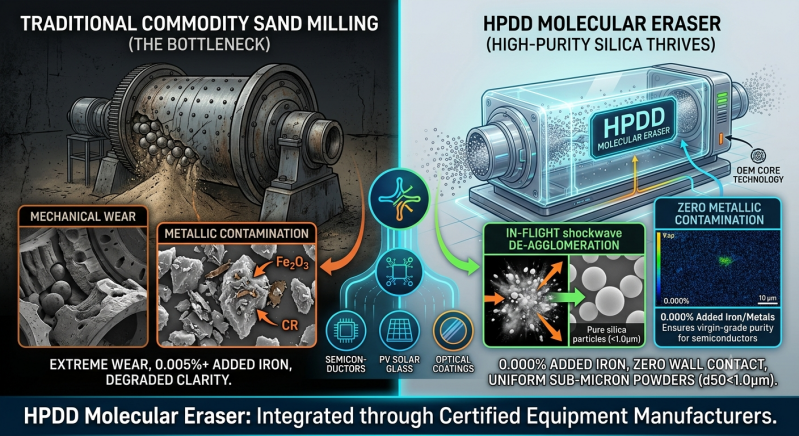
Why Commodity Sand Milling Misses the Point, and Where High-Purity Silica Thrives 💡⚙️
In bulk glass manufacturing, sand grain size is strictly bounded: too coarse, and it won't melt; too fine (<100\mu), and it causes dust, foam, and burner blow-off.
But shift the focus from commodity container glass to High-Purity Quartz (HPQ), Fumed Silica, and Advanced Micro-Silica, and the engineering challenges flip entirely.
In these high-value sectors, serving semiconductors, PV solar glass, optical coatings, and specialty composites, processing fine silica with traditional mechanical mills creates two major operational bottlenecks:
❌ Extreme Mechanical Wear: Silica is highly abrasive, causing continuous degradation of grinding media, liners, and rotors.
❌ Metallic Contamination: Microscopic wear particles from traditional mills introduce iron, degrading optical clarity and chemical purity.
This is precisely where the HPDD Molecular Eraser (In-Flight Processing) delivers a structural breakthrough:
🔹 In-Flight Shockwave De-agglomeration: Particles are reduced mid-air via gas-kinetic decompression, achieving uniform sub-micron powders with zero wall contact.
🔹 Zero Metallic Contamination: No grinding media means 0.000\% added iron or metallic impurities, preserving virgin-grade optical purity.
🔹 Zero Maintenance Downtime: Eliminates abrasive mechanical wear and coking, enabling 24/7 continuous operation.
🔹 Integrated Thermal Synergy: Operates in a closed-loop system with integrated heat recovery and optional cryogenic process cold (down to -73C).
(Note: Hydro Puls Direct-Drive is an OEM core technology provider. We do not deliver directly to end users, but integrate our HPDD modules exclusively through certified equipment manufacturers, system integrators, and engineering specialists).
Where do you see the biggest processing bottlenecks in high-purity material milling? Let’s exchange views in the comments! 👇