

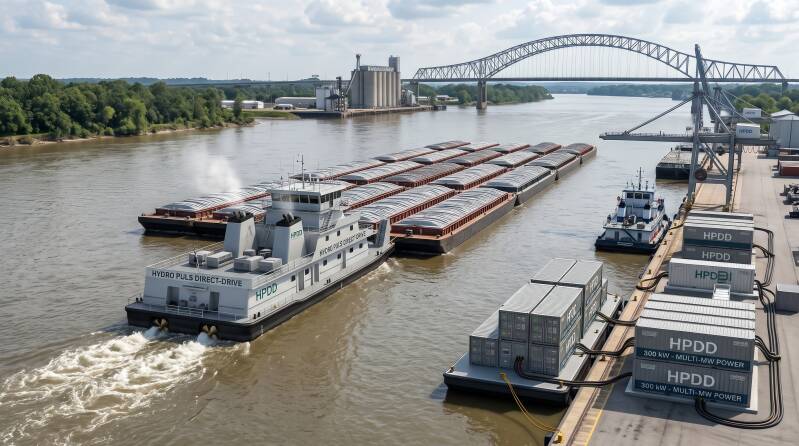
Decarbonizing the Mississippi River Basin: High-Torque Propulsion and Clean Shore Power for America’s Freight Artery 🚢⚡
The Mississippi River Basin is the backbone of North American bulk logistics, moving hundreds of millions of tons of grain, fertilizer, energy, and commodities annually.
Yet, this vital commercial corridor faces severe, converging operational challenges:
• Continuous Extreme Torque: Pushing flotillas of 20 to 40+ loaded barges upstream against heavy river currents requires continuous, multi-thousand-horsepower output.
• The Battery-Electric Dead End: Storing enough energy in lithium battery packs (BESS) for days-long upstream river transits would add thousands of tons of deadweight, drastically reducing cargo capacity.
• Strict Environmental & Community Pressure: Aging marine diesel engines generate immense NOx and particulate emissions across river towns and municipal ports.
• Grid Bottlenecks at River Terminals: Inland ports require heavy electrical capacity for crane operations and shore power (cold ironing), but local utility interconnects along the basin often lack transmission headroom.
The Hydro Puls Direct-Drive (HPDD) architecture provides a native, zero-emission solution designed for these heavy-duty duty cycles:
1. Crankshaft-Free Direct Hydrostatic Thrust (+600 Bar):
Delivers positive-displacement hydraulic power directly to high-torque river thrusters. Running natively on high-density zero-carbon fuels (such as green ammonia or hydrogen), it matches diesel torque curves without the weight penalties or thermal runaway risks of chemical batteries.
2. Containerized Modular Power Swarms for Ports:
Standardized 300 kW to multi-megawatt HPDD generation skids deploy directly onto floating barges or river quaysides. They supply firm, dispatchable shore power and microgrid stability for logistics terminals, entirely independent of utility substation queues.
3. Zero Liquid Discharge & Net-Positive Water Generation:
Instead of draining strained municipal river water or dumping cooling effluent, the platform operates a closed-loop heat cycle and actively condenses clean, technical-grade freshwater from clean-fuel exhaust streams.
Real corridor decarbonization requires heavy-duty engineering that respects the brutal physics of commercial river freight.
Explore our modular propulsion and microgrid platforms: www.hpdd.eu
#MississippiRiver #MRCTI #InlandMarine #Towboats #MaritimeDecarbonization #CleanTech #HydrogenPower #GreenAmmonia #HydroPulsDirectDrive #HPDD #InfrastructureResilience