

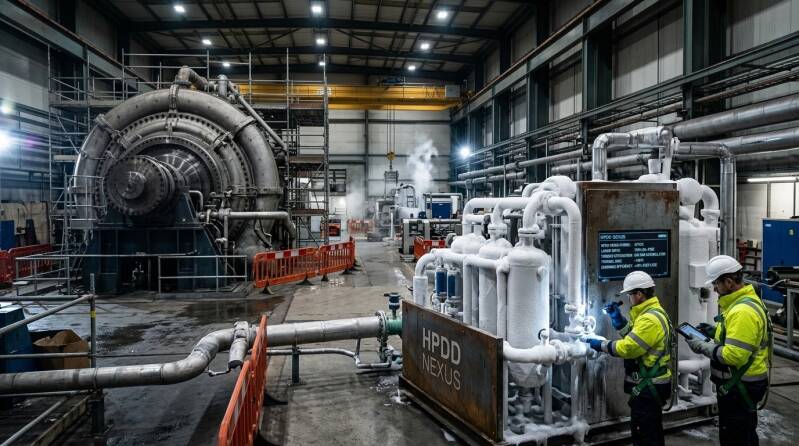
Many in heavy industry still swear by turbines. That is understandable, they have formed the backbone of power and process engineering for decades.
However, in an operational landscape demanding dynamic flexibility, modular scalability, and zero-compromise efficiency, legacy turbines are hitting hard thermodynamic and economic walls:
1. High fuel consumption off-design: Turbines are engineered for narrow, steady-state baseload sweet spots. The moment they modulate, thermal efficiency plummets and specific fuel consumption spikes.
2. Inflexible load following: High rotational inertia and aerodynamic constraints severely limit dynamic ramp rates and turndown ratios.
3. Crushing CAPEX & OPEX: Exotic superalloys, hot-gas-path coatings, and specialized lifecycle overhauls drive up total cost of ownership per megawatt.
The answer isn't speculative or unproven science.
It is smarter architectural integration of proven physics.
Hydro Puls Direct-Drive (HPDD) doesn't reinvent the laws of thermodynamics. Its performance is derived directly from fundamental physical principles, verified fluid dynamics, and mature industrial hydraulics. The mass and energy balances are governed by established science.
What changes is the physical architecture:
- Eliminating heavy rotating compressor trains, crankshafts, and mechanical friction.
- Replacing rotational inertia with a responsive linear direct-drive core that modulates effortlessly across variable process loads.
- Natively delivering deep cryogenic cooling (-180°C) without parasitic external refrigeration loops.
The future of industrial power generation is not about protecting 20th-century rotating machinery, it is about maximizing useful work from every unit of energy through cleaner physical design.
#PowerGeneration #Turbines #EnergyTransition #Thermodynamics #HPDD #CleanTech #Decarbonization #Engineering