

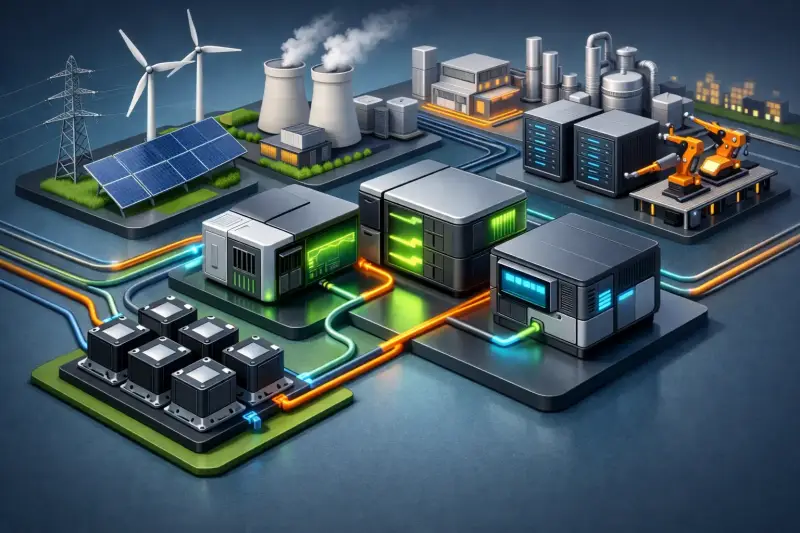
Best Industrial Power Architectures for 24/7 Loads
A cement kiln cannot accept power interruptions due to an undersized battery, a data center cannot treat cooling and electricity as isolated problems, and a desalination plant needs pressure, not premium electricity. Industrial sites consume work, heat, cooling, pressure, and stability, not merely kilowatt-hours.
Traditional designs centered on a generator set feeding downstream motors, compressors, and chillers are familiar but inefficient. Every conversion step imposes penalties. A resilient architecture matches the prime mover directly to the site's actual duty cycle.
Four Architectures for Industrial Demands
1. Grid-Connected with Storage: Logical for reliable grids and low thermal demand. The risks are grid congestion, demand charges, and outages. Batteries excel at short-duration power quality, but they are not an economical substitute for continuous process heat or heavy mechanical work.
2. Conventional CHP (Engines/Turbines): Proven for simultaneous electrical and thermal loads. The trade-off is rigid coupling: generation follows power demand, causing part-load efficiency drops and routing mechanical duties through lossy electrical conversions.
3. Renewables with Storage & Backup: Reduces fuel exposure and emissions, but critical operations cannot rely on annual generation averages. Sizing for worst-case lulls demands significant CAPEX in land, storage, and oversized backup capacity.
4. Direct-Drive Thermal-Hydraulic Architecture: Generates controlled fluid power directly for pumps, compressors, and machinery without mandatory intermediate electricity. By isolating the combustion core from downstream load shocks via hydraulic accumulators, the prime mover operates continuously at its optimal thermodynamic point. As framed by Hydro Puls Systems (Autonomous Energy Heart), this platform eliminates parasitic conversion steps and seamlessly integrates waste heat and cooling recovery.
Specify Around the Load, Not the Catalog
Rather than picking equipment first, map the complete site energy profile: electrical load, process heat by temperature tier, hydraulic/pneumatic pressure and flow, cooling, and water resilience.
Anchor to Base Load: Size the primary energy core for minimum continuous demand; assign transient peaks to hydraulic, thermal, or electrical buffers.
True Fuel Optionality: Planning for hydrogen or ammonia requires engineering materials, combustion control, delivery pressures, and safety into the base design from day one, not as an afterthought.
The most resilient industrial installation does not have the most components; it eliminates unnecessary conversion steps and allows the prime mover to operate strictly where physics favors it.