

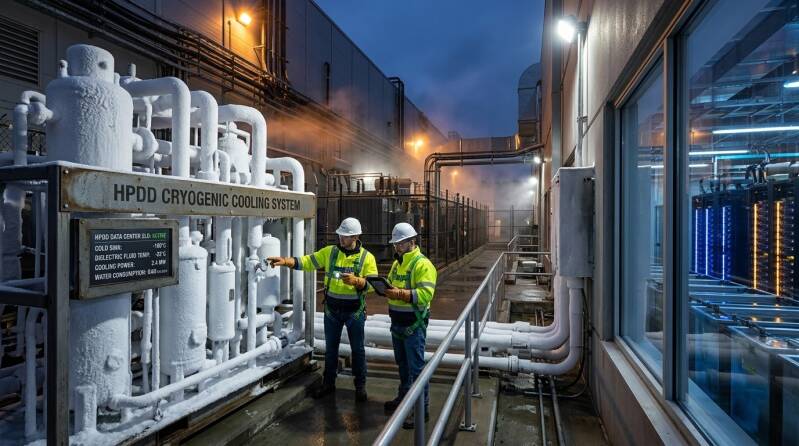
The real bottleneck of AI compute is no longer algorithmic. It is physical, thermal, and hydrological.
As high-density GPU clusters scale exponentially, the infrastructure supporting them is hitting a hard ceiling:
- Power grids are overloaded by parasitic cooling machinery.
- Evaporative cooling towers consume millions of liters of scarce fresh water daily.
- Conventional chillers introduce complex rotating failure modes and severe acoustic pollution.
The future of compute cannot rely on draining municipal water supplies or overloading grid substations.
The HPDD Solution: Closed-Loop Zero Liquid Discharge (ZLD) Cryogenic Cooling
Hydro Puls Direct-Drive (HPDD) addresses the problem directly at Layer 0—the physical foundation:
- Native Cryogenic Cold Sink (-180°C): HPDD delivers continuous deep cooling as an inherent process byproduct, bypassing energy-hungry external refrigeration loops.
- True Zero Liquid Discharge (ZLD): A completely closed dielectric immersion loop handles extreme chip-level thermal flux without consuming or evaporating a single drop of water.
- Off-Grid Autarchy: Eliminating parasitic chiller loads slashes overall facility power demand, allowing modular AI nodes to operate independently alongside dedicated microgrids.
- Zero Mechanical Vibration & Noise: A crankless, linear direct-drive core eliminates the mechanical wear, noise pollution, and maintenance overhead of conventional rotating compressor plants.
Scaling next-generation compute requires solving thermodynamics from the foundation up.
#ArtificialIntelligence #DataCenters #ImmersionCooling #ZLD #CleanTech #HPDD #HighPerformanceCompute #DeepTech