

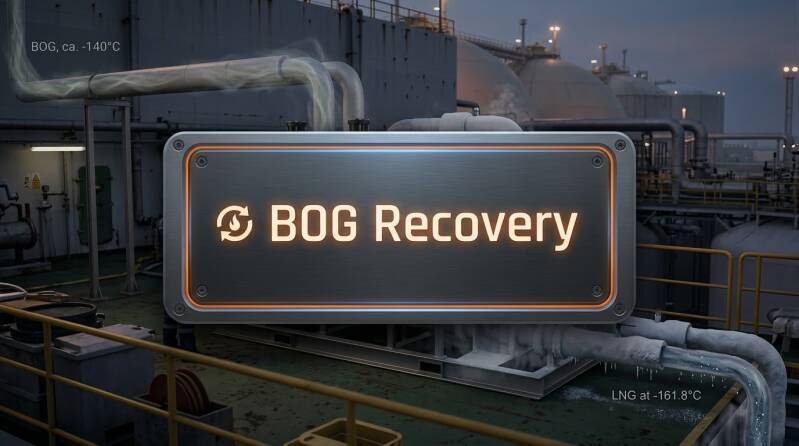
Why flare or re-compress Boil-Off Gas when you can reliquefy it natively at the source?
During LNG storage and marine transport, external thermal ingress continuously vaporizes cargo: Boil-Off Gas (BOG).
Managing this boil-off traditionally demands massive, maintenance-intensive multi-stage compressor trains with gearboxes and electric motors, or forces operators to burn and flare valuable product.
Hydro Puls Direct-Drive (HPDD) solves this operational bottleneck at the physics level:
* Direct Reactive Pulse Pressure: Completely eliminates rotating drivetrains, crankshafts, and heavy machinery foundations.
* Inherent -180°C Cryogenic Sink: Deep cold duty delivered as a direct, zero-parasitic byproduct of the reaction cycle.
* 100% Liquid Recovery: Cold vapor BOG (approx. -140°C) is directly sub-cooled across a compact heat-exchanger core back into stable liquid LNG (-161.8°C) returned to the cargo tanks.
* Flat Part-Load Efficiency: Boil-off fluctuations driven by weather or sea states are managed simply by modulating pulse frequency (e.g., 18.5 Hz) rather than throttling valves, maintaining peak thermodynamic efficiency.
A compact, modular skid engineered to eliminate mechanical wear, methane slip, and flaring across LNG carriers, FSRUs, and bunkering terminals.
How is your engineering team tackling boil-off gas handling and parasitic reliquefaction loads on floating assets?
#LNG #Cryogenics #BoilOffGas #BOG #Maritime #HPDD #EnergyEfficiency #FLNG #Decarbonization #CleanTech