

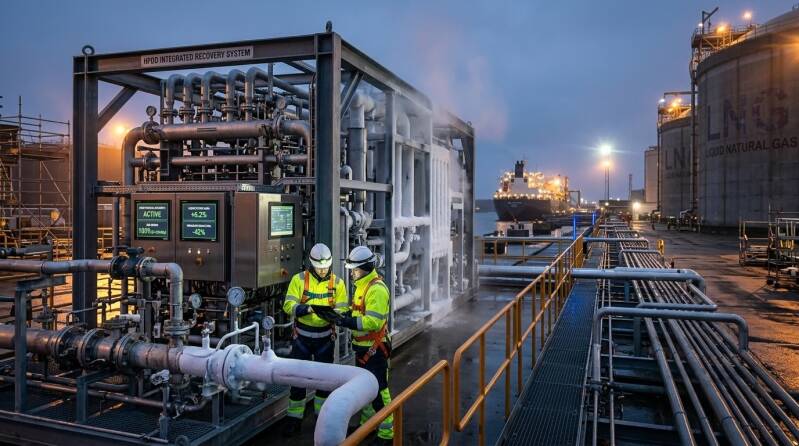
What happens when you combine HPDD liquefaction and HPDD BOG recovery?
The numbers speak for themselves.
In the conventional LNG supply chain, a staggering fraction of feed gas is burned simply to keep the process cold.
When you integrate HPDD liquefaction with HPDD BOG reliquefaction, the cumulative energy recovery transforms project economics:
The Numbers:
* 35% to 45% reduction in parasitic power:
Heavy, fuel-hungry rotating compressor trains are removed at the source.
* +5% to +7% more saleable LNG:
Gas that would otherwise be combusted on-site to generate refrigeration is preserved as deliverable product.
* 100% Boil-Off Gas (BOG) recovery:
Continuous storage and transit vaporization (typically 0.10% to 0.15% per day) is natively condensed back to liquid using the inherent -180°C cryogenic sink.
* Zero flaring, zero methane slip:
Eliminates wasteful vent stacks and auxiliary combustion across cargo holds, FSRUs, and terminals.
The Global Impact:
Across a global production base exceeding 400 million tonnes of LNG per year, this unified exergy loop yields:
* Tens of billions of cubic metres of preserved natural gas delivered to market without drilling a single new well.
* Millions of tonnes of avoided CO₂ emissions by cutting parasitic combustion at the plant and at sea.
* Structurally lower unit costs, boosting operator margins while putting downward pressure on wholesale gas prices for end consumers.
True energy efficiency means stopping the practice of burning clean fuel just to produce cold.
#LNG #Cryogenics #BoilOffGas #BOG #EnergyEfficiency #Sustainability #HPDD #CleanTech #Decarbonization