

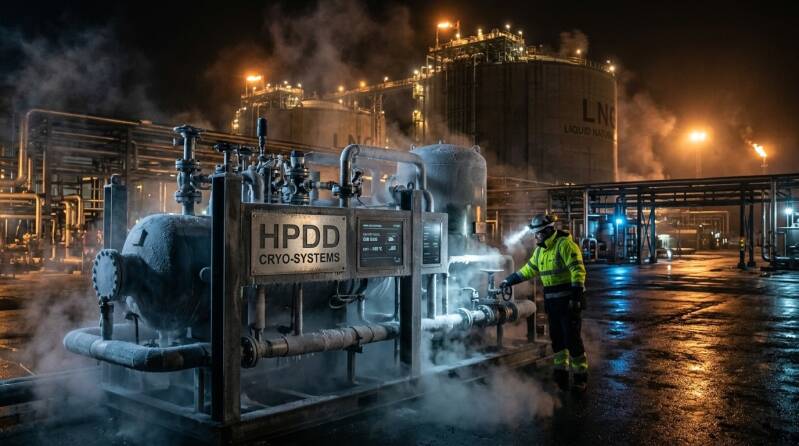
Unlocking Billions of Cubic Metres of Natural Gas Without Drilling a Single New Well.
Over 400 million tonnes of LNG are produced globally each year. Yet, one staggering operational reality often goes unnoticed:
Between 8% and 15% of the total feed gas is burned right at the liquefaction plant, solely to run massive rotating compressors and turbines to chill the gas down to -162°C.
Burning fuel to make cold is modern industry's greatest thermodynamic tax.
With Hydro Puls Direct Drive (HPDD), we eliminate this compression bottleneck at the physics level:
By transforming reactive pulse dynamics directly into high-pressure drive and delivering deep cryogenic temperatures (-180°C) as a zero-parasitic native byproduct, external rotating turbomachinery becomes obsolete.
The Triple-Win for the Global Energy Market:
• More Gas for the World: Slashing parasitic liquefaction energy by 35% to 45% immediately preserves tens of billions of cubic metres of clean natural gas worldwide.
• Higher Margins for Operators: Converting parasitic fuel losses into saleable export LNG yields a +5% to +7% product boost, generating millions in recurring annual cashflow per plant with drastically lower CAPEX.
• Competitive Energy for Consumers:
Increasing net delivered volume without inflating production or exploration costs exerts downward pressure on wholesale gas prices, delivering tangible relief to household utility bills and industrial users.
• Direct Decarbonisation: Eliminating massive on-site turbine combustion prevents millions of tonnes of industrial CO₂ emissions annually at the source.
Energy security and sustainability do not always require drilling more; they require wasting less.
How is your engineering team approaching parasitic refrigeration loads in LNG and FLNG infrastructure?
#LNG #Cryogenics #FLNG #Decarbonization #EnergyTransition #ProcessEngineering #HPDD #CleanTech #IndustrialInnovation