Stop Treating Maritime Sludge as Inevitable Waste: Solve the Problem Pre-Combustion
A typical 100,000 DWT container vessel running on heavy fuel oil generates 30 to 40 tons of toxic sludge every single month. Under tightening MARPOL Annex VI regulations, offloading this waste ashore costs shipowners tens of thousands of dollars per port call.
Why wait for heavy hydrocarbons to drop out as waste when you can optimize combustion directly at the source?
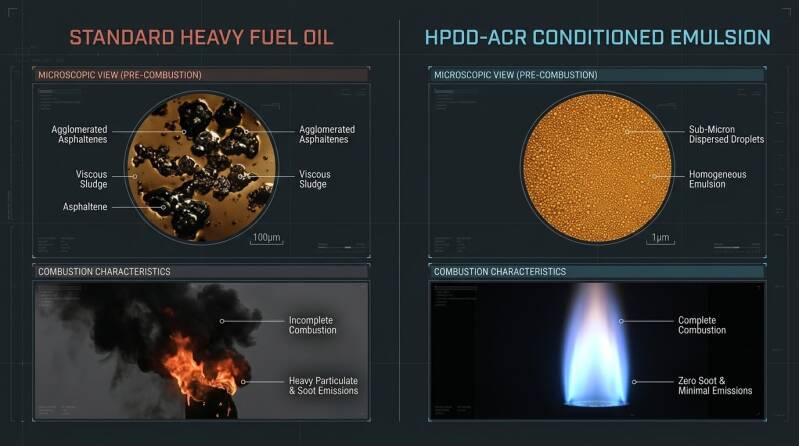
The core challenge of heavy bunker fuels (HFO / VLSFO) is physical rather than chemical: asphaltenes and heavy paraffins agglomerate into unstable micelles. These clusters atomize poorly, burn sluggishly, and drop out inside separators and settling tanks.
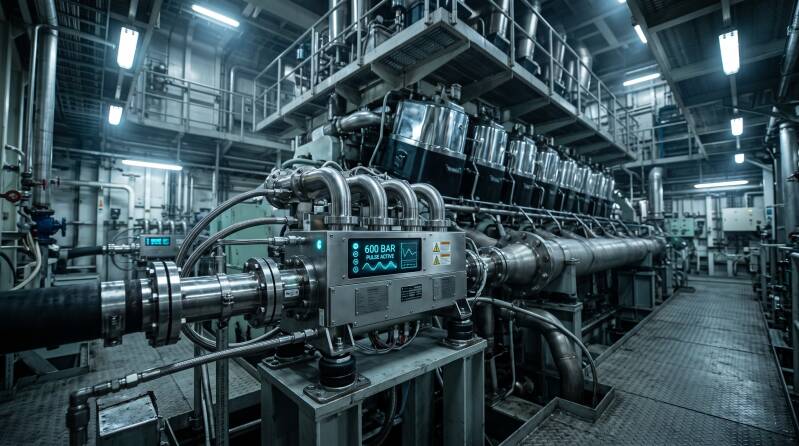
By deploying pre-combustion acoustic cavitation via the HPDD-ACR module directly in the fuel feed line ahead of the high-pressure injectors, fuel dynamics change completely:
• Mechanical Asphaltene De-agglomeration: High-frequency acoustic shockwaves physically dismantle heavy molecular clusters without chemical additives, immediately lowering dynamic viscosity.
• Secondary Micro-Explosions: Encapsulating a tiny, stable fraction of water droplets (<2 µm) induces flash vaporization inside the cylinder. This tears the surrounding oil droplet apart from the inside out, driving near-total combustion.
• Acoustic Cat Fines Isolation: Abrasive catalytic fines (silicon and aluminum) are sheared away from the viscous oil matrix and separated before reaching fuel pumps and cylinder liners.
Operational & Environmental Metrics:
• 60% to 80% reduction in onboard sludge generation
• 40% to 60% reduction in black carbon and particulate matter (PM)
• 15% to 25% lower NOx emissions via latent peak-temperature buffering
• 2% to 4% net reduction in Specific Fuel Oil Consumption (SFOC) at identical shaft output
Coupled with an onboard HPDD-ACR-VCD unit for any residual streams, this turns heavy marine fuel into a clean, closed-loop asset: lower fuel bills, reduced engine wear, and zero reliance on costly shore offloading.
How is your fleet engineering team approaching pre-combustion fuel conditioning versus downstream waste management?
#MaritimeEngineering #ShippingDecarbonization #CleanTech #MarineFuel #HPDD #SludgeReduction #EmissionsReduction #SustainableShipping #MarineIndustry