Transforming Maritime Sludge from an OPEX Tax into Recoverable Fuel & Dry Minerals
Every month, a standard 100,000 DWT container vessel running on heavy fuel oil generates roughly 30 to 40 tons of dense, toxic shipboard sludge. Under tightening MARPOL Annex VI regulations, offloading this hazardous waste ashore has become a brutal operational expense for shipowners worldwide.
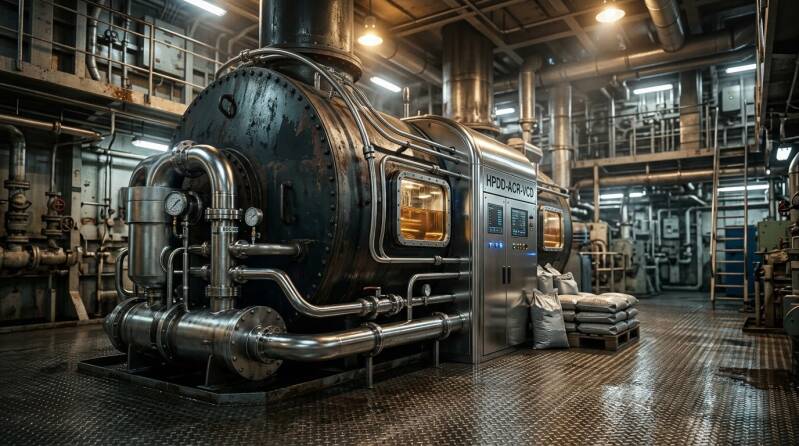
While traditional onboard marine incinerators sit decommissioned across global fleets due to emission limits, their heavy, insulated bodies offer the ideal brownfield shell for advanced zero-emission processing.
The real engineering bottleneck has always been thermal cracking: attempting to flash-vaporize heavy asphaltenes and unburned lube oil inside high-temperature coils inevitably triggers severe coking, inner-wall fouling, and system clogs.
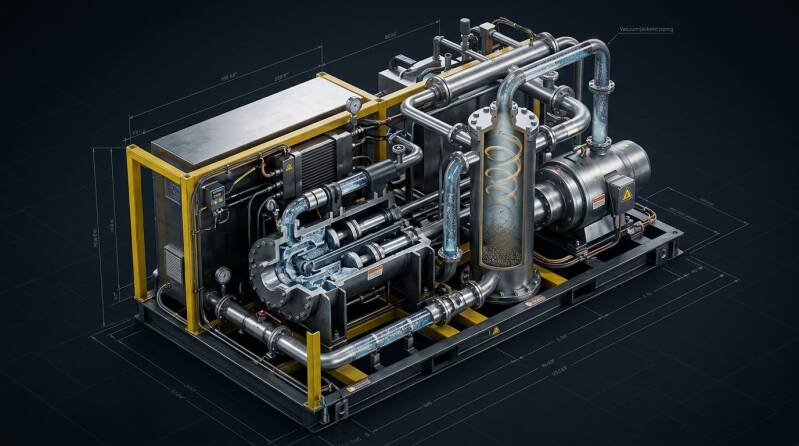
By shifting from brute-force surface heating to the HPDD-ACR-VCD (Acoustic Cavitation Reactor / Vapor Compression Distillation) platform—the exact physics deployed for heavy oil sands separation—the equation changes completely:
1. Acoustic Shearing Over Thermal Shock (ACR)
High-frequency acoustic pulse waves tear the stubborn water-in-oil emulsion apart at the molecular boundary layer. Micro-implosions mechanically detach trapped water and lighter hydrocarbon chains without localized wall overheating or pyrolysis carbon build-up.
2. Closed-Loop Phase Separation (VCD)
Instead of forcing the stream through vulnerable heated coils, the energized mass enters a dynamic vapor compression separation chamber:
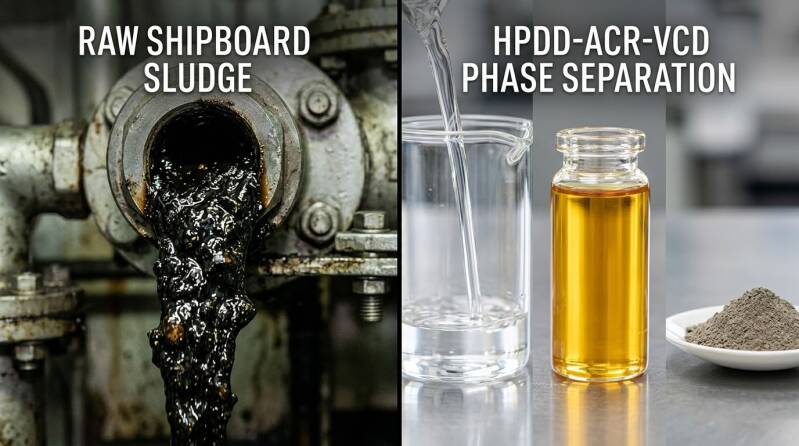
• Clean Steam: Recovered cleanly for onboard boiler feed or heat integration.
• Recovered Fuel Fractions: Lighter hydrocarbons vaporize and condense into usable clean gas oil, immediately lowering onboard fuel consumption.
• Dry Mineral Ash: Heavy metals, catalyst fines, and coke particles drop out continuously as inert, dry dust that fits into a few sealed bags for low-cost onshore disposal.
3. Brownfield Simplicity & Zero-Coking Reliability
Leveraging the existing shipboard sludge pump, front-end homogenizer, and decommissioned incinerator containment shell creates an ultra-compact, modular retrofitting skid with near-zero added footprint.
Turning 40 tons of toxic maritime liability into usable fuel and inert mineral dust proves that high-frequency pulse dynamics can solve shipping's dirtiest waste stream at sea.
#MaritimeTech #ShippingDecarbonization #MarineEngineering #SludgeTreatment #AcousticCavitation #CleanTech #VCD #WasteToEnergy #CircularEconomy