

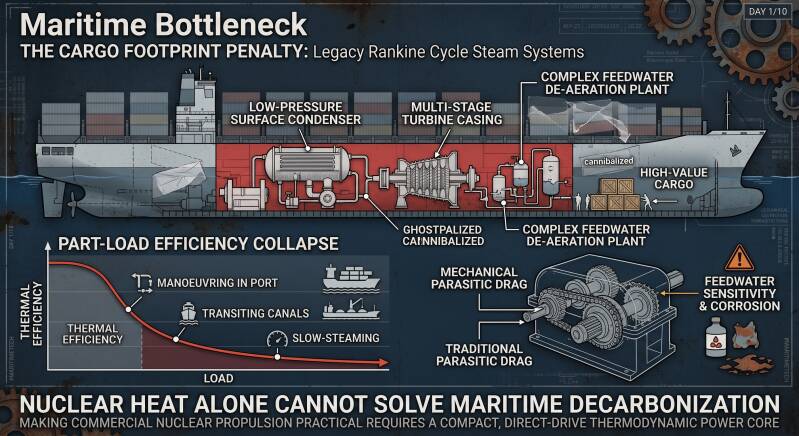
Day 1/10: The Maritime Bottleneck — Why Conventional Nuclear Conversion Fails at Sea
The maritime industry faces an urgent mandate to decarbonize, and while Small Modular Reactors (SMRs) are widely discussed as the ultimate clean heat source, commercial adoption continues to hit a fundamental engineering barrier: relying on legacy Rankine steam turbine cycles.
Nuclear propulsion is not new, but attempting to scale down land-based or military steam systems for modern commercial cargo vessels creates severe operational and economic bottlenecks:
* The Cargo Footprint Penalty: Classic steam systems require sprawling low-pressure surface condensers, massive multi-stage turbine casings, and complex feedwater de-aeration plants. In commercial freight, this heavy balance-of-plant (BoP) directly cannibalizes high-value cargo and displacement volume.
* The Part-Load Efficiency Collapse: Commercial shipping operates dynamically, manoeuvring in port, transiting restricted canals, and slow-steaming across oceans. Traditional Rankine cycles suffer catastrophic drops in thermal efficiency under partial loads due to steam throttling and irreversible pressure drops across control valves.
* Mechanical Complexity & Transmission Losses: High-RPM steam turbines require heavy reduction gearboxes to turn low-RPM propeller shafts. These massive drivetrains introduce significant mechanical parasitic drag, vibration, and heavy maintenance regimes that complicate autonomous, long-endurance voyaging.
* Feedwater Sensitivity & Corrosion: Maintaining ultra-pure demineralized water in harsh, corrosive marine environments demands continuous chemical treatment and multi-loop isolation to prevent scaling and phase-change failures.
Nuclear heat alone cannot solve maritime decarbonization if the conversion system remains trapped in 19th-century steam mechanics. Making commercial nuclear propulsion practical requires a compact, direct-drive thermodynamic power core capable of flat efficiency curves across the entire load spectrum.
Tomorrow in Day 2: The SMR–HPDD-Nexus Core — Direct Thermal-to-Pulse Power Conversion.
#MaritimeTech #NuclearPropulsion #SMR #Decarbonization #CleanShipping #Thermodynamics #DeepTech #MarineEngineering