Why are we still crushing cement with steel balls in 2026 (when physics can do it 40% smarter)?
Making cement currently requires grinding rock-hard clinker nodules into powder.
The traditional method?
Throw thousands of heavy steel balls into a massive rotating drum and mechanically smash the rocks for hours.
The drawbacks:
• Enormous amounts of electricity wasted solely on mechanical friction.
• Kilograms of worn-out steel debris ending up directly in the cement.
• Uneven, coarse grains where a large portion barely reacts with water.
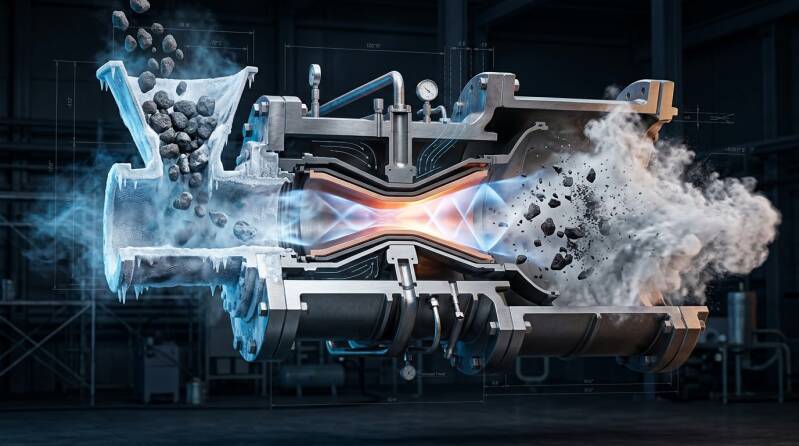
With Hydro Puls Direct-Drive (HPDD), we achieve fine powder without a single rotating grinding part:
1. The "Ice Cube" Trick (-70°C):
An ice cube straight from the freezer shatters effortlessly when tapped. We chill the hot clinker nodules down to -70°C using the free, cold byproduct of our gas expansion loop. Below its glass-transition threshold, the rock turns glass-brittle.
2. The "Aerosol Spray" Effect (Mach 2.5):
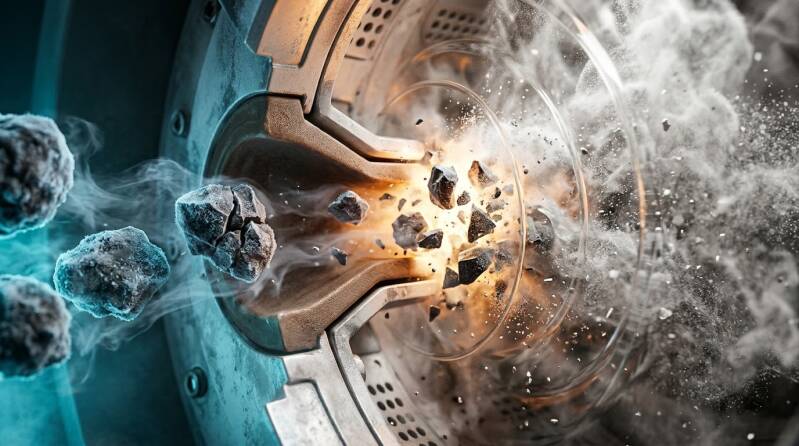
Just like a spray can hissing out under pressure, we feed those brittle grains through a ceramic nozzle. In an instant, the pressure plunges from 371 bar down to 1 bar.
3. Mid-Air Shatter (1.5 seconds):
That sudden decompression wave causes the grains to flash-shatter mid-air along their natural crystal fracture lines. No grinding balls, no rollers, just an acoustic shockwave.
The result: "1-Micron Cement"
Zero coarse chunks, just an ultra-uniform, microscopic powder.
What does this mean for a concrete plant?
Because these microscopically fine particles pack densely into voids and react instantly with water, you need 30% to 40% less cement to pour a wall with the exact same strength.
Less cement consumption means an immediate drop in CO2 emissions and lower production costs.
Stop smashing rocks with brute force. Let physics do the work.
#Cement #Concrete #ConstructionTech #Innovation #HydroPulsDirectDrive #CleanTech #Sustainability