

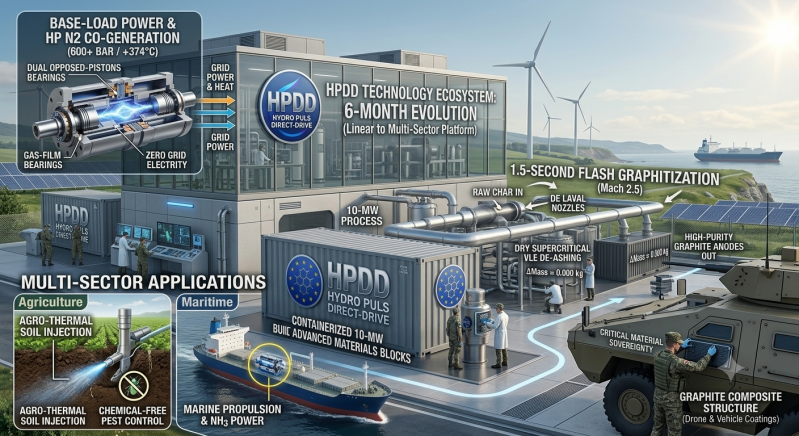
🚀 The 6-Month Evolution of Hydro Puls Direct-Drive (HPDD): From Linear Propulsion to a Multi-Sector DeepTech Platform
Over the past six months, what began as an advanced direct-drive linear engine architecture has matured into a versatile, high-pressure poly-generation platform disrupting energy, metallurgy, and heavy industry.
Here is a recap of how the HPDD core technology has advanced across key pillars:
⚡ 1. Extreme Pressure & Thermodynamic Baseline
• Standardized the core operating platform to 600+ bar and +230°C steady-state thermal architecture.
• Validated dual opposed-piston dynamics (2 pairs) utilizing self-sustaining gas-film bearings and unpressurized siloxane fluid management.
• Integrated precision Inconel 718 metallurgy with micrometer-scale thermal expansion clearance matching (109 µm bore-to-piston tracking).
🔋 2. Flash Graphitization & Battery Metallurgy
• Developed the continuous 1.5-second Mach 2.5 flash-graphitization loop, bypassing weeks of high-energy Acheson thermal baking.
• Introduced dry supercritical VLE de-ashing (Patent 17) to drop inorganic ash below < 2.0% under a strict closed-loop mass conservation standard (ΔMass = 0.000 kg).
• Positioned localized synthetic graphite synthesis as a cornerstone for European critical raw material and defense sovereignty.
🌾 3. Decentralized Poly-Generation & Agronomic Sovereignty
• Expanded the multi-physics application suite into modular 10-MW skids delivering baseload power (70–80% thermal efficiency), hyperthermal heat (+374°C), and sub-zero cryogenic chilling (-73°C) simultaneously.
• Deployed chemical-free agro-thermal soil injection using co-generated high-pressure nitrogen vectors to eradicate pests while safeguarding the natural soil microbiome.
🚢 4. Maritime & High-Frequency Power Scaling
• Solidified the high-frequency roadmap toward 200 Hz / 160 kW high-density units for next-generation marine propulsion and clean ammonia (NH3) power generation.
• Engaged maritime, cleantech, and process industry leaders to integrate zero-emission thermodynamic cycles into industrial fleets and micro-grids.
Scaling disruptive hardware requires relentless commitment to first principles, precision mechanics, and closed-loop thermodynamics. The next phase: publishing third-party pilot validation datasets and rolling out modular industrial deployments.
#HydroPuls #HPDD #DeepTech #EngineeringInnovation #EnergyTransition #SyntheticGraphite #CleanTech #Thermodynamics #BatteryMetallurgy