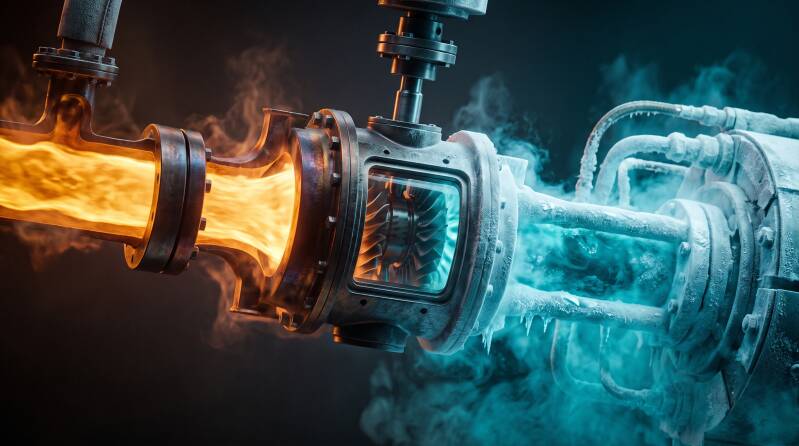
A major thermodynamic breakthrough for commercial fusion: turning the cryogenic parasitic load into a net power generator.
Huge credit to our engineering team for cracking this energy puzzle.
In magnetic confinement fusion (Tokamaks, Stellarators, HTS systems), hitting a scientific surplus in the plasma (Q_plasma > 1) is only half the battle. The true hurdle for commercial deployment is delivering net electricity to the grid (Q_electric > 1).
The silent bottleneck behind the scenes?
The cryogenic plant.
To keep high-temperature superconducting (HTS / REBCO) magnets cold, conventional cryoplants consume tens of megawatts of parasitic electricity. Over 40% of that massive draw is wasted simply pre-cooling gases from ambient temperature (+20°C) down to the 80 K baseline.
Thanks to the hard work and thermodynamic modeling of our engineering team, our Hydro Puls Direct-Drive (HPDD) architecture has re-engineered this balance from the ground up:
Instead of using heavy, multi-stage electric compressors to "fight" thermal loads, our team engineered a way to route a dense, closed-loop Nitrogen stream (600 bar) through a two-stage thermodynamic cascade:
1. Isobaric ORC Power Extraction:
At a steady 600 bar, high-grade enthalpy is tapped from 374°C down to 80°C via an integrated Organic Rankine Cycle (ORC)—generating secondary net electricity first.
2. Isentropic Turbo-Expansion:
The pre-cooled, ultra-dense gas is then expanded from 600 bar down to 1 bar. Because mechanical shaft work is extracted during the stroke (W = ∫V dP), our engineers pushed the exhaust temperature well past our previous -93°C mark, reaching an astonishing -168°C to -182°C (91 K to 105 K).
The operational impact on a fusion facility:
• Bridges up to 95% of the thermal lift between ambient (+20°C) and the 80 K magnet radiation shields.
• Zero additional grid electricity required for this cooling stage.
• Slashes overall cryoplant electrical demand by 35% to 45%—preserving 12 to 15 MW of firm power on a 35 MW cryoplant that flows directly to the grid instead of parasitic motors.
Cryogenic cooling no longer needs to be a multi-megawatt tax on fusion energy. When engineered as an integrated thermodynamic byproduct, it becomes a power-generating asset.
Proud of what our engineering team has achieved here. Commercial fusion will be won on the balance-of-plant energy ledger.
#NuclearFusion #DeepTech #EngineeringExcellence #CleanEnergy #Superconductivity #HTS #Cryogenics #Thermodynamics #HydroPulsDirectDrive #Innovation