

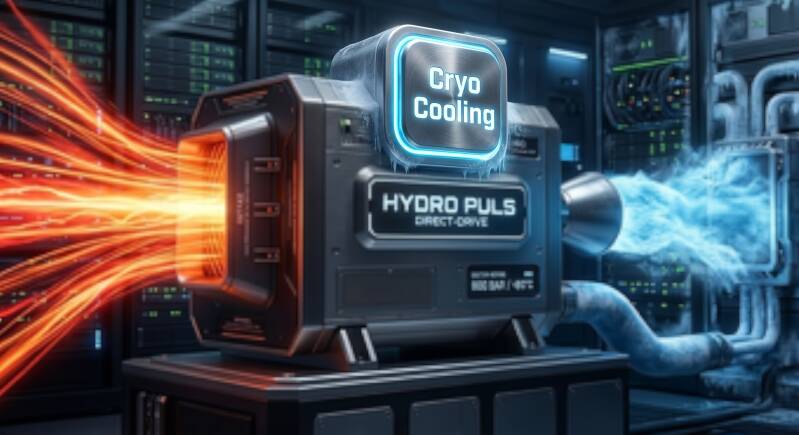
Why generating cold in 2026 is still a thermodynamic mistake (and how it can actually be free):
If you are driving a car downhill, would you floor the accelerator while slamming both feet on the brakes?
Of course not. Yet that is precisely how the modern world generates refrigeration.
Even with today's advanced heat pumps and chillers, we dump enormous amounts of high-grade electricity into heavy rotating compressors. We burn energy, lose over 40% to mechanical friction and grid losses, and then use that remaining power to force a machine to push heat uphill against nature.
As a result, cooling has quietly become one of the single largest power drains on the planet.
With Hydro Puls Direct-Drive (HPDD), we flip that logic entirely: cooling shouldn't cost electricity—it should be a free, natural byproduct.
How?
When our crankless reaction core delivers work, it does so via direct fluid displacement against a hermetically sealed gas matrix (600 bar).
When that compressed gas expands to transfer work, fundamental thermodynamics take over: isentropic expansion forces the gas to cool rapidly and deeply—reaching down to -73°C.
The result:
1. Zero parasitic electricity: The deep cold occurs spontaneously during the expansion stroke that is already delivering useful mechanical work.
2. Simultaneous clean power and process work: While deep refrigeration is generated, the system simultaneously drives direct hydraulic output or baseload electricity.
3. Zero mechanical failure points: No rotating compressor shafts, no leaking mechanical seals, and no high-GWP chemical refrigerants escaping into the atmosphere.
Wherever 24/7 continuous cooling is required—from AI data centers and cold-storage logistics to syngas processing, gas liquefaction, and fusion pre-cooling—running dedicated electric chillers is stranded capital.
Stop stepping on the gas while slamming on the brakes. Let the physics roll downhill.
#CleanTech #EnergyTransition #Thermodynamics #IndustrialCooling #HydroPulsDirectDrive #Decarbonization #DeepTech #DataCenters