"Won’t that machine tear itself to pieces?"
It is the single most common question from engineers when they first hear about the extreme kinetic forces inside our Acoustic Cavitation Reactor (ACR).
People immediately picture conventional industrial size-reduction machinery:
• Blades dulling and chipping.
• Rotor-stator teeth shearing under shock loads.
• High-maintenance grinders and shredders being chewed up by abrasive friction.
That skepticism is completely valid—if you are trapped in the mindset of metal-on-metal mechanics. The ACR operates on a fundamentally different physical principle.
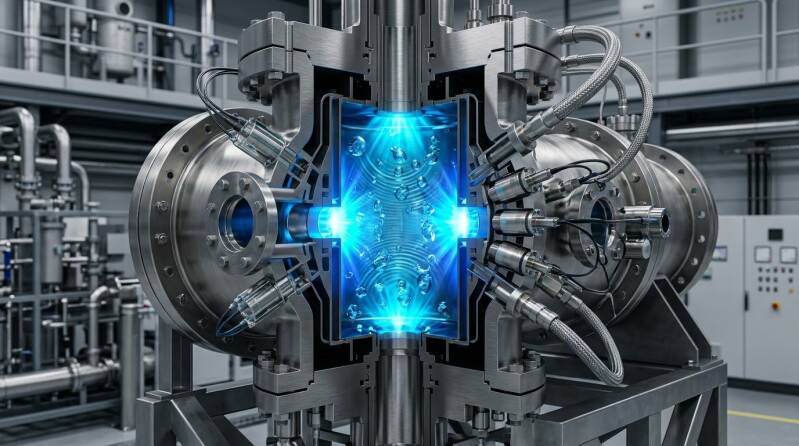
There are no mechanical cutters, spinning knives, or impact hammers inside the ACR.
The brute force is entirely executed and absorbed by—and within—dense nitrogen at 600 bar.
The fluid dynamics behind it:
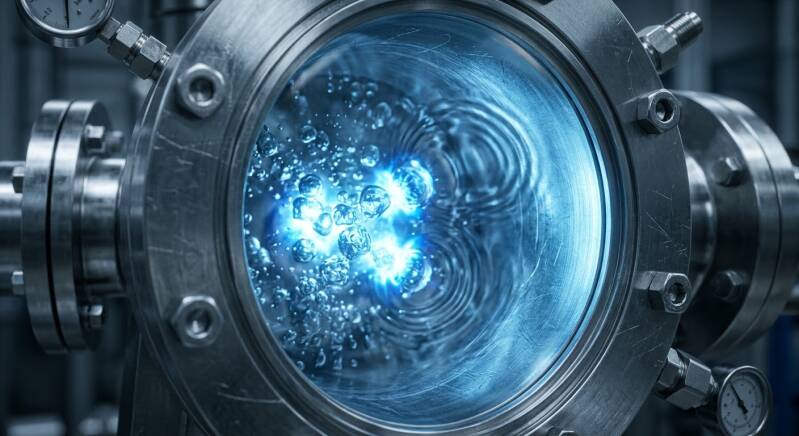
1. Zero Mechanical Contact Surfaces: Instead of mechanical shear plates, ultrasonic pressure waves and cavitation micro-implosions propagate directly through the fluid matrix.
2. A Fluid Anvil: The dense nitrogen phase under 600 bar acts as the kinetic hammer. Molecular collisions and violent shockwaves occur entirely inside the fluid itself.
3. An Inherent Hydrostatic Cushion: That exact same 600-bar nitrogen matrix hydrostatically absorbs the released energy immediately after the collapse.
The operational result:
Zero mechanical abrasion. Zero dulling cutting edges. Zero fatigue failure of rotating parts. Exactly 0 wear on that front.
When you stop trying to force matter with moving steel and let the physics of high-density fluid dynamics deliver the work, maintenance-heavy destruction turns into zero-wear process intensification.
#HydroPulsDirectDrive #ProcessIntensification #FluidDynamics #ChemicalEngineering #DeepTech #Cavitation #CleanTech