

⚡ The Invisible Revolution: Why Supercritical Gases Are Redefining Process Metallurgy and Clean Energy
When a gas is driven past its thermodynamic critical point, the classical boundary between liquid and gas dissolves. What emerges is a supercritical fluid: a phase possessing the density of a liquid alongside the transport properties and gas-like diffusivity of a gas.
In legacy industrial engineering, gases are treated primarily as inert carriers or simple combustion working fluids. Under extreme thermodynamic parameters, however, supercritical media (such as supercritical N₂, CO₂, and steam) transform into highly tunable reaction vectors that rewrite fundamental thermochemical processing.
Key drivers behind the supercritical transformation:
🔹 1. Rapid Mass Transfer & Zero Surface Tension
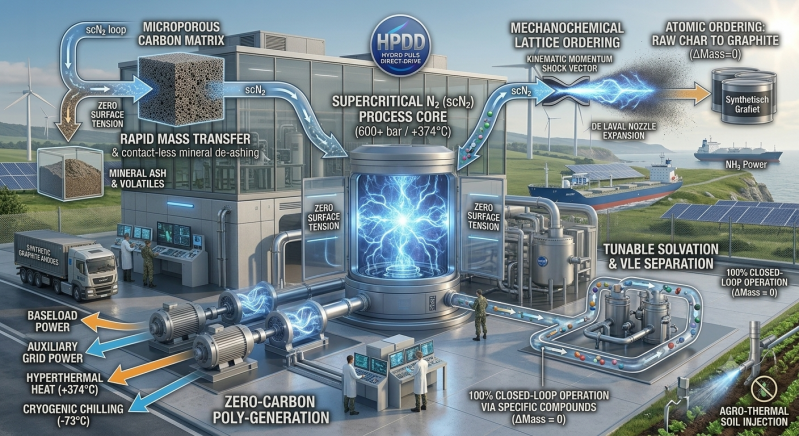
With zero surface tension, supercritical fluids effortlessly penetrate microporous carbon matrices down to the atomic scale. This unlocks contactless extraction, rapid volatile stripping, and precise mineral de-ashing without relying on toxic acid-washing lines.
🔹 2. Mechanochemical Lattice Ordering
At extreme pressures (600+ bar) coupled with supersonic expansion, supercritical vectors act as high-momentum shock carriers. Instead of requiring weeks of equilibrium baking in conventional furnaces, targeted kinetic energy inputs force carbon atoms into ordered crystalline lattices (such as battery-grade synthetic graphite) within fractions of a second.
🔹 3. Tunable Solvation & Closed-Loop Separation (VLE)
Micro-adjustments in pressure and expansion dynamics across De Laval nozzle geometries instantaneously alter the fluid’s solvating capacity. Solid particulates, mineral phases, and volatilized fractions separate cleanly through vapor-liquid equilibrium (VLE), keeping process architectures completely sealed with strict mass conservation (Delta\Mass} = 0).
🔹 4. Zero-Carbon Poly-Generation & Thermal Recovery
Supercritical expansion systems deliver exceptional thermal-to-mechanical conversion efficiencies. Capturing kinetic energy directly across the non-equilibrium expansion boundary enables simultaneous direct-drive power, baseload electricity, and high-enthalpy thermal management without parasitic auxiliary loads.
Transitioning from slow, thermal-equilibrium batch processing to dynamic, non-equilibrium gas kinetics marks the end of inefficient legacy furnaces and chemical leaching.
The future of advanced material synthesis and energy infrastructure belongs to mastering the supercritical regime.
#SupercriticalFluids #Thermodynamics #DeepTech #ProcessEngineering #MaterialScience #CleanTech #Innovation #Graphitization #HydroPuls