When a technical debate turns personal, it usually means you have hit the exact pressure point of an entire industry.
In discussions surrounding the maritime energy transition and alternative fuels, the same pattern keeps repeating:
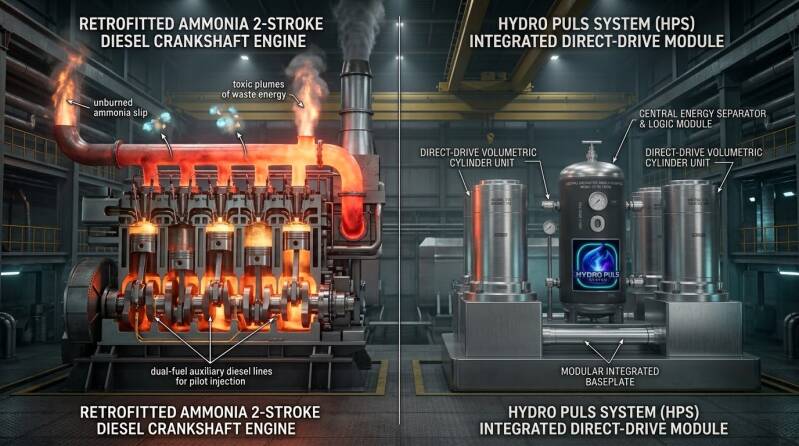
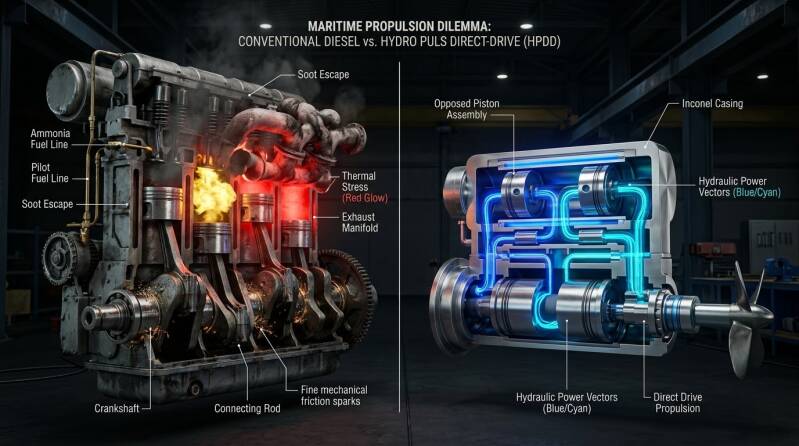
Legacy thinking desperately attempts to force 21st-century, zero-carbon molecules (like green ammonia) into 19th-century reciprocating crankshaft engines.
When you point out the uncompromising laws of thermodynamics:
• Ammonia’s laminar flame velocity is 5 to 10 times slower than diesel;
• A crankshaft forces the piston downward immediately after Top Dead Center, right when the fuel requires dwell time under peak pressure;
• A "diesel pilot" (5% to 15% fossil fuel) is not an innovation, but a mechanical crutch to prevent flame blowout;
• And over two-thirds (65%+) of costly zero-carbon fuel is destroyed directly as waste heat through exhaust blowdown and cylinder cooling...
...the substantive counter-arguments quickly dry up.
Why? Because you are not merely identifying a component constraint; you are exposing the obsolescence of an entire mechanical paradigm.
If a fuel cannot sustain autonomous combustion inside a machine without a fossil pilot flame, the problem does not lie with the molecule. It lies with the mechanism.
Real industrial decarbonization will not come from bolting on ever-larger SCR scrubbers, complex dual-fuel manifolds, or redundant bunkering systems. It requires rethinking the conversion architecture from the ground up:
Crankless, direct-drive, and hermetically sealed (like the Hydro Puls Direct-Drive platform).
Let thermodynamics and empirical data lead the discussion. Physics never bends to legacy consensus.
#MaritimeEngineering #Thermodynamics #Decarbonization #GreenAmmonia #HPDD #HydroPulsDirectDrive #CleanTech #DeepTech #Innovation #FutureOfShipping