Let's resolve a persistent misconception once and for all:
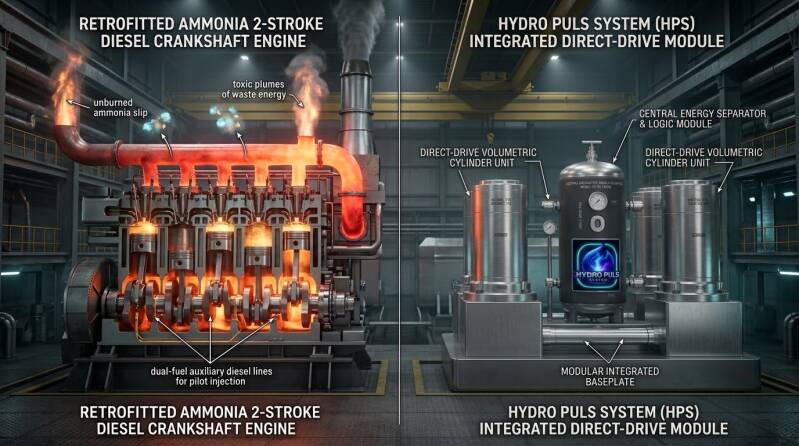
The Hydro Puls Direct-Drive (HPDD) platform is NOT an internal combustion engine.
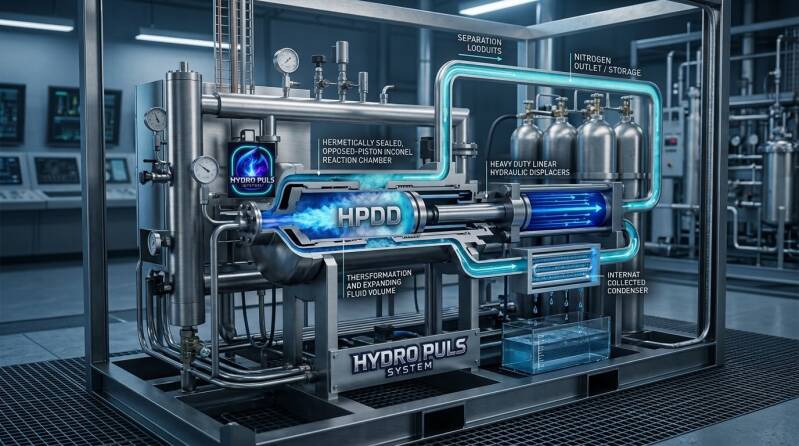
Viewing HPDD through the lens of crankshafts, spark plugs, and exhaust manifolds completely misses the physics behind the technology. HPDD is a hermetically sealed, crankless chemical reactor that couples thermochemical conversion directly to linear fluid power.
There is no exhaust. There are no flue gases. There are zero atmospheric emissions.
What does this reactor actually do?
1. Direct Generation of Stiff Hydraulic Pressure:
Instead of spinning a mechanical crankshaft—where two-thirds of fuel energy is destroyed via friction and heat dissipation—the reaction chamber converts volumetric expansion directly into high-pressure hydraulic displacement. This output is ready for direct mechanical propulsion, severe gas compression (such as 250 bar Bio-CNG), or reverse-osmosis desalination.
2. Pure Nitrogen (N2) Separation:
Within this strictly controlled closed-cycle reaction, the process fluid disassociates and reforms cleanly without forming toxic nitrous oxides (NOx or N2O). Pure nitrogen is isolated for inerting, industrial gases, or cryo-expansion.
3. Pure Water (H2O) Recovery:
Instead of dumping superheated steam laced with toxic slip out an exhaust stack, the reaction water condenses internally as ultra-pure water. A valuable industrial asset rather than atmospheric waste.
Conventional engines attempt to force chemical combustion against a receding piston, losing over 65% of their energy as waste heat. HPDD confines the reaction hermetically: true process intensification turning chemical bond energy directly into hydraulic force, pure nitrogen, and clean water.
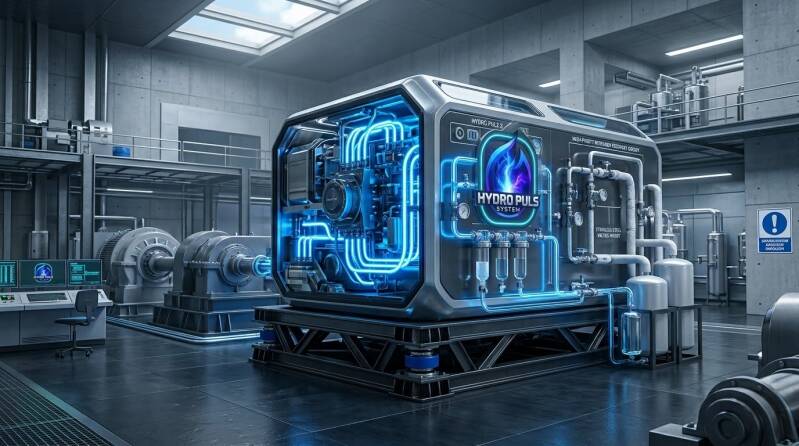
Not an engine. A chemical reactor for the 21st century.
#HPDD #HydroPulsDirectDrive #ProcessIntensification #ChemicalReactor #CleanTech #FluidPower #Hydraulics #ZeroEmission #DeepTech #GreenAmmonia #Decarbonization