Why Syngas-to-Bio-CNG upgrading fails on conventional process economics, and how we solve it mechanically:
Converting Syngas into Bio-Methane (CO + 3H2 → CH4 + H2O and CO2 + 4H2 → CH4 + 2H2O) for transportation (CNG) or industrial use is chemically proven, but operationally hits two massive bottlenecks:
1. Severe Parasitic Power Demand for Multi-Stage Compression: Boosting gas to synthesis pressure, and then up to 200–250 bar for CNG storage, consumes astronomical amounts of electricity via heavy, maintenance-intensive rotary compressors.
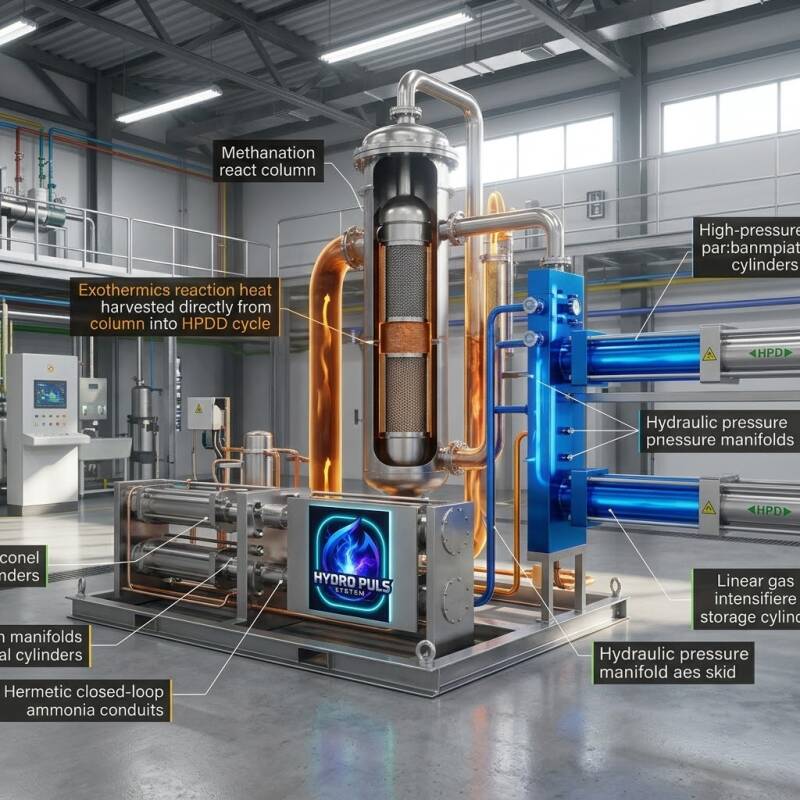
2. Managing Intense Exothermic Reaction Heat: Catalytic methanation produces massive high-grade heat (300°C–400°C), which in conventional plants is often wasted or dumped into cooling towers.
The Hydro Puls Direct-Drive (HPDD) platform tackles this flowsheet inefficiency by mechanically unifying these two energy streams:
• Thermal Harvesting of Reaction Heat:
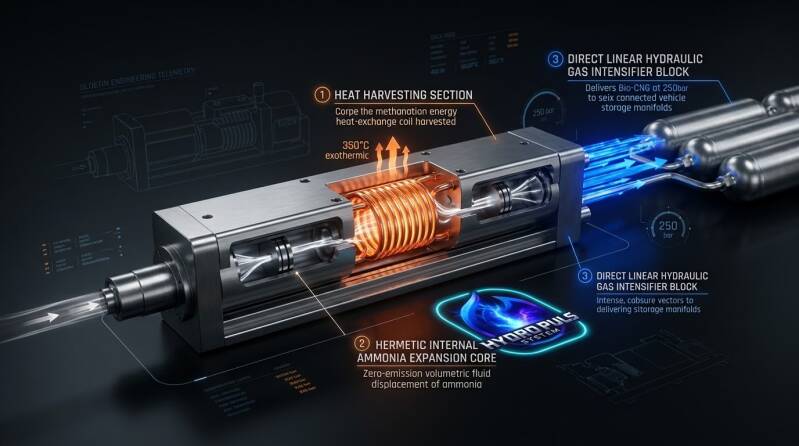
Instead of treating the exothermic heat as a cooling problem, HPDD absorbs this thermal energy directly into its closed-loop ammonia cycle, driving volumetric expansion without combustion.
• Direct-Drive Linear Gas Compression to 250 bar:
The mechanical work generated by HPDD drives stiff, linear hydraulic intensifiers directly. The upgraded biomethane is compressed straight to 200–250 bar for Bio-CNG storage and vehicle dispensing, bypassing rotary electric compressors, frequency drives, and their compounding conversion losses.
• Integral Gas Conditioning & Zero Slip boundary:
The closed thermodynamic cycle allows localized thermal management for reaction water knockout and gas purification, ensuring pure methane yield under a strictly hermetic boundary (ΔMass = 0.000 kg).
In short: HPDD turns the exothermic waste heat of the catalytic methanation reaction directly into the 250 bar dispensing pressure required for your CNG vehicle fleet.
This is how you transform an energy-intensive process step into a self-sufficient Bio-CNG asset.
#BioCNG #Syngas #Methanation #CleanTech #ProcessIntensification #HPDD #HydroPulsDirectDrive #Biogas #Decarbonization #RenewableGas #EnergyTransition